Disclosure: This post (probably) contains affiliate links. If you click on one, I may make a small commission. Of course, this will come at no extra cost to you and helps keep this site running.
Look for places to visit in South Korea and you’ll quickly see Gyeongju rise to the top of the list. Gyeongju isn’t a big city, many in Korea are much larger, but it’s big on appeal. With many things to do in Gyeongju and the gorgeous backdrop of mountains and Gyeongju National Park, it’s hard to find reasons not to visit.
My original interest in visiting Gyeongju was in its history, as it has strong ties to one of the most important kingdoms in Korea’s history. And while many Gyeongju attractions do focus on this history, I learned that there’s much more to this relaxed, green city than I knew. Discover why Gyeongju is worth visiting and what you can do there with this guide to the city.
Why visit Gyeongju?

Gyeongju is sometimes described as the “museum without walls”, as the city is loaded with culturally important historical landmarks. Most of the city’s important sites relate to the Silla kingdom, which ruled Korea’s east for centuries in the 1st millennium.
Of the various Gyeongju attractions, many are ancient Silla tombs where members of the royal family were buried. You can see some tombs in Seoul (Seolleung and Jeongneung in Gangnam), but it’s very different in Gyeongju as you’ll see. Travellers interested in history will find a lot to like about visiting Gyeongju, a UNESCO World Heritage Site.
History may be the most obvious reason to go to Gyeongju, but it’s not the only one. The city is also very pretty thanks to its extensive green space. Traditional buildings add to its charm, as does the city’s food scene, leaving you with plenty to enjoy.
Getting to and around Gyeongju

The first step to visiting Gyeongju is getting there. Busan and Daegu are the two main cities near Gyeongju in this part of South Korea. Ulsan is even closer, but foreign travellers are more likely to come from Busan or Daegu.
While trains do go from Busan to Gyeongju regularly, the train station is quite a way from the city centre. Going by bus from Busan or Daegu is easier as it’s a short walk from the bus station to the very middle of Gyeongju.
Buses run regularly from Busan to the Gyeongju Express Bus Terminal and the whole process is quite easy with ticket machines that can let you do it all in English.
For a more hands-off approach, you can book a tour from Busan to do a day trip to Gyeongju. Your time in the city won’t be quite as long, but you will get to combine it with places such as Yandong Folk Village and Bulguksa Temple.
As for getting around Gyeongju, my experience was it’s easy enough to just walk between attractions. Renting a bicycle or an electric scooter would be a good idea though if you set your eyes on some of the outer tombs.
Where to stay in Gyeongju

Just as getting to Gyeongju isn’t complicated, neither is finding somewhere to stay in the city. The two main areas for Gyeongju accommodation are between the bus station and Geumgwanchong tomb and around Hwangnidan Street.
Staying near Hwangnidan Street is generally more expensive, as this is where the many hanok-style accommodation is found. For my visit, I stayed at the Gyeongju Bee House, a hotel/hostel with a cosy and casual atmosphere. It’s a safe choice if you’re after an affordable place to stay.
Things to do in Gyeongju
While you probably already have an idea of what to do in Gyeongju, let’s look at the Gyeongju tourist attractions you need to know about. Plan your itinerary around these places to visit and you’ll be set for a good time.
Daereungwon Tomb Complex

If you’re looking for one place where you can learn about Gyeongju’s past, go to the Daereungwon Tomb Complex. This is the main attraction for many visitors, as the complex contains many Silla burial mounds and provides opportunities to learn about their history.
While you’ll see obvious grass mounds in many places in the city, the Daereungwon Tomb Complex takes things to another level. Much of a visit here is walking through the grounds, past mounds, ponds, and gardens. At the mounds, you’re given information on the tombs and the life story of the king buried there.
That’s pleasant enough and all, but it’s not too in-depth. The good part is when you reach the Cheonmachong burial mound. There, you can actually enter the tomb and walk into it to see what it’s like from the inside. Treasures inside Cheonmachong include golden ornaments from the 5-6th centuries, both for the king and his royal horse.

Gyeongju Silla mounds and Geumgwanchong

You don’t have to look far in Gyeongju to find the city’s signature mounds, they’re everywhere. Walking mere steps from my accommodation I found myself already standing between several in a local park. The city is relatively flat so these sudden uniform mounds are incredibly obvious.
The Daereungwon Tomb Complex is a good place to start if you’re looking for burial mounds. But basically, any green patch on a map has them. Some mounds are closer to the city centre, while others, such as the Seondeogyeowangneung Royal Tomb, are on the outskirts.
One special mound that I suggest visiting is the Geumgwanchong burial mound. You can visit inside this mound as well, however, its story is a little different to that of Cheonmachong.

Whereas Cheonmachong was excavated properly in the 70s, this mound was excavated during Japan’s occupation of Korea. Through its exhibits and a video, you can learn the history of how the mounds were excavated and the problems of untrained people doing it. Sometimes the historiography is as interesting as the history.
Gyeongju hanok-style architecture

While much of the city centre of Gyeongju looks unremarkably modern, things change on its south side. The neighbourhood bordering the Daereungwon Tomb Complex is the tourist zone of the city and has a lot of buildings designed in the traditional hanok style.
I’ve worded it that way because I don’t think many or any of the buildings are actually all that old. The whole area feels much newer and less original than the Jeonju Hanok Village, that’s for sure. That said, I highly recommend a stroll here, especially if you’re hungry.
Hwangnidan Street is the main street in this area and you’ll find restaurants and cafes occupying these timber-framed two-storey buildings. I’m not saying the traditional designs don’t provide a nice atmosphere, but based on the construction I saw, they’re mostly new additions.
Gyochon Traditional Village

To see what traditional homes and neighbourhoods do look like, you need to keep heading south until you reach the Gyochon Traditional Village. With its stone walls and pedestrian streets, this “village” has preserved the layout and feel of a small traditional village, even if most buildings are recreations.
The Gyochon Traditional Village was basically empty when I went. It seems like there are a lot more activities there normally, but I just did a walk-through and moved on. I will say, I did like the murals on these houses. That’s not something I’d seen in Jeonju.
Woljeonggyo Bridge

One of the most picturesque landmarks in Gyeongju is the Woljeonggyo Bridge. Spanning the Muncheon stream, it’s a reconstruction of an ancient covered bridge. Still, it’s a beautiful bridge and the entire area around it is pretty to see.
You can get to the bridge quickly from the Gyochon Traditional Village. After a short walk, you reach its grassy banks and can head on to the stepping stones. South Korea loves putting these stepping stones in streams and rivers, which is great to get a good view of the bridge along the stream.
Gyerim Forest and Cheomseongdae Observatory

Follow the road leading from the Woljeonggyo Bridge north and you’ll soon find yourself surrounded by trees. This is the Gyerim Forest, a small area of woodland, squeezed between burial mounds and old earthen fortifications. I’ve since learned that the forest is tied to several local legends, but as a visitor, it’s just a beautiful place to walk through.
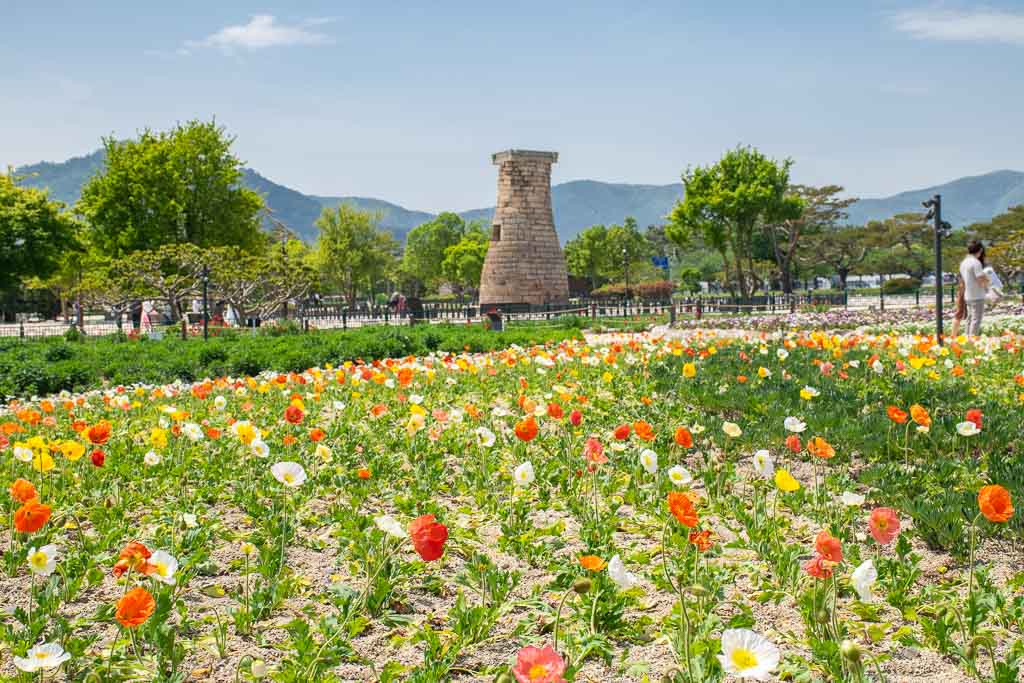
Gyerim Forest is just one small part of a huge park. Trails for walking and cycling link up ancient burial mounds, huge flower gardens, and perhaps most famously, the Cheomseongdae Observatory.
This small stone tower may not seem like much, except for all the tourists around it, but it’s a 7th-century astronomical observatory. This makes it the oldest surving one in all of Asia, and notably is made up of 365 stones, indicating the days in the year.
Wolseong Fortress

Taking up a large section of the park mentioned earlier is the Wolseong Fortress. You really can’t miss it as you explore thanks to the moat and huge grassy banks where its walls used to be. Gyeongju was the capital of Silla, so naturally, it needed some decent defences.
Exploring Wolseong Fortress you’ll notice a few things. First, the embankments are great for getting views over this mostly flat city. Second, the fortress is a decent size and takes a while to walk around. Finally, you won’t find much here to see at this stage, as you can’t get near the current excavations and archaeological work.
Gyeongju National Museum

The best place to go in Gyeongju if you want to learn about the city and Silla is the Gyeongju National Museum. There’s no question this is the biggest and best Gyeongju museum, with multiple buildings and things to see. It has an ancient Silla bell under a gazebo, a central main exhibition with artifacts and treasures, and a unique exhibition on Silla Buddhist art.
Allow a couple of hours to make your way through everything here, it’s worth it. There’s even a coffee shop here if you need a break.
Wolji Pond

Follow the main road back towards the centre of Gyeongju and you’ll find another attraction across the road. The Wolji Pond gets mentioned quite a lot among Gyeongju attractions, but I have to say it’s a little underwhelming. It dates to 674 and sat next to the Gyeongju Donggung Palace, a palace for the crown prince.
Gyeongju Donggung Palace no longer exists as the site was long abandoned. However, the pond has survived and in recent years they’ve reconstructed several of the pagodas around it.
Having seen photos of it at night, I can see the appeal of an evening visit. The pond has been used in several Korean period dramas, so that’s another reason people go. Otherwise, it’s just a pretty park you have to pay to see.
Other places to visit while in Gyeongju

While I saw quite a lot of the city, there are places in Gyeongju that I didn’t get to. Some were outer royal tombs that I didn’t have the energy or time to trek out to.
But there are also several notable attractions that you can visit on day trips to Gyeongju or day trips from Gyeongju. Bad weather ruined my chances of visiting any of these spots, but they’re worth looking into.
- Bulguksa Temple – A famous ancient temple that’s a UNESCO site
- Seokguram Grotto – Located near Bulguksa Temple, it features a large Buddha statue
- Yangdong Folk Village – South Korea has many folk villages that showcase traditional life such as this
Did you know there were so many things to do in Gyeongju? Have you been, and if so, what would you recommend? Please share your thoughts in the comments below.
