
Disclosure: This post (probably) contains affiliate links. If you click on one, I may make a small commission. Of course, this will come at no extra cost to you and helps keep this site running.
South Korea is one of Asia’s growing tourist destinations, and it’s easy to see why. More and more people are visiting South Korea to experience its culture — whether it’s K-pop, K-dramas, or Korean food — and to see what else the country has to offer.
The good news is that travelling in South Korea has never been easier. Even better, while international tourism is growing, it hasn’t reached the crazy (and unsustainable) heights of other travel hotspots. Now is the time to go, but it helps to know a few things before you do.
1. More than Seoul

If you’re visiting South Korea, chances are you’re going to Seoul.
After all, it is the capital city, home to famous attractions, and by far the easiest place to reach. But if you have the chance, I highly recommend experiencing more of the country.
A day trip is good; a trip to another city or region is better.
I spent a couple of weeks in South Korea and visited four other cities on the trip. But there are so many more. And not just cities, with folk villages, coastal spots, and national parks all waiting to be explored.
Busan is probably the next most popular city after Seoul. It’s best known for its beaches, coastline, and colourful Gamcheon Culture Village.
The other three cities I visited each focused on Korean history:
- Jeonju – a western city with neighbourhood of traditional “hanok” homes where you can stay.
- Gyeongju – an eastern city with burial mounds and royal artifacts.
- Suwon – a fortified city just south of Seoul with a nice hill hike.
2. Getting to South Korea

It shouldn’t be hard to work out that flying is your most likely way of getting to South Korea.
You certainly won’t be coming across a land border.
Flights to South Korea usually connect through other major Asian hubs for major airlines. They generally fly into Incheon International Airport outside Seoul.
However, you’ll have more options when flying from closer cities, such as those in Japan, Hong Kong, China, and Taiwan. Airlines often have routes from these countries to other cities, such as Busan and Seoul’s second airport, Gimpo International Airport.
The other thing you need to know about before coming to South Korea is the visa situation.
You can find visa information for your nationality here. All nationalities generally need a visa or enjoy visa-free entry with an Electronic Travel Authorization (K-ETA).
Interestingly, South Korea created an exemption from the K-ETA in 2023 for some countries, including Australia (after I paid for mine). With it, you could just turn up. This exemption is set to run out at the end of 2024, so travellers going to South Korea in 2025 will need a K-ETA.
3. Getting around South Korea

Whether you’re just staying in one city or exploring the country, you need to know how to get around.
Getting around big cities like Seoul and Busan isn’t hard. Both have excellent public transport that can take you anywhere you need to go. Each has an extensive metro, plus local buses for areas away from the metro network.
To use public transport in most cities, you’ll want a transportation card such as the T-Money card. This card is exclusive for foreigners and is a prepaid, contactless smart card you can use to pay for subway trips, bus rides, shopping at convenience stores, and more.
To navigate public transport, you can use Google Maps, but it has a downside. Google Maps can’t give you walking directions or the length of time a walk will take because of restrictions in South Korea.
One other tidbit is that city bus routes often only go in one direction, so you’ll need a different route number when making a return journey.
I have never used taxis or rideshares in South Korea. More information on that is here.
Travelling city to city
Now, how about getting between cities in South Korea?
Train and bus are usually both available for most journeys, but it’s up to you which you take.
The major challenge I found with intercity travel in South Korea is that not all of your options are easy to book online as an international visitor. Use the official Korail site to easily see timetables and prices, but you can’t seem to make ticket reservations for all trains; some are unavailable.
Why? No idea.
Other websites only have certain trains that you can book (12Go); others have all the trains but seem to have a large booking fee (RailNinja).
I booked all my journeys in person, which also isn’t ideal.
It’s worth booking train trips in advance to get a seat reservation. I had to stand for most of the journey back to Seoul from Busan because I left buying a ticket to the last minute and couldn’t get a reserved seat. Go to the station several days in advance if you can to avoid this.
Buying intercity bus tickets in person went fine. Bus stations have ticket machines that streamline the process. Some places, such as Gyeongju, are also much easier to reach by bus than train.
The one exception to all of this is Jeju Island.
You can fly or take a boat across to this popular island destination. That is unless a storm grounds flights to the island for days, as it did for me. It seems severe weather often causes flight disruptions to the island, so please keep this in mind when planning a visit.
4. Money and budgeting

Just as important as how you’ll get around the country is how you’ll pay for things.
Now, I’ve already explained how transportation cards like the T-Money card can be useful for paying for certain things. But what about everything else?
Normally, when I travel, I use my credit card with no international transaction fees. And for some things, it worked fine.
But I found multiple times, usually with smaller independent businesses and bus stations, where it wouldn’t work. Having a second card was a godsend, particularly a Wise card, since I could store Korean Won (KRW) on it, which was never denied.
For the same reason, I recommend getting cash out when you arrive, as it’s still widely used. Again, Wise made that easy.
How expensive is South Korea?
South Korea is one destination where it’s only as affordable as you let it be.
Some things there are extremely affordable, others not so much.
A good rule of thumb is anytime you visit a franchise/chain store for things like coffee or baked goods, don’t expect it to be cheap. Lunch from Paris Baguette will cost you almost more than it does for something similar in Australia.
But eat in a little gimbap store or at a market, and suddenly, you’re getting very good value for money.
Museums and cultural attractions are among the few things in South Korea that seem consistently affordable.
Public transport isn’t too bad either, though.
Take the AREX train from Incheon Airport to Seoul Station. The stopping all stations train is 4750KRW, while the express is 9500KRW. Both are pretty reasonable compared with airport connections in other countries.
Intercity bus prices are comparable to a bus trip through Western Europe, while trains in South Korea are much cheaper than Japanese trains.
All of this makes budgeting a trip to South Korea very specific to your own style of travel.
5. Food in South Korea
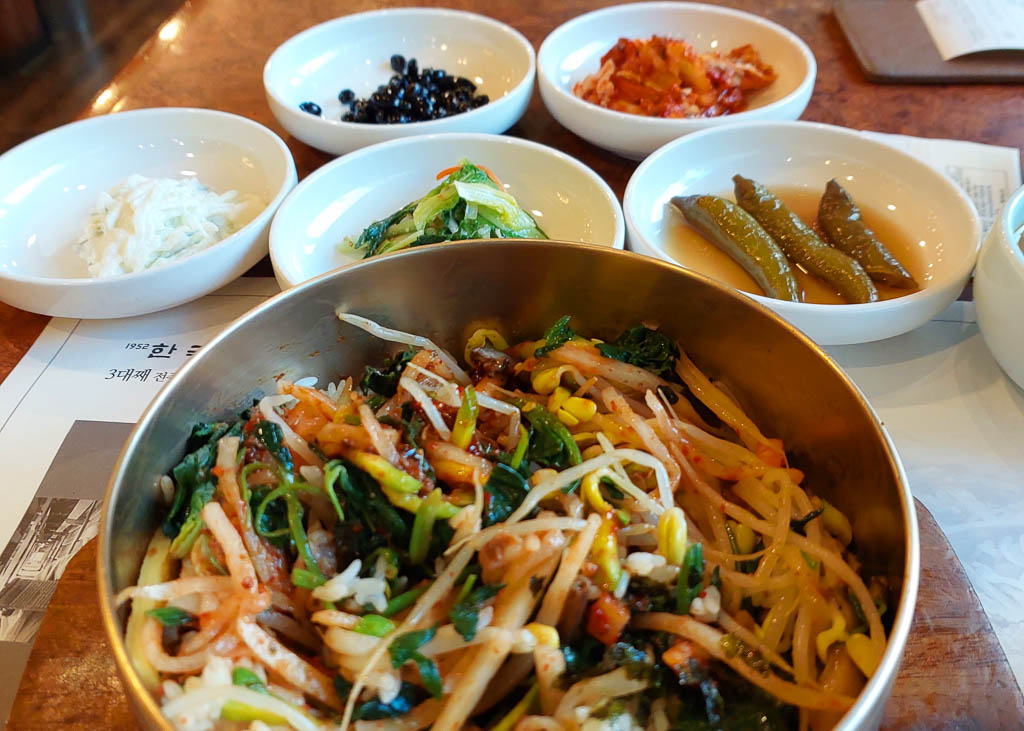
When in South Korea, you can’t pass up the chance to try all sorts of Korean food. For many people, South Korean food is the only reason they visit.
If you’re a foodie, you probably won’t need my help. You’ll have a huge list of dishes, markets, and restaurants you plan to hit, one after the other, without time in between to breathe.
For everyone else, I suggest doing a little research in advance. Learn about different Korean dishes, snacks, and drinks to have a starting point. Because there is just so much to try. My super basic recommendations for common Korean food to try are:
- Bibimbap
- Tteokbokki
- Gimbap
- Bulgogi
- Fried Chicken
As for where to go, dining at food markets is an easy option. Places like the Myeongdong Street Market and Gwangjang Market in Seoul or Bupyeong Kkangtong Market in Busan can be convenient places to try all sorts of things.
Also, if you think you’ll be dining/drinking with Korean people, you should research Korean etiquette to help things go smoother.
6. Coping with language

I think it’s a fair assumption that most foreign visitors to South Korea don’t speak or read Korean.
Maybe you’ve picked up a few words here and there from watching K-dramas (with subtitles, not dubbed, of course).
And if so, that’s great because travelling is usually better if you know a few basic phrases, including (with rough phonetics and oversimplified answers):
- Hello – Annyeonghaseyo
- Thank you – Kamsahmnida
- Yes – Ne
- No – Aniyo
- Please – Juseyo
But they’ll only get you so far with conversation. Fortunately, you can get by with English in a lot of situations, at least in big cities/tourist destinations.
Reading signs
Reading Hangul, the Korean alphabet is another story.
Hangul uses unique characters that do not overlap with other East Asian countries. This means you’ll be starting fresh if you want to learn to read it.
But I don’t think Korean is that hard to read.
Once you learn the tricks for remembering the sound each character makes and how characters form together, you can get to a point where you can slowly read signs.
Not that you need to all that often since it’s quite common for signs to also show translations or English spellings. It does feel good if you can recognise “서울” as Seoul and understand how it works.
This video does a great job of loosely covering the basics to help you start:
7. History and North Korea

As an outsider, it’s easy to fixate on the ongoing tension between the Republic of Korea (South Korea) and the Democratic People’s Republic of Korea (North Korea).
This is particularly true when people think about the history of the Korean Peninsula. That’s because, for many Westerners, that’s their only connection to Korea – even if it’s just having watched M*A*S*H.
But the region’s history is just as eventful before 1950. And it only makes South Korea an even more interesting place to visit.
Seoul’s museums are a great starting point for this history. The National Museum of Korea is huge and fascinating. I realise plenty of people don’t come to South Korea for this, but it and the War Memorial of Korea give such a thorough background to everything you see when visiting.
I highly recommend going to them before you do a DMZ tour – something most international visitors can’t resist (myself included). Having the context before you go allows you to appreciate the experience more deeply.
But again, Korea’s history is more than just the last 75 years. If you’ve seen a Korean period drama set during the Joseon Dynasty, you’ll know what I’m talking about.
The region’s history has rarely been quiet, and I think it’s fair to say that history has shaped many aspects of Korean culture – from people’s behaviour to diets, interests, and so much more.
Resources for visiting South Korea

- Getting There: To find the best-priced and most convenient flights to visit South Korea, check Kayak.
- Accommodation: Here, you can find hotels, apartments, and guesthouses throughout South Korea.
- Tours: Countless day trips and sightseeing tours are available when visiting South Korea.
- Car Hire: You can travel when and where you like by renting a car to drive in South Korea.
- Managing Money: The Wise card can be a great option for getting cash out and making purchases.
- Travel Medical Insurance: Need coverage in case you get sick or injured, or your luggage gets lost? Get a quote for Nomad Insurance from SafetyWing.

1 comment
Sounds like navigating public transport in Seoul and Busan will be a breeze! Except for the one-way bus routes… I can already imagine myself getting lost. 😂