Disclosure: This post (probably) contains affiliate links. If you click on one, I may make a small commission. Of course, this will come at no extra cost to you and helps keep this site running.
When people think of Bulgaria, they likely either think of the country’s Black Sea coast or the colder, greyer side of the capital Sofia. Based on my extensive travels through Bulgaria, neither is a good reflection of what the country is like. But I do think the attractions of Plovdiv, Bulgaria’s ancient second city, do a good job of showing what Bulgaria is like.
Plovdiv is quintessentially Bulgarian; it has a long, complex history and plenty of stories to tell. But there are moments as you visit Plovdiv where you feel a colourful optimistic energy and a sense of community. One eye is on the past, the other on the future. That shines through in many of the things to do in Plovdiv, allowing visitors like me and you to get to know the different parts of the city.
Is Plovdiv worth visiting?

Take a quick look through the below attractions in Plovdiv, and you should know your answer. Yes, Plovdiv is worth visiting when travelling in Bulgaria. Not only is it an ancient city with many surviving landmarks from its past, but it also has a fun and youthful ambience.
As a traveller who enjoys visiting historical attractions, the things to do in Plovdiv really appealed to me. I’m also having a hard time deciding whether Plovdiv or Veliko Turnovo deserve the crown as Bulgaria’s prettiest city. If I haven’t sold you on visiting Plovdiv yet, read on.
How to get to Plovdiv

Plovdiv sits in the central south of Bulgaria in a convenient spot for certain trips. Whether you’re travelling across Bulgaria or through the Balkans, adding it to your trip shouldn’t be hard.
Driving with a rental car is the most flexible way to visit Plovdiv. Drive in, look around, and then continue exploring. Parking may prove a challenge if you stay in the Old Town or the Trap, though.
Travelling to Plovdiv with public transport is quite common. Buses run to the city from across Bulgaria, but often not frequently. You’ll find bus routes from large cities in neighbouring countries, including Istanbul and Thessaloniki.
Getting to Plovdiv by train is also possible, depending on where you’re coming from. The main routes are from Sofia and Burgas on the coast, but you can also alight at Plovdiv on the Istanbul to Sofia train.
By far the easiest way to visit Plovdiv is on a guided tour. Taking a full-day tour from Sofia handles all the logistics for you and helps you see as much as possible.
Where to stay in Plovdiv

It will take a little time to get used to the layout of Plovdiv. But to find somewhere to stay in Plovdiv, there are three neighbourhoods to know. In the Central District, focus your attention on the area of the city centre between the Ancient Stadium and Roman Forum, as well as the neighbourhoods of Kapana and the Old Town.
During my visit, I stayed at the Residence Art Guest House in the Kapana area. I couldn’t have asked for a better location to stay in, and while the rooms there are fairly basic, it’s a good affordable option.
If you’re looking to quickly book your Plovdiv accommodation, try these highly-rated hotels:
Things to see in Plovdiv
It feels like wherever you turn in Plovdiv, there are more and more things to see. That’s because the main Plovdiv attractions aren’t limited to the Old Town.
Instead, the things to see in Plovdiv are spread out, encouraging you to explore the city more widely. You can do this alone or take a guided walking tour to make things easier.
Either way, here are the main places you need to know to plan your sightseeing.
Plovdiv Roman Ruins
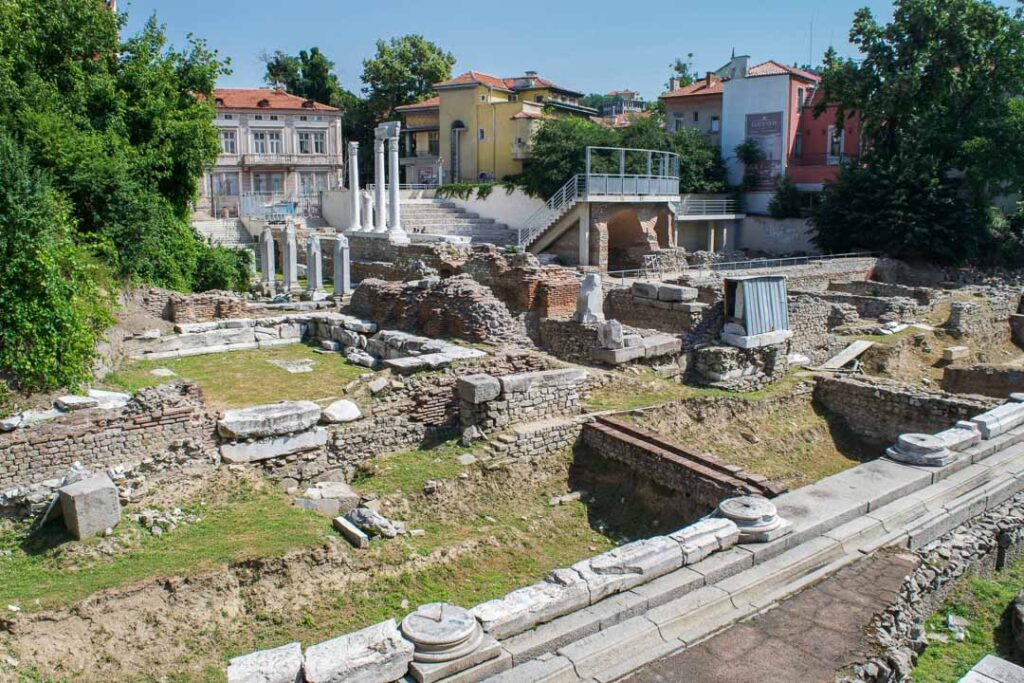
Plovdiv’s history remained mostly uneventful for thousands of years, as just a simple Thracian settlement, until the arrival of Philip of Macedon in 342 BC. With Philips’s conquest of the town, it changed its name to Philippopolis. The town would then become part of a tug-of-war for generations between the local Thracians and the kings of Macedon, until the arrival of the Romans.
Under the Romans, Philippopolis became known as Trimontium, grew to be the main city of Thrace and thrived. This was in part because it was on the ‘Via Militaris‘, the Roman road that led through the Balkans to Constantinople, modern-day Istanbul. The road was a vital trade network for the Roman Empire and the economies of cities on the route flourished.
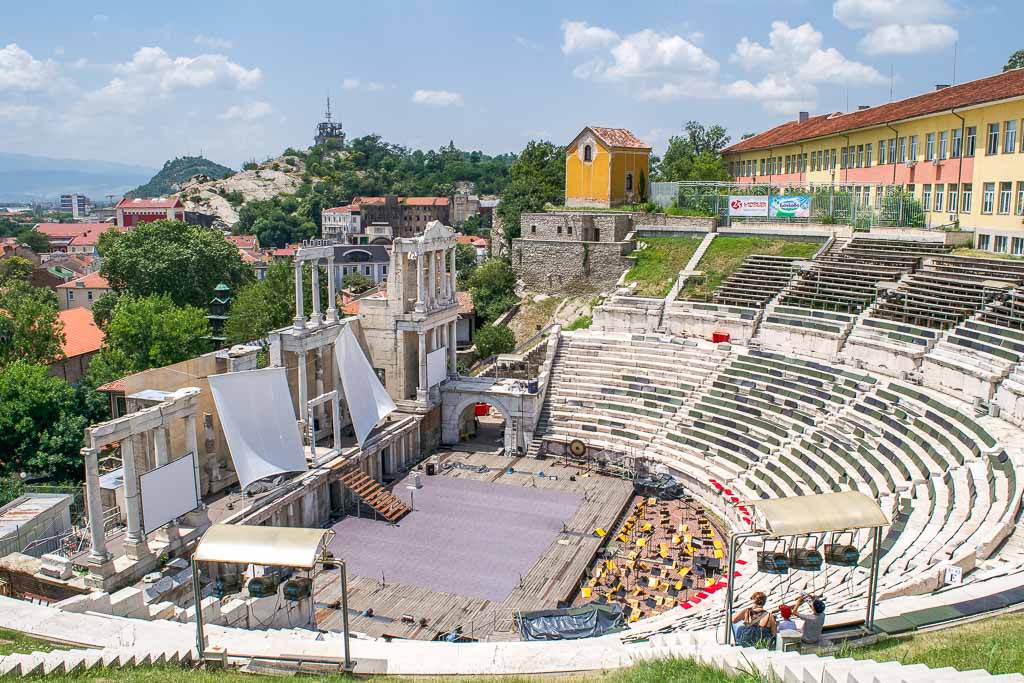
This is the first period of Plovdiv’s history that visitors can see with their own eyes. The city has many impressive Roman ruins that can be found in the city centre. The greatest of these ruins is the mighty Roman Theatre found in Plovdiv’s old town.
The theatre built in 117 AD was able to hold 6000 people and was used for theatrical performances, gladiator fights and the local assembly. This ancient theatre has been impressively preserved and is a symbol of the appreciation the city has for its history.
Roman Stadium of Trimontium
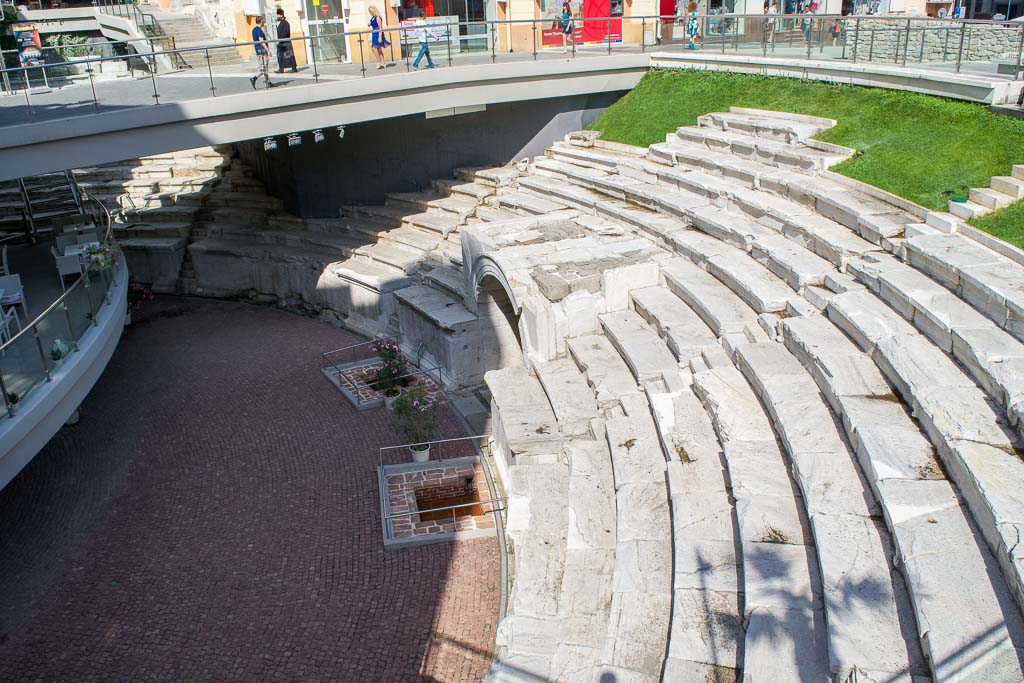
Another interesting Roman ruin of the city is the Roman Stadium of Trimontium, found sunken under one of the city’s main pedestrian streets. This impressive marble stadium could host as many as 30,000 people and was built sometime between 117 – 138 AD. With visits from Roman Emperors in 214 and 218 AD, games similar to the Olympics were held in the stadium.
Today, only the northern end of the stadium seating is visible. This ruin has only been partly excavated due to its awkward location, smack bang in the middle of a lively pedestrian area. To me, it was kind of cool knowing that as you walk through Plovdiv, beneath your feet could be the remains of great Roman structures. Literally, history beneath your feet.
Plovdiv Old Town
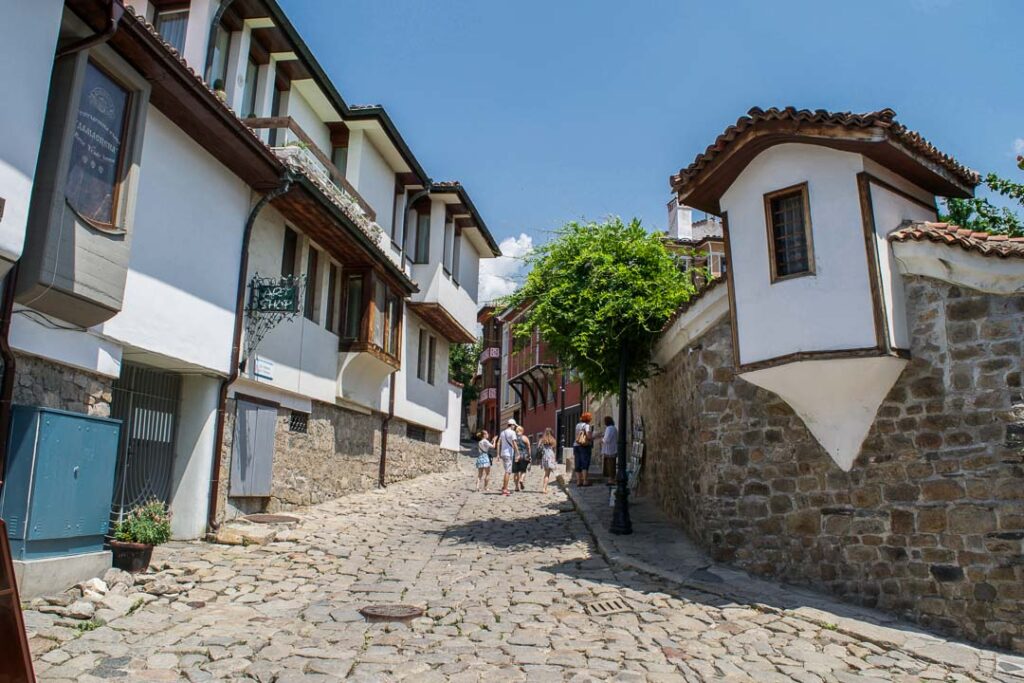
Much of Plovdiv’s history after the Romans revolves around the rise of the First Bulgarian Empire and repeated conflicts with the Byzantines and Crusaders over the region.
For Plovdiv, the Middle Ages was a turbulent time. As such, there aren’t too many remnants found around the city from that period. One structure that has survived from the Middle Ages is the Hisar Kapia, the fortress gate.
This gate belongs to the fortifications that surrounded the area across the hilltops of Dzhambaz Hill, Nebet Hill, and Taksim Hill, which now comprise Plovdiv Old Town.
While this area of Plovdiv has been fortified since ancient times, the current design and structure reflect its medieval incarnation. Walking through the narrow path up under the gate, it’s hard not to be impressed by its imposing presence.
Ottoman Houses

From the 14th century onwards, Plovdiv came under the rule of the Ottoman Empire and saw quite some changes. The city again changed names to Filibe and found stability under the Ottoman Turks.
Its focus changed from the constant turmoil of war to becoming an important economic and cultural hub. With this wealth, many citizens proceeded to build elegant houses in the area of Old Town.
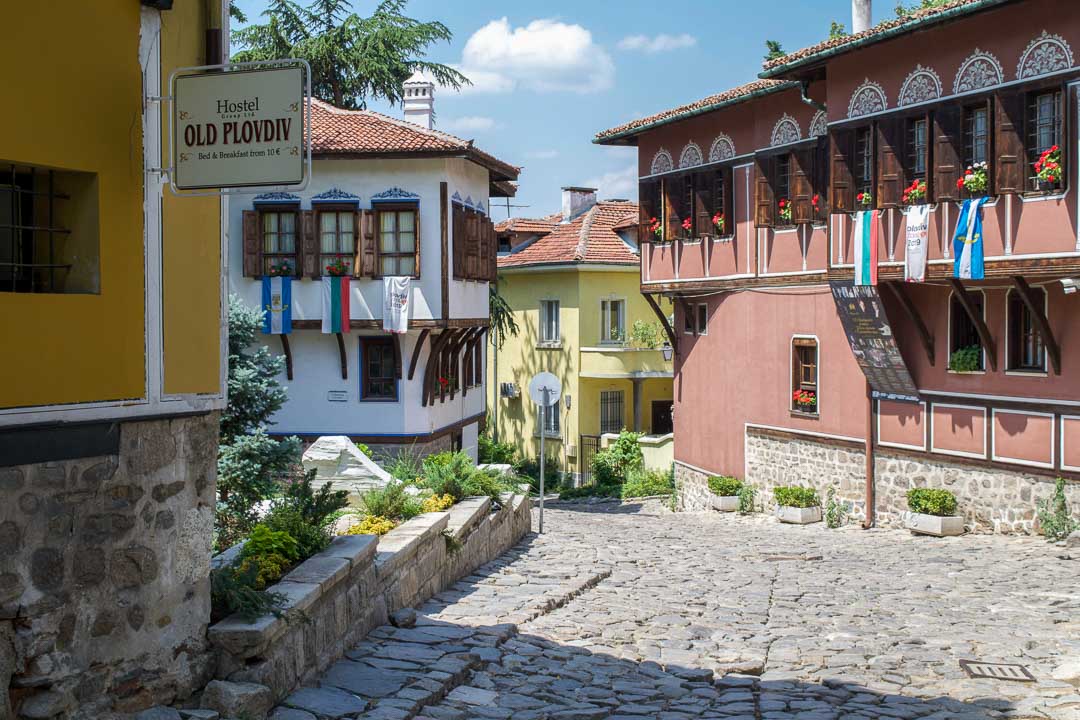
Some of Old Town’s most impressive houses date back to the early to mid-19th century. These Ottoman houses were typically owned by well-to-do merchants and many have survived in a very fine state. Wandering the lumpy, cobbled streets of Plovdiv Old Town you will come across plenty of these beautiful buildings.
They generally have very intricate paintwork on their upper levels, in the Ottoman style of upper floors that hang over the ground floor. If you like, there are several houses that you can enter and explore for a small fee. Two fine examples are the Hindliyan and Balabanov Houses.
Kapana, “The Trap”
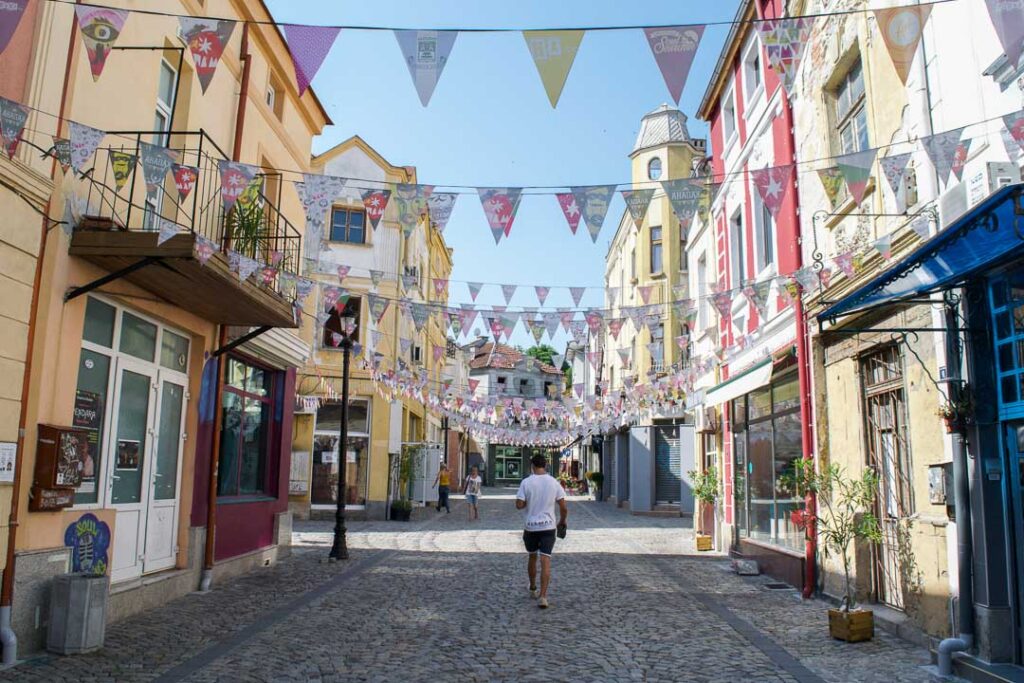
To see a wildly different side to Plovdiv, you just have to venture into the Kapana neighbourhood, aka “The Trap”. This web of pedestrian streets fits snuggly between Old Town and the town centre and has sprung up recently as a local hotspot. I’d say it’s one of the best places to visit in Plovdiv if you just want to soak up the city’s atmosphere.
Historically Kapana is one of the oldest parts of the city, but you won’t find any ruins or Ottoman houses. For centuries, craftsmen lived in the area, although things have since changed.
Visiting Plovdiv now, it plays host to entrepreneurs, thriving with cafes, bars and restaurants – each more bohemian than the last. As a major university city in Bulgaria, the local student population also seems to appreciate this hipster paradise.
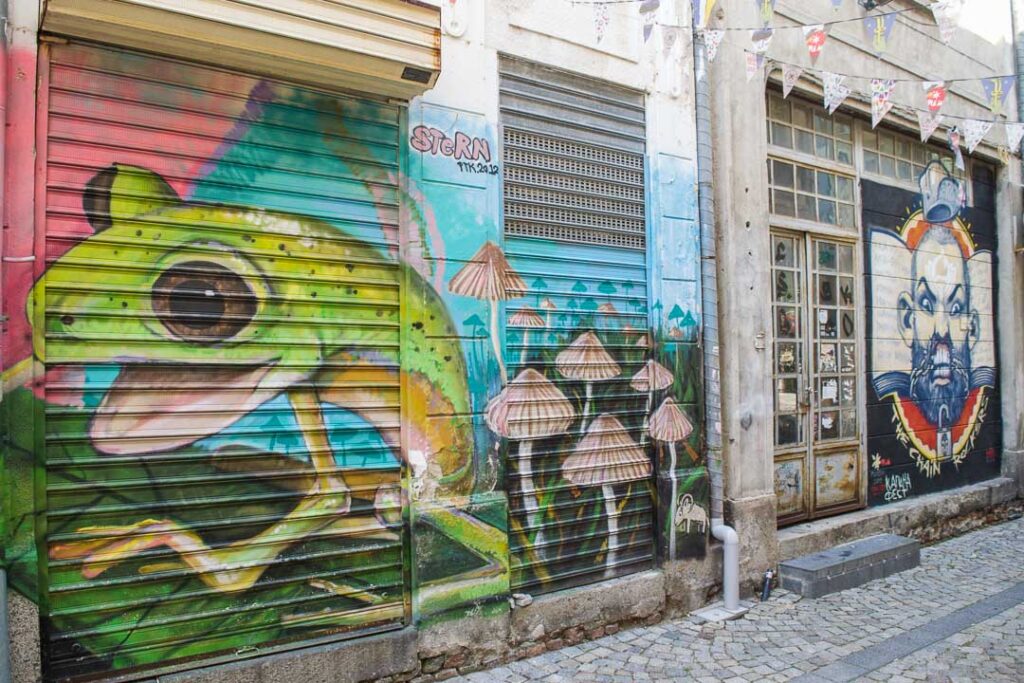
The city has poured quite a lot of effort into making The Trap the heart of Plovdiv’s selection as the European Capital of Culture for 2019. Hopefully, with this event, the city will receive some much-deserved attention. The project intended to convert this neglected part of town into an artistic and creative district of the city.
As such, along with the new businesses that have popped up, the area has been livened up with colourful bunting hanging over its pedestrian streets and some fun and vibrant street art.
Speaking of businesses, a quick Google will show you that several of the best restaurants, cafes and dessert spots are all found within this small corner of the city. If you doubt the web, simply walk about at noon or dinner time and you’ll see very few spare seats. I recommend making reservations for dinner here as spots are seriously limited.
The Six Hills of Plovdiv
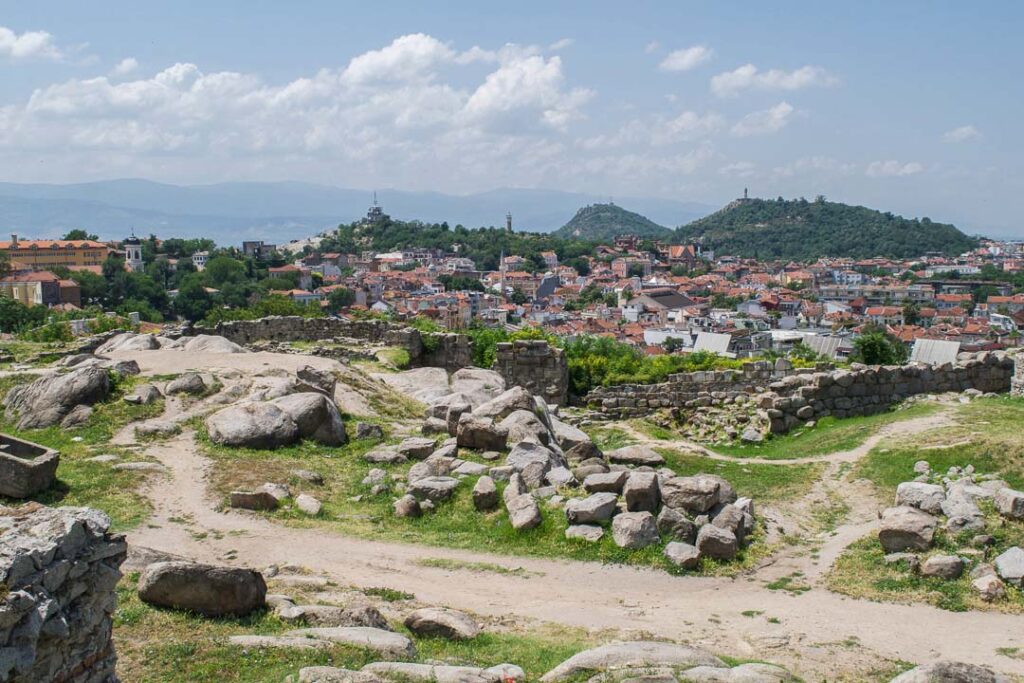
When it comes to seeing how the city’s history and modern life come together, the six hills throughout the city are the perfect place to do so. Plovdiv sits in a plain between the country’s two main mountain ranges, the Balkan Mountains to the north and the Rhodope Mountains to the south. The city itself is quite close to the edge of the plain and therefore has a far more hilly landscape.
For many ancient cities, being surrounded by seven hills was considered auspicious. You’d be surprised how many cities are built on seven hills – Rome, Athens, Jerusalem and Plovdiv – to name a few. I know what you’re thinking, first, he said six, and now he says seven.
How many hills does Plovdiv have? While Plovdiv once had seven hills, it only has six today. Markovo Hill, the seventh, was destroyed during the early 20th century and used for raw building material. So yes, six.
Plovdiv’s six hills are scattered throughout the wider city, but several are close to the city centre. Each has a different perspective of the city, but all are fantastic. What makes them so great is that you’ll regularly find locals still using these spaces and their historical remnants. That means climbing the city’s hills is one of the best things to do in Plovdiv.
Sunset at Nebet Hill
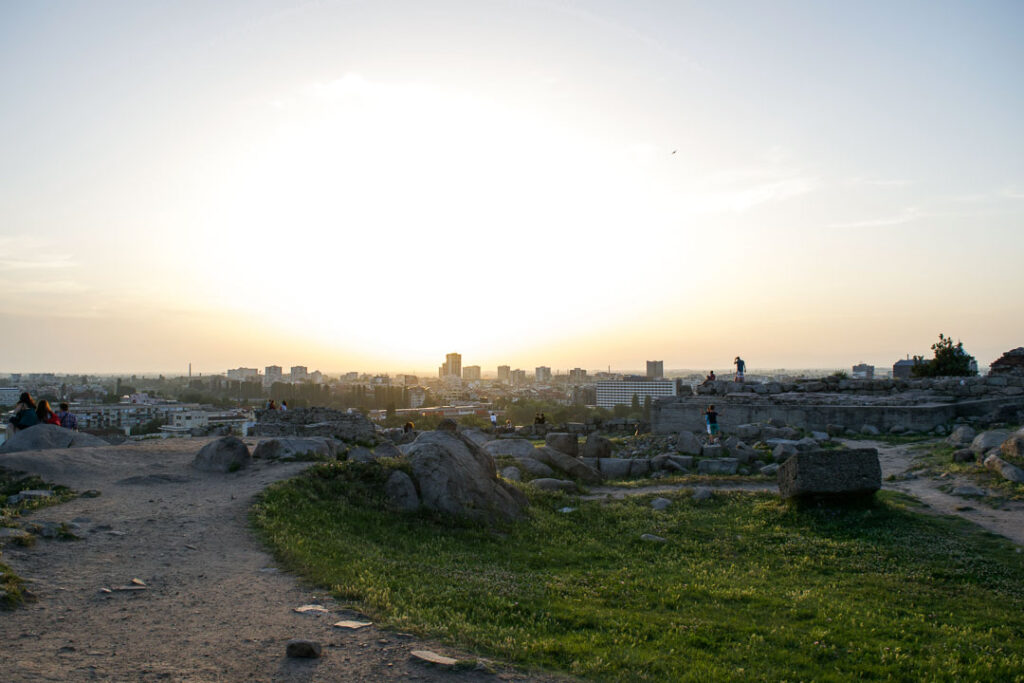
Nebet Hill, one of the hills in Old Town, is the perfect example of what I’m talking about. Remains of the ancient Thracian settlement from millennia ago litter the top of Nebet Hill. Nebet Hill also happens to be one of the most popular spots for locals to come and watch the sunset.
You find families spending time together and teenagers just hanging out, all while in the presence of the remains of ancient structures. It’s so great to see such a historical spot stay ingrained in the everyday life of the local people. I think it perfectly sums up the city’s atmosphere. Here’s hoping Plovdiv’s youthful spirit and storied history manage to stay intertwined.
Have you ever wanted to visit Plovdiv Bulgaria? Can you think of a city you’ve been to that seamlessly blends its history with its modern self? Please share in the comments below.

This article is now available as a mobile app. Go to GPSmyCity to download the app for GPS-assisted travel directions to the attractions featured in this article.

18 comments
I absolutely love the Roman Theatre, the cobbled streets of the old town and the street art. Fascinating fact about the seven hills, I never knew that despite visiting Rome and Athens! And Kapana’s architecture isn’t what I was expecting; you are right, a very colourful history!
What an amazing place Plovdiv. The cobblestone streets, Ottoman Houses, Street Art, and my favorite the Roman Stadium. The Roman Stadium if it was all there would be massive. Well written and enjoyed the history that went with this town. Thanks for sharing!
I love how much history there is in that place and how you’ve weaved it into the post. Fascinating stuff and looks like a great place to explore. Did you do any hiking around the hills? Great to read about the less explored places in Bulgaria, while everyone is parroting on about the sea side resorts!
Bulgaria hasn’t really been on our radar but looks a really interesting place to visit. Thanks for sharing!
never knew Bulgaria had so much history! fascinating read as always about these lesser known parts of Europe. Also didn’t know that fact about the 6 hills, the Ottoman wooden homes and roman ruins look incredibly preserved, I feel like I’ve got a good flavour of Plovdiv through your photos too. Thanks for sharing!
Another beautiful place I have not heard of. I love the old town, we just don’t have anything that is like that at all here. Old here is 50 years. Thanks for sharing on #TheWeeklyPostcard!
Your beautiful posts about Bulgaria will surely make me to there to visit it. Beautiful pictures!
Your posts about Bulgaria never cease to amaze me! This also seems like a very cool town so I’ve pinned this too for later!! That Ottoman house is beautiful! #TheWeeklyPostcard
Love all the historical sites snd the history of the six hills there in Plovdiv. Just looks like a cool and laidback place to explore. I would love to wonder that maze of streets and check out the local dining. Again, thanks for sharing another unique place!
What a great introduction to the city! I have to admit I do not know a lot about it. I got my first taste of Eastern Europe recently and I am pumped to explore more of the area. Have to add Bulgaria to my plans!
Bulgarian continues to impress me! I had no idea there would be Roman ruins here. I love
The cobblestone streets and the charm you shared in this post!
Plovdiv is my kind of place. Plenty of history to explore and lots of culture to top it off. Since learning about the Romans at primary school I’ve been a fan of visiting stadiums and ruins. There is something intriguing about this period in history. Have saved it to my Pinterest board.
Plovdiv looks wonderful! Even from your pictures I felt this unique atmosphere! such a step into the history with all the cultural heritage… even pinned in to my travel board to read it all over again when in Bulgaria! Thanks for sharing
I hadn’t heard of Plovdiv, so thank you for introducing me to another lovely place to add to my list.
Wow, Plovdiv has changed since we visited a few years back. I guess it’s time to return. Great photos.
Thanks for linking up with #wkendtravelinspiration!
I love all the history of the place, it looks really beautiful! Your posts are making me more and more keen to visit Bulgaria!
We are headed to Bulgaria for 2 weeks or so in November so great to read about a recent visit to Plovdiv as it is one of the places we’ll be visiting. Looks like a great city to explore!
I love pLOVEdiv! One of my favorite places in Bulgaria. And I’m so happy to see all the lovely comments on this post. I’m not saying this just because Bulgaria is my home country, but I really think that more people need to know about her beauty and history and visit it.