
Disclosure: This post (probably) contains affiliate links. If you click on one, I may make a small commission. Of course, this will come at no extra cost to you and helps keep this site running.
As someone who has a considerable interest in history, I always like to learn about the past of places I visit. This is likely clear in many of my posts, often fixating on historical landmarks and such. In the last year or so, I’ve been surprised to notice a common thread through many of the places to which I’ve travelled. That thread is the Ancient Romans.
While I was well aware of the immense spread of the Roman Empire, it’s another thing to keep coming across remnants of their empire strewn about Europe and beyond. Consistently finding reminders of the Romans helped me appreciate just how vast their control was over the ancient Western world.
Roman Ruins Around Europe
Since it has been roughly 2000 years since they were at the height of their power, I’m amazed at how much remains of what was an invading force. Finding ruins in the Roman heartland of Italy is one thing, but to be thousands of kilometres away and visiting wonderfully intact Roman ruins is quite another.
Another thing that I find fascinating is the sheer variety of what remains from the Roman rule. If all that was left were Roman baths everywhere, I doubt it would have quite the same impact. Below are six remarkably different, but remarkable Roman ruins I’ve had the pleasure of visiting in various parts of the world.
Split, Croatia

There are quite a few places on the opposite side of the Adriatic Sea to Italy that have Roman ruins, but few compare with the Croatian city of Split. This remarkable city popular today with sailing trips along Croatia’s beautiful coastline also happens to be the site of a former Roman palace.
It’s hard to believe that the city’s entire fortified old town was once the grounds for the palace of Roman Emperor Diocletian when he retired in 305 AD. The palace spanned 30,000 square meters, running right up to the waterfront and also included military barracks.
Unfortunately, what has survived from Diocletian’s time is limited. Within Diocletian’s Palace, you will see pillars and arches that were once part of the city walls and gates. There are also 3 black sphinxes publicly displayed that were once gifts used to decorate the palace. Several modern buildings like the Cathedral of St Domino have been built upon former Roman buildings. The cathedral was formerly Diocletian’s Mausoleum before being repurposed. Some sections of the emperor’s apartments also remain intact.
What’s great about exploring these ruins is that you can get a real sense of what Diocletian’s Palace might have felt like. Whereas in other places you see the ruins of a place isolated, here the ruins have been incorporated into the city’s old town. The white marble stonework from the Roman arches and pillars matches the white marble used to line the streets. You almost feel like you’re walking through a historical re-creation, although one in which people live and work.

How to Visit the Ruins: You can either stay in Split or visit the city ruins as part of a tour.
Volubilis, Morocco

One of the more fascinating places to come across Roman ruins is in northern Morocco at the Volubilis site. When you think of the Romans, it’s often about Europe but they had quite a presence in North Africa as well.
Many of the sites today in this part of the world are somewhat difficult to visit for a variety of reasons, but not Volubilis. The ruins lie within an easy day trip’s distance from cities like Fes and Meknes in the immensely safe country of Morocco. UNESCO has even described it as “one of the richest sites of this period in North Africa”.
The archaeological site itself seemingly lies in the middle of nowhere. However, they have a fairly important neighbour in the holy town of Moulay Idriss. Moulay Idriss was founded by the people of Volubilis after its decline in the 11th century.
While that is the end of Volubilis’ story, its story starts back in the 3rd century BC as the capital of the ancient Mauritanian Kingdom. As was seemingly inevitable in those times, the city fell under Roman influence, then rule, in 44 AD. It was under the Romans that the city prospered and many of the ruins at the site are from this period.

The city’s inhabitants grew quite wealthy growing olives which is reflected in many of the ruins. Throughout the site are many fragmented examples of mosaics, a symbol of wealth in the Roman’s day. The main structures that you’re able to see there today include the imposing Arch of Caracalla, the Basilica and the Capitoline Temple.
The Basilica with its row of arches is probably the most striking building, once serving as an administrative building. There aren’t too many buildings that have either survived or been fully reconstructed, but the rocks and the main road give you a real sense of how big the city must have been. Overall, a very interesting site of ruins on the fringe of the Roman Empire.
How to Visit the Ruins: You can either stay somewhat close by in Moulay Idriss or visit the ruins with a tour.
Plovdiv, Bulgaria
For many cities the ruins are either at a distance from the city or in a particular area, but not so in Plovdiv. The city of Plovdiv in central Bulgaria has managed to build up around its scattered ruins, all the while preserving them.
It often feels that you keep running into them as you explore this wonderfully entertaining city. It’s not only that there are lots of ruins in Plovdiv, or that they are spread out, but how they are seemingly incorporated in a fairly modern city.
The city now known as Plovdiv has been a part of many empires and kingdoms during its lengthy history. For our purposes, we’ll cut straight to 46 AD where under Roman Emperor Claudius the city was made regional capital of Thrace within the Roman Empire.
Known then as Trimontium, the city was a vital point on the road east from Rome. This status as regional capital was reaffirmed very recently by the discovery of an inscription in the city’s Roman Theatre dating the ruin several decades earlier than previously thought. It was yet again under Roman rule that the city flourished and experienced over a century of peace which was rare for the time.

Probably the best example of the city’s modern approach to its Roman history is the way they have preserved the Ancient Stadium. The stadium which has only been partly excavated happens to lie below and in the centre of one of Plovdiv’s main pedestrian streets. As such, the area has been designed to preserve the site but also make it visible and accessible for those passing by. To me, it seemed like a perfect meld of past and present.
Other important sites include the immense Ancient Theatre, one of the best preserved in the Balkans and several Agora that are being worked on. It seems like there is still plenty of the city’s Roman sites to be explored and excavated. As the work progresses, expect Plovdiv to become a premier destination for those seeking to take a look into this period of history.
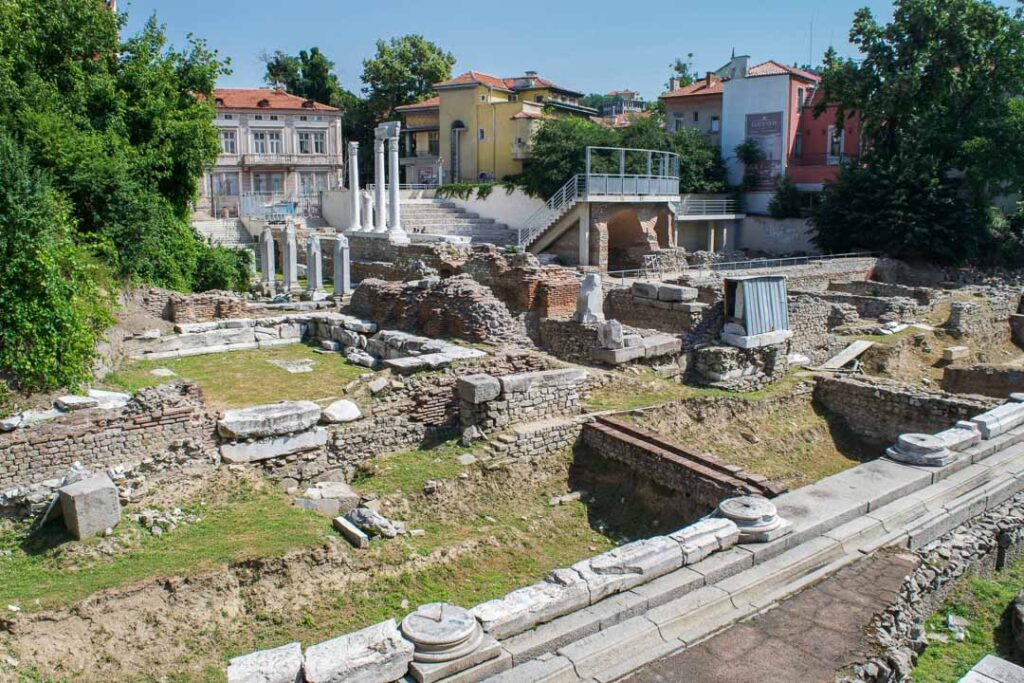
How to Visit the Ruins: You can either stay in Plovdiv or visit the ruins and city with a tour.
Ephesus, Turkey

While many Roman ruins give you the sense of what a landmark or building once looked like, a visit to Ephesus shows you what an entire Roman city felt like. Found outside the town of Selçuk on Turkey’s west coast, this archaeological site is one of the country’s most impressive historical landmarks. There aren’t too many places where you can explore the ancient remains of an entire city and still feel like you are standing in said city. Ephesus is one of those places.
It would be fair to say that Ephesus was as much an ancient Greek city as it was Roman. The city existed for over a millennia before falling under Roman rule in 129 BC. After a period of struggles, Ephesus began to prosper and had visits from famed figures like Ptolemy XII, Mark Anthony and Cleopatra.
Under the rule of Emperor Augustus, it was made the capital of Roman-occupied Asia and became a very important city for the Romans. Even with cautious estimates of the population at 30-50,000 people, Ephesus would have been one of the biggest cities in the region but it may have been even bigger. Either way, Ephesus was a great city under the Romans and would remain quite important up until the 15th century when it was abandoned.

Visiting Ephesus is pretty straightforward. Simply start at the top of the hill at the southern entrance and make your way down the hill on the incredible marble road of Ephesus.
At first, it may just seem like you passing between ruins but it soon starts to feel like you’re moving through city streets. This comes home when you reach the top of the main road down through the site, seeing a long line of pillars along a paved road. It doesn’t take much of an imagination to see a city in front of you.
Ephesus is more than the sum of its parts, but some of those parts are pretty spectacular in their own right too. One of the most breathtaking structures is the remains of the Library of Celsus, a huge double-story stone facade. This is a sight to behold, particularly from the top of the hill as the road weaves down to it.
Quite funny (at least to me) is the adjoining brothel that had a secret passage between them. The other big monument is the Great Theatre which is quite colossal, with equally great views. Ephesus is just an all-around awesome in the truest sense of the word.

How to Visit the Ruins: You can either stay in Selcuk or visit the ruins and city with a tour.
Cordoba, Spain

This may be a bit of a surprise but the fantastic city of Cordoba does indeed have Roman ruins. I say this because Cordoba already has so much going for it that it may be easy to overlook those ruins. There’s the amazing Mosque-Cathedral, the gorgeous gardens of the Alcazar de los Reyes Cristianos and the gorgeous Andalusian architecture. Oh and Roman ruins. It’s not often you find places with such a diverse and overwhelming historical presence.
Cordoba, conquered by the Romans in 206 BC, grew to become one of three regional capitals on the Iberian Peninsula. Despite some occasional resistance against the Romans, the city thrived with newly built city walls, a stone bridge, forums and an amphitheatre. In a sense, the city of Cordoba owes just as much of its layout to the Romans as it does to those that followed like the Moors and the Spanish.
One of the city’s landmarks that owe its heritage to the Romans is the Roman Bridge over the Guadalquivir River. While it has seen countless renovations throughout the years, it still holds a similar look to that used by the Romans taking the Via Augusta road from Rome to Cadiz.
Slightly more reflective of its Roman origins is the Roman Temple of Cordoba. The only Roman temple to be excavated in Cordoba, this temple was built during the 1st century AD and was likely the main temple of the city. Unfortunately many of Cordoba’s other Roman sites, like the city’s amphitheatre found beneath the university, have not been fully unearthed but do hint at Cordoba’s Roman past.

How to Visit the Ruins: You can either stay in Cordoba, or visit the ruins and city with a tour.
Bitola, North Macedonia

The most unknown on this list has to be the ruins of Heraclea Lyncestis on the outskirts of Bitola in southern Rep. of Macedonia. Since tourism is still quite fledgling in North Macedonia these ruins do not see much foot traffic, which is great for those who do visit.
Tourists to Heraclea Lyncestis are mostly given free rein to explore the ruins at their leisure and are even asked to effectively walk up along old stone walls on occasion. A truly rare opportunity to have such a fascinating historical site to yourself and be simply trusted to respect its importance and fragility.
To be honest, Heraclea Lyncestis owes a lot of its interest to people other than the Romans. It was founded by Philip II of Macedon in the 4th century BC and wasn’t part of the Roman Empire until the 2nd century BC. However, it was under Emperor Hadrian (he of the wall in Britain) that the large theatre on the hill was built, hosting gladiator fights.
Because the city of Heraclea was situated on an important regional road for the Romans, the Via Egnatia, it began to benefit and prosper. Other buildings were either erected or restored during this time and the city became protected by walls. It would eventually fall to the Byzantine Empire and become an important Christian Bishopric.
The site is home to the usual remains of baths and temples and a fairly sizeable theatre. And yet, I think the main draw of Heraclea Lyncestis has to be the incredibly well-preserved mosaics on display. I’m not sure whether they all are, but many of the mosaics date from the 4th to 6th century likely making them after the Romans’ time.
Still, they are quite exceptional with great detail and colour. There are also remains of very early Christian churches, including the Great Basilica with another mosaic floor. It seems that there is still plenty of ongoing excavation and seems to be a site on the rise.

How to Visit the Ruins: You can either stay in Bitola or visit the ruins and city with a tour.
Have you visited any of the above remarkable Roman ruins? Are there others in Europe that you’d recommend? Please share in the comments below.

20 comments
There are viaducts on Gozo (the sister island to Malta) that I’ve seen a few times but I never thought about other countries having the remains of Roman structures. This is a great list. #wanderfulwednesday
I’ve visited Roman ruins (or at least I think they were Roman?!!) in Lyon, a viaduct and an amphitheatre. It seemed really lovely and not crowded at all. Guess that’s a huge advantage if looking for Roman ruins outside of Italy 😀
What an awesome post! Who knew there were so many Roman ruins were visiting outside of Italy. I’ve seen a lot of the ruins in Spain, but have to admit I had no idea there were Roman ruins in Morocco .. What a great list 😀
They really went everywhere, didn’t they? (They weren’t called Roamin for nunthin! Boomtish) Great post!
I love Roman ruins. It really is fascinating the impact that the Romans had and interesting to think where things would be without them. You can see the influence even in today’s architecture. Your post helps put this in perspective. Thanks for sharing on #TheWeeklyPostcard.
Good examples! Nimes, Arles, Orange, Pont du Gard and many others in France can be added to the list as well
I absolutely loved this post – what a fantastic idea! I spent this summer visiting Italy again with my niece as she loves history as much as me and we had a great time exploring Rome in particular. I then went onto Split (oh well that is the most amazing place and now only second to Rome as my favourite city in Europe) and then in October to Fishbourne near Chichester (I am from the North-East of England originally – my Dad was born in Wallsend and there was a bit of wall in front of my Grandma’s house so I grew up with the Romans as it were lol) so have seen from as far away as the north of England to Split the reach of this amazing Empire. I haven’t seen most of the places you have visited though – fantastic to see just how powerful and far reaching the Roman Empire was!
Sorry meant to say #TheWeeklyPostcard – and agree with Arnie the ruins in the south of France are fantastic too!
Thanks – the photos of Ephesus brought back some fond memories. Great tour!
This is a great idea for a post! There really is so much beautiful history to be seen 🙂
Interesting post! Split particularly looks amazing. Much more evocative when the ruins have been incorporated into the city’s old town, as you say; I always have a bit of a failure of imagination when I drive out to an isolated ruin in the middle of nowhere, although the others do look brill. The only one here that I’ve been to is Cordoba and I loved that bridge. It’s incredible to think of the reach of the Roman Empire – the film Gladiator really got me thinking about it (is that embarrassing?) and I’d love to go back in time and have a walk around these places. #TheWeeklyPostcard
I find Roman ruins to be quite interesting. Looks like you went to Split the same summer as us because those are the same exact people I have in my photo reenacting Diocletian! We even have Roman ruins here in Regensburg too! #TheWeeklyPostcard
Haha, maybe we almost missed each other. I’d like to see more of Germany, including its ruins
i haven’t been to any of these places, but each seems worth a visit. isn’t it remarkable how far and wide the Romans reached way back when?
It really is remarkable Eileen 😉
I thought I was the only one crazy about these piles of rocks! Volubulis is definitely high on my list.
Haha, I quite love those rocks too Jim.
Lovely selection of cites and great set of photos
Thanks for reading Jarek!
There are great ruins everywhere. I’ve seen amazing ones in Lyon (France), The Cotswolds (England) and Lebanon. Amazing! #TheWeeklyPostcard