Disclosure: This post (probably) contains affiliate links. If you click on one, I may make a small commission. Of course, this will come at no extra cost to you and helps keep this site running.
For travellers looking for places to visit away from Thailand’s beaches, Chiang Mai is one of the best options. This city in northern Thailand is a major cultural destination, but it is also popular for its vibrant nightlife and laid-back atmosphere.
Many people come to Chiang Mai without giving much thought to what they want to see there. They just come for the atmosphere and experience, which is fine. Should you arrive and suddenly wonder what to do in Chiang Mai, don’t worry. Here are some of the basic things to do in Chiang Mai to get your visit off to a great start.
Getting to Chiang Mai

If you’re planning to visit Chiang Mai, you probably want to know how to get there.
The good news is that you have plenty of options, particularly if you’re coming from Bangkok.
Flying to Chiang Mai is one option. Airlines from all over Asia fly to its international airport, with Thai AirAsia and Bangkok Airways being particularly prominent, covering the main domestic routes, such as Bangkok and Phuket.
Train, but specifically the overnight train, is another way to get there.
The ride from Bangkok takes roughly 13 hours, which is why most people opt for an overnight trip. It’s an experience and more comfortable than I expected.
You can board the train from other stops along the way, particularly Ayutthaya and Phitsanulok, but most people just go from Bangkok (Krung Thep Aphiwat Central Terminal).
Buses provide even more options for getting to Chiang Mai. Routes connect the city with Bangkok (quicker than the train), but also Chiang Rai and Chiang Khong (on the Laos border).
Finally, there are shuttles and transfers. Look up possible options for these here, just expect to pay more than if you go with public transport.
Where to stay in Chiang Mai

The part of planning your Chiang Mai visit that’s likely to stress you the most is deciding where to stay.
Look at a map of the city and you’ll see the clear outline of the historical center. The normal instinct is to try to stay inside that area. While it’s a convenient area to stay in, don’t feel too pressured to find somewhere inside the walls.
Stay a short walk from a city gate, and you’re really no further from food options and attractions; plus, tuk-tuks make getting around Chiang Mai super easy.
During my visit, I stayed at Chiang Mai Gate Hotel, south of the city center. It’s a perfectly fine 3-star hotel and will work if you’re on a budget and want a hotel with a pool.
But if you’re after something nicer, these are some of Chiang Mai’s most highly-rated options:
Chiang Mai tours

While I think you can experience a fair bit of Chiang Mai on your own, tours can be really helpful.
Whether it’s activities and experiences that you can’t organize yourself, or just things that are easier if someone else handles them, tours can add a lot to your visit. I did a mix of sightseeing on my own and tours/activities, and found that a great balance to get more from my visit.
Below are some of the most popular options, just to save you time browsing through hundreds of Chiang Mai tours:
- Chiang Mai: Historic Temples and City Guided Walking Tour
- Chiang Mai: Bua Thong Sticky Waterfall and Huge Cave Tour
- Chiang Mai: Doi Inthanon Park and Pha Dok Siew Trail Trek
- From Chiang Mai: Chiang Dao Cave Trekking Full-Day Tour
- Chiang Mai: White, Blue & Red Temples Tour with Lalitta Cafe
Ideas for what to do in Chiang Mai
With the key parts of planning your Chiang Mai trip out of the way, let’s look at what to do there. Even though the city is known for its lifestyle more than anything, there are plenty of things to do in Chiang Mai to keep you busy. These are the ones I’d start with to cover your bases.
Note: You won’t find any recommendations for visiting an elephant sanctuary here. That requires extensive research into which places operate ethically, something I highly urge you to do before booking any elephant experiences.
Walk around the Old City

Unlike cities like Bangkok, it’s very easy to tell where the center of Chiang Mai is.
That’s because the Old City sits behind a square moat backed by high brick walls. The historical center is home to many of the main things to do in Chiang Mai, and it’s a great starting point for exploring.
Find the nearest city gate to you, admire the view of the city walls, and head on in. Walking around Chiang Mai’s Old City, you can immediately see how the city differs from Bangkok and other Thai destinations.
Although it’s the historical center of Chiang Mai, don’t expect this area to be exclusively historical buildings. In fact, much of the area feels quite contemporary.
However, you will find some occasional old-fashioned buildings, not to mention many local temples, which we’ll get to next.
Other things to look out for are the Three Kings Monument on the city’s main square and various local museums, such as the Chiang Mai City Arts & Cultural Centre.
Wat Chedi Luang

Chiang Mai is home to hundreds of temples, making visiting temples a common thing to do in Chiang Mai’s Old City.
The challenge is deciding which you should visit, since it’s better to pick special ones to start with, before you get burned out.
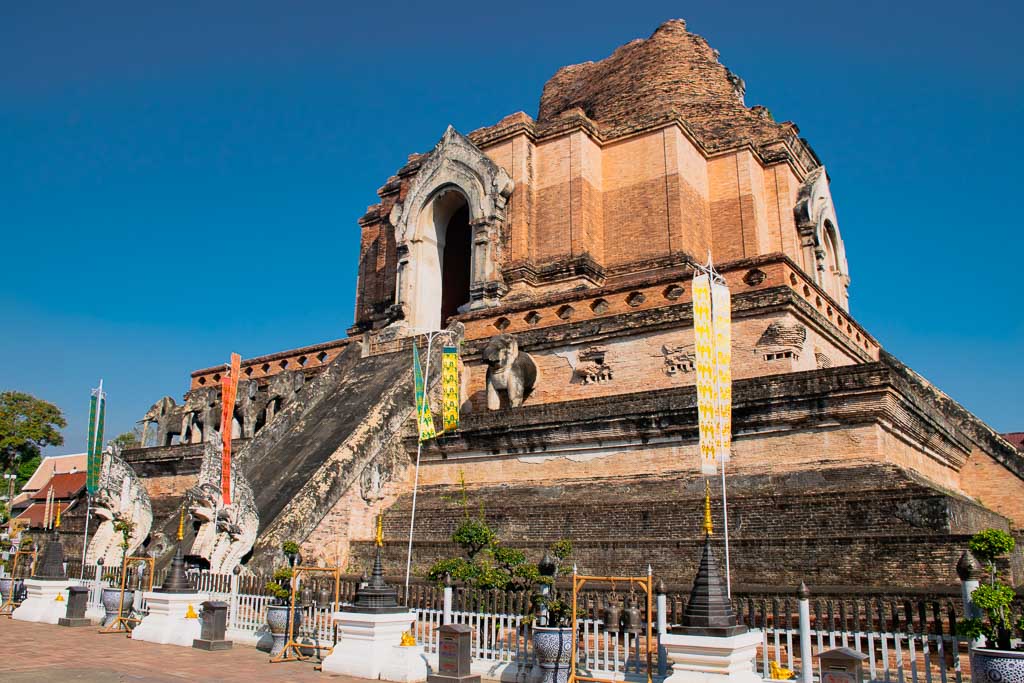
My recommendation is the Wat Chedi Luang. This large complex in the heart of Chiang Mai features beautiful Thai halls and the towering ruins of a brick chedi, similar to those found in Ayutthaya.
The size of the chedi is probably what you first notice about it, but there are also lots of details to take in here. There’s the fragmented roof from earthquake damage, the naga statues and elephant statues that line its sides, plus the golden Buddha statues hidden in alcoves on the side.
Make sure to also see the other halls, home to more Buddha statues and ornate design. There’s just so much to see, which is why I think it’s a great starting point.
Other temples to consider are Wat Phra Singh Woramahawihan and Wat Chiang Man, plus Wat Lok Moli just outside the Old City.
Lanna Folklife Centre

Visitors wanting to know more about the culture of Chiang Mai and Northern Thailand need to visit the Lanna Folklife Centre.
This museum, opposite the Three Kings Monument, is an excellent introduction to the region’s culture. It showcases all sorts of art forms of the Lanna (a kingdom that once covered northern Thailand), plus the importance of Buddhism and beliefs/symbolism surrounding it.
There’s even a display about Lanna food, allowing you to learn about the region’s specific cuisine.
Coming to the Lanna Folklife Centre early on is a great way to get more out of visiting Chiang Mai attractions. It helps explain small details that you might see later on and gives you the context to better appreciate them.
It doesn’t hurt that some of the art, like the above statues, is quite beautiful.
Thai cooking classes

Exploring Thai food is a huge perk of visiting Thailand, and that’s definitely true when visiting Chiang Mai.
Northern Thailand is known for its regional cuisine, with Chiang Mai the perfect place to explore it. Many tourists are content with just hitting up restaurants and trying street food. However, if you want something more, then a cooking class is the way to go.
For those with doubts about joining a class, just look at how many cooking classes there are in Chiang Mai. It’s popular for a reason.
The cooking class I went to showed us how to make four dishes. Some were typical Thai dishes such as Pad kaphrao (Thai holy basil) and mango sticky rice, but we did learn how to make one regional dish, Khao Soi. These days, my favourite Thai dish is a toss-up between pad kaphrao and khao soi.
Even if you don’t need to be shown how to make these dishes, it’s a fun group activity, and you won’t leave hungry. Plus, it gives you the opportunity to interact more with the local community.
Wat Phra That Doi Suthep

Interestingly, one of the most famous Chiang Mai attractions isn’t even in the city.
But when you see Wat Phra That Doi Suthep up on its hill overlooking the city, you understand why it’s so popular.
The temple is considered a sacred site, as legend says a white elephant carried a piece of bone from the shoulder of Buddha to this spot on the hill. While this legend is important to Thai visitors, many tourists climb the 300+ steps to the top of Wat Phra That Doi Suthep for its sky-high views of the city.
Not that the temple itself isn’t a beautiful place to explore. At the heart of the temple is a gleaming golden pagoda, which was covered in equally golden scaffolding during my visit.
Wander around the temple and you’ll find many other shrines, home to Buddhas made of green glass and panels made of finely carved wood.
The only downside to visiting Wat Phra That Doi Suthep is getting there. We hired a rót daang to take us up and back from our hotel, but you can also just use Grab or take a tour.
Wat Pha Lat

Since you’ve already made the trip up the hill to visit Wat Phra That Doi Suthep, there’s another attraction nearby you can add in.
Partway down the Doi Suthep hill is another temple, Wat Pha Lat. We asked our driver to stop here on a whim, and I’m glad we did. Set in lush forest surroundings, this temple is much more tranquil than Wat Phra That Doi Suthep.
And while it lacks the flash of the upper temple, it has stupas, shrines, and reflecting pools to admire, including several naga staircases like the ones above. You even get a glimpse of the city through one break in the trees. Plus, it has free entry, unlike many popular temples. I wouldn’t travel all the way from the city just to visit here, but it’s the perfect companion to Wat Phra That Doi Suthep.
Visit different night markets

Night markets and street food markets are a staple of Southeast Asia, and Chiang Mai is no exception.
While there’s the main Chiang Mai Night Market in the historical centre, along Tha Phae Walking Street, you can find a bunch of them on the east side of the city.
Tha Phae Walking Street is your typical street market, with temporary stalls and crowds filling the street past the Tha Phae Gate.
One of the largest is Anusarn Market, a sprawling covered market with a large food court surrounded by souvenir stalls. You can also visit clubs and attend cabaret shows afterwards if you prefer.
For a more food-focused option, try Lanna Square in the historic center, where tables and stalls are set up in front of a stage. You’ll find a similar experience over at Ploen Ruedee Night Market as well.
So, whether you’re after an evening meal or some shopping, night markets are the best way to start the evening in Chiang Mai.
Take a hill tribe trek

Having explored the city’s sights and food, it’s time to see what the rest of northern Thailand is like.
While many people go off to visit Chiang Rai and Pai, an alternative is to spend a few days hiking between ethnic villages in the countryside.
Various tours offer this experience, but the one I did took me to near Huai Nam Dang National Park. While these tours are described as treks, they involve a lot more than just hiking.
Leaving Chiang Mai, we stopped at Mok Fa Waterfall to see the beautiful spot and get our feet wet. Similarly, when leaving the villages, we took a bamboo rafting trip down the Mae Taeng back towards Chiang Mai.
Local villages in this area are home to the Karen people, providing an opportunity to experience their way of life. You get to see their homes, try local food, and learn about various handicrafts.
If you want to get out of the city for a bit, joining one of these tours is a great idea.
