
Disclosure: This post (probably) contains affiliate links. If you click on one, I may make a small commission. Of course, this will come at no extra cost to you and helps keep this site running.
Chiang Mai has become one of Thailand’s most popular destinations, with no shortage of cultural things to do there. Yet one of my highlights there was joining a Chiang Mai hill tribe trek tour. With it, we left the city behind and spent three days experiencing the countryside of Northern Thailand.
Deciding whether you want to miss out on more time in Chiang Mai for a trek can be a hard decision. You might be unsure if you’re up for the hiking or what the conditions will be like. Or you might question whether the experience and things you see will make it worth it. Here, you can see what it’s like hill tribe trekking in Chiang Mai to help you decide.
Is the Chiang Mai hill tribe trek worth doing?

If you’re a curious person, then I’d most definitely say yes.
Whether you want to know what the countryside looks like or like the idea of learning about the Karen people, then this is the way to do it.
You need to be comfortable spending time outdoors and roughing it a little, as the overnight facilities are basic. If that kind of thing worries you, consider a 1-day trekking tour instead.
But for me, spending the evenings around campfires and the mornings watching the sun rise over the landscape are experiences not to be missed.
Where is the trekking?

It depends on who you go with.
Most trekking tours from Chiang Mai visit villages of the Karen people, which dot much of northwest Thailand. Each tour company has its own arrangements with different villages.
My trekking tour was an add-on to my G Adventures tour from Laos – similar to this tour.
G Adventures has an arrangement with villages in the hills between Pai and the Chiang Dao Wildlife Sanctuary. Intrepid and the smaller operators also work with different villages, and not necessarily in the area.
Working out where the tours go can be tricky. G Adventures took us to stay in Ban Mae Jok and Pa Khao Lam, one of which took a long time to find on Google Maps. Locating the villages for other tours can be just as hard.
It’s worth mentioning that these are villages of the Karen people, not to be mistaken for the Kayan Lahwi. This is a different ethnic group, who are quite famous for their long neck tradition.
How hard is the Chiang Mai hill tribe trek?
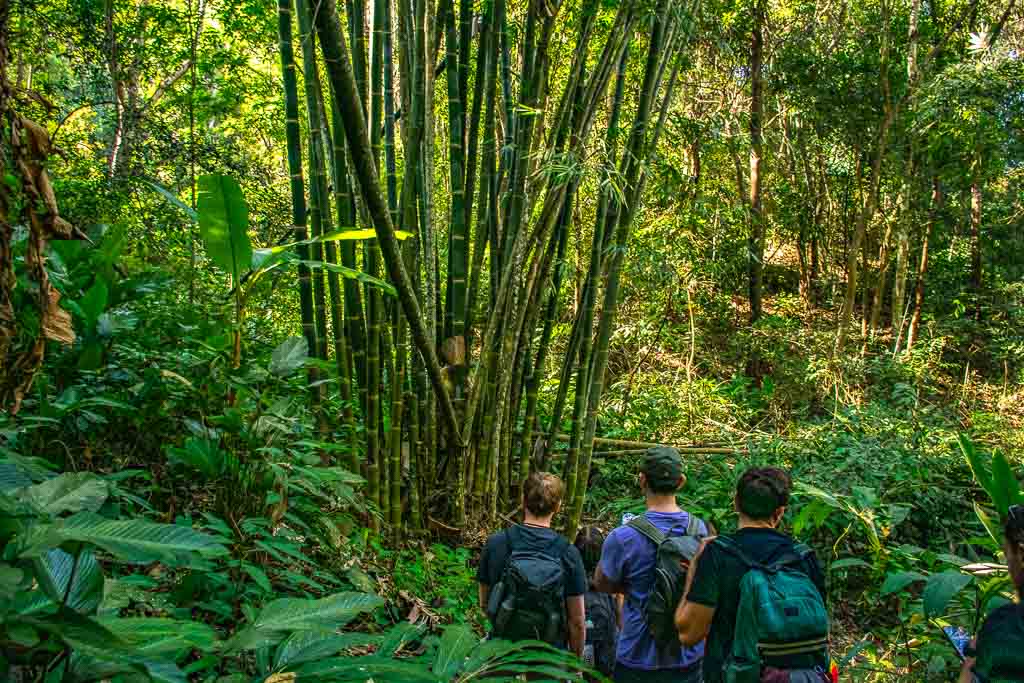
Since the difficulty of the trek depends on where you go, I can only comment on what our hiking was like.
From my perspective, calling this a “trek” is a little over the top.
Yes, we spent some of the three days hiking in the forest and remote areas. The route occasionally took us along rough paths, and much of the time, we climbed up and down hills.
However, we never actually spent much time walking. The middle day was our longest and flattest day of hiking, and we only walked for around 3.5 hours.
With regular rests, this is not really a massive workout. You will get a little sweaty on the uphill sections, but you don’t need a special level of fitness to manage it.
Hill tribe trek itinerary
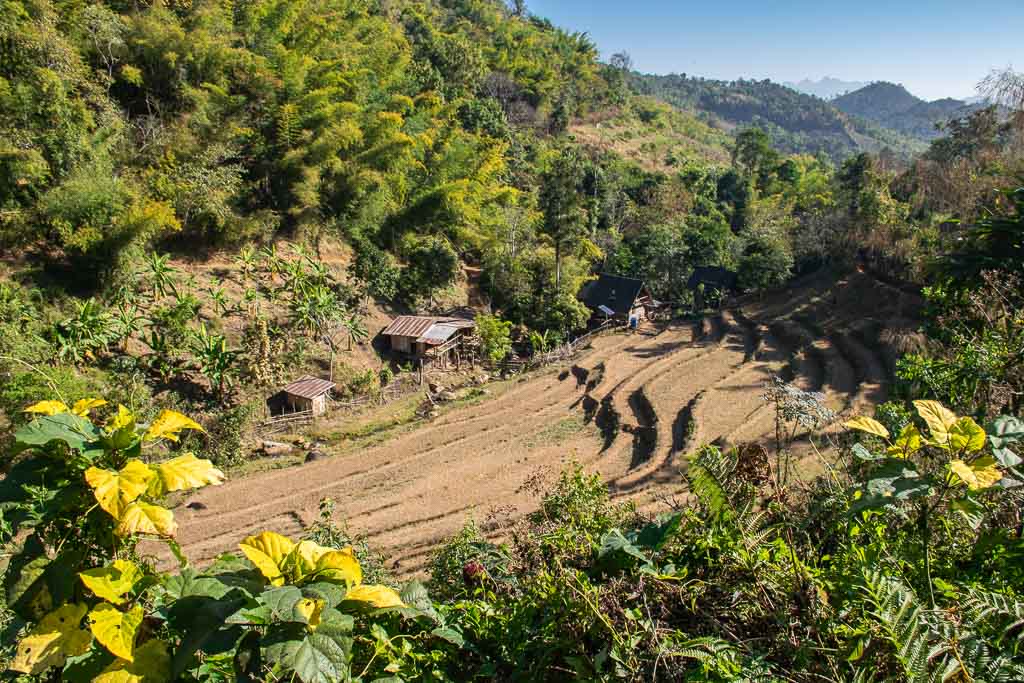
To understand whether hill tribe trekking in Thailand is worth your time, you need to know what it involves. Because hiking is just one part of the experience, and honestly, it’s the least memorable part.
This tour’s real focus is on village life for the Karen hill tribes. You see what their homes and villages are like, as well as how they interact with nature.
It also has the same energy as a camping trip. You’re away from the modern world, away from the internet, and home comforts. With the right people, it’s a fun bonding experience.
Day 1 – Ban Mae Jok
The start of the tour isn’t remarkable. You drive out of Chiang Mai by songthaew, stopping at a village to get snacks at a local market on the way.
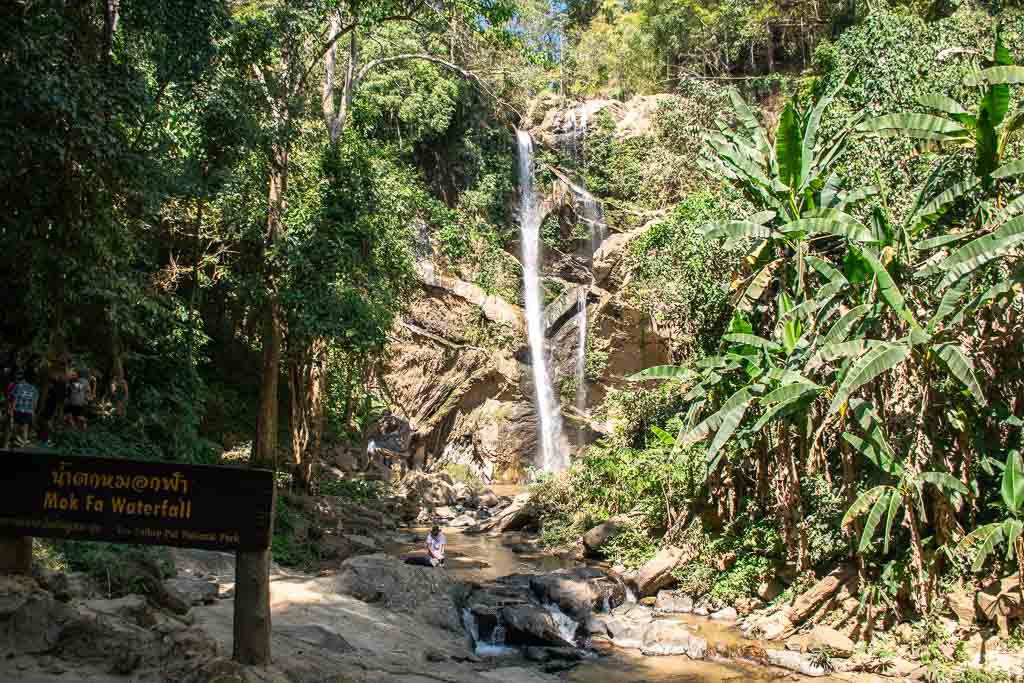
Things get more interesting when you arrive at Mok Fa Waterfall.
It’s only a short walk up to the waterfall, but Mok Fa Waterfall feels hidden away, like a secret spot. Even in the dry season, the waterfall had enough water to form a shallow pool to cool off in.
This break makes the rest of the dull drive more bearable. By mid-afternoon, you’ll be let out in the middle of nowhere and left with your Karen guides on a dirt road.
Reaching the village of Ban Mae Jok requires a 2-hour hike. The first half hour is easy with open terrain, but soon you’re into the jungle among towering bamboo trees and huge banana plants.
Accommodation at Ban Mae Jok is simple. Hikers share two large rooms, sleeping on simple mattresses under nets, with basic Thai meals prepared by the hosts.
Day 2 – Pa Khao Lam
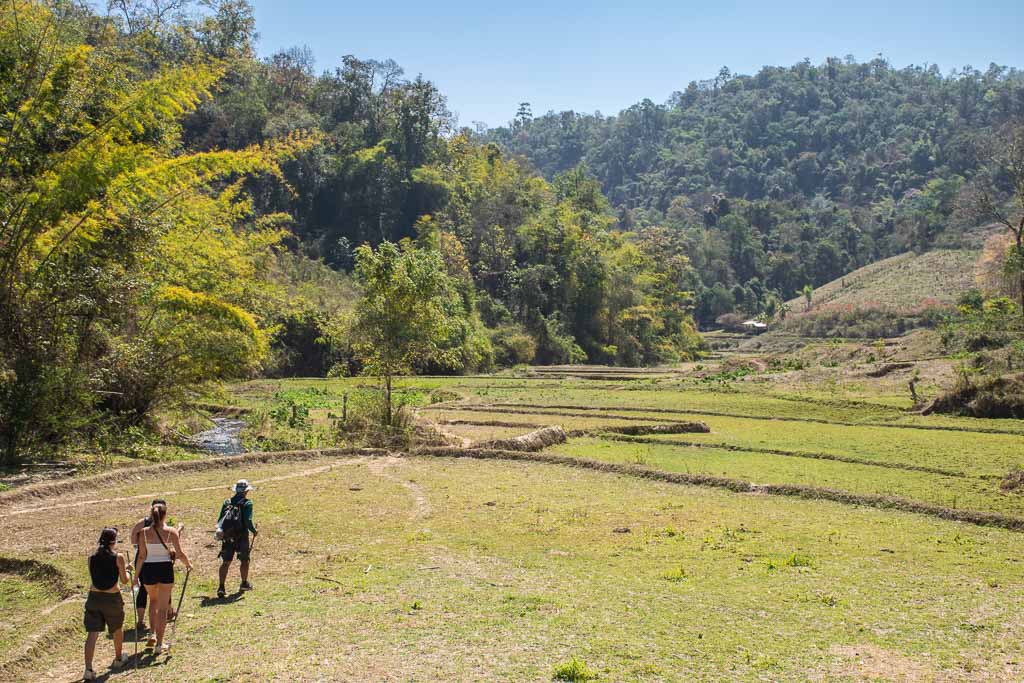
Day 2 begins gently with a walk down from our guest house to the actual village.
Walking through on a narrow paved track, you see that living conditions in these remote areas are quite basic. Homes are simple, raised structures, usually with livestock of pigs and chickens around. Still, with the rice terraces leading down to the bottom of the valley, it’s a beautiful place.
From there, it’s onto dusty forest trails in the hills. Among the dense trees, there’s not much to see, so it’s a pleasant change when the trail brings you down to some open rice terraces. Walking across the rice terraces is easy in the dry season.
Things don’t change much until you start to see fences again and soon lots of banana plants. This is the next village, Pa Khao Lam, which is bigger and has a sealed road running through it.
As we headed down to the river, where our guesthouse for the night was, we spotted a wild elephant walking through the village—a real treat.
Because you arrive so much earlier at this village, there’s much more time for activities at Pa Khao Lam. Playing soccer at the local school was fun, but you can also swim in the river, learn local weaving techniques, and try eating ants.
Piles of bamboo around the guesthouse are a hint to the next day’s activity.
Day 3 – Mae Taeng River rafting

Pa Khao Lam sits on the Mae Taeng River, and locals make rafts of bamboo to travel downriver.
Even though we were on the river, the morning started with a walk—less than an hour—to reach the rafting departure point. As I said, it was less hiking than you’d expect.
While the bamboo rafts are relatively simple, they’re huge and surprisingly sturdy. You can stand or sit on them. Water will come up through the large gaps between the bamboo, so prepare to get wet when sitting.
The trip down the river goes for a while, giving you plenty of time to admire the quiet and breathtaking nature. You’re in the middle of nowhere, and it’s captivating. Occasionally, you need to pay attention as the raft travels through small rapids, but they’re also good fun.
To take a break, we stopped at a calm point of the river and went swimming. However, the particular riverbank we used was infested with spiders, which rightly freaked a lot of people out.
The rafting ends once you reach a small village on the Mae Taeng River down at Chamcha Coffee. After coffee and lunch at this popular spot, it’s time for the long drive back to Chiang Mai by songthaew.
Do you visit an elephant sanctuary?
On my tour, thankfully, no.
So-called “Elephant Sanctuaries” litter the hills north of Chiang Mai. Unfortunately, some trekking tours include a visit to see the elephants. Many of these businesses still allow harmful practices such as animal interaction, including riding and washing the elephants.
Finding the ethical places that are truly designed around animal welfare requires you to do your research. Read more about why this is so important here.
