Disclosure: This post (probably) contains affiliate links. If you click on one, I may make a small commission. Of course, this will come at no extra cost to you and helps keep this site running.
You may think of Bangkok and beaches when it comes to Thailand, but so much of the country lies inland among hills and forests. Kanchanaburi is a great example of what Thailand’s interior is like, as the best places to visit in Kanchanaburi celebrate the province’s wilderness and gorgeous river scenery.
But what makes the town of Kanchanaburi a popular tourist destination isn’t just its proximity to national parks. The war history of Kanchanaburi draws many Western tourists to visit, something you don’t often find in Thailand, with many of its main attractions associated with the Japanese occupation during World War II. These two sides of sightseeing in Kanchanaburi, make it quite a unique place to visit.
How long do you need in Kanchanaburi?

A day trip to Kanchanaburi is the most common way people see this interesting part of Thailand. However, I think you need at least two days in Kanchanaburi just to see its highlights.
Yes, you can see some of Kanchanaburi with a one-day trip from Bangkok. Tours are designed to show you local highlights, such as this Kanchanaburi tour or this Kanchanaburi and Erawan Falls tour. But even comparing these two itineraries, you can see that they include different attractions.
I spent around three days in Kanchanaburi sightseeing and found even that wasn’t enough to go everywhere.
But at least if you allow two days in Kanchanaburi, you have time for one day in the town itself and one for exploring more of Kanchanaburi Province. You can even book a 2-day tour to do this, which covers most of the places to visit in Kanchanaburi and even lets you stay the night in a floating raft hotel.
The bottom line is, one day in Kanchanaburi won’t go to waste, but 2-3 days is better if you can do it.
How to get to Kanchanaburi

The town of Kanchanaburi is located in western Thailand, between Bangkok and the Myanmar border. And when it comes to getting to Kanchanaburi, Bangkok is most likely where you’ll be coming from.
Options for getting from Bangkok to Kanchanaburi include train, minibus, and private transfers.
Trains run from Bangkok to Kanchanaburi out of Thonburi Station and go twice per day, once in the morning and again in the early afternoon. However, you can’t book train tickets in advance, which makes it a little uncertain when travelling in busy months such as December to February.
A far more reliable and frequent way to go is by minibus from Bangkok. Minibuses run every hour from both the Southern Terminal and Mochit New Van Terminal, allowing you to use whichever bus station is more convenient.
Those preferring a more straightforward and comfortable journey should consider booking a private transfer. The trip will cost a lot more, but you may value the door-to-door convenience.
What about when you’re not coming from Bangkok? Well, you will find options for other destinations in this part of Thailand. For instance, you can take shared hotel transfers from Ayutthaya and minivans from Hua Hin.
How to get around Kanchanaburi

Don’t underestimate Kanchanaburi just because it’s a town.
Getting from one end of town to the other easily takes an hour’s walk, which isn’t something you want to do with Thailand’s weather. I speak from experience. The reason it’s so far is that the town is stretched out along the River Khwae.
It doesn’t help that some attractions and landmarks are at far ends of Kanchanaburi town. The River Khwae Bridge is in the town’s far northwest, while Kanchanaburi is down in the centre of town to the southeast.
Rather than walk around town, I recommend either hailing a tuk-tuk or booking a Grab rideshare. All my journeys around town cost between 60-100 THB using either. Going to outer places such as the Tiger Cave Temple will cost more though.
Where to stay in Kanchanaburi

You’ll probably be overwhelmed by just how many places to stay in Kanchanaburi there are.
When visiting Kanchanaburi, you can choose anything from a riverside resort to hostels and guesthouses for your accommodation. What’s more, the value for money in Kanchanaburi is better than much of Thailand in my book.
In my opinion, the best area of Kanchanaburi to stay in is at the northern end of town. Accommodation between the River Khwae Bridge and Kanchanaburi War Cemetery is the most convenient spot for sightseeing, food, and getting about.
I won’t deny that the resorts on the western bank of the river did look very nice though.
My time in Kanchanaburi was spent at Chez Bure, a hotel in a quieter area between the two restaurant/hotel sections of River Kwai Road. The staff here are wonderful, they constantly offer free snacks, and the rooms are spacious and clean.
Should you want other hotel recommendations, these places are very well-rated:
Where to eat in Kanchanaburi

Rarely have I had as much good luck with food as I did in Kanchanaburi. So I’m delighted that I have recommendations for places to eat in town. My luck extended to both restaurants and cafes, even if they didn’t highlight the region’s cuisine:
- On’s Thai-Issan Vegan – a tasty vegan restaurant that also offers cooking classes
- Kin Khao Lam Restaurant – a simple restaurant with delicious khao soi
- Ko Kook – a Vietnamese restaurant with great breakfast options
- Tongkan Café – a pretty and modern cafe by the water
- Gravité Coffee – a fantastic coffee shop on a side street
Things to do in Kanchanaburi
Let’s dig into the main things to do in Kanchanaburi, starting with the main attractions in the town itself. These places to visit lean heavily into the town’s World War II history and its river scenery.
River Khwae Bridge

Of the attractions in Kanchanaburi that people come to see, the most popular is the River Khwae Bridge.
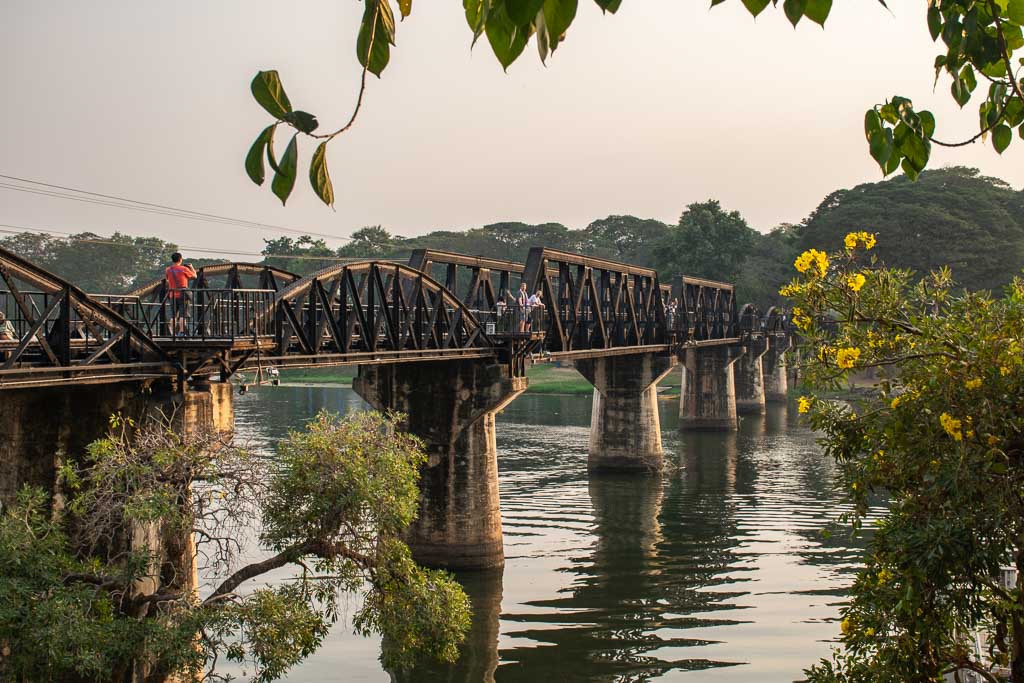
Made famous by the film “The Bridge Over the River Kwai” (based on a book), the bridge is a relic from Japan’s occupation of Thailand during World War II. It was part of the Burma Railway that Japan built to supply its attack on Burma, modern-day Myanmar.
However, the Burma Railway is known by another name – the Death Railway. Estimates suggest around 100,000 people died performing forced labour to build the railway, some of whom were Allied prisoners of war (POWs).
The River Khwae Bridge was one of seven iron bridges built for the railway, but the only one located in Thailand. It was famously bombed, with POWs marshalled on the bridge as a deterrence, several times and then rebuilt after the end of the war.

Visitors can walk across the bridge and watch the local train that crosses it several times per day. It’s also quite beautiful up there on the tracks, looking out along the river. I found it strange contemplating its bleak history while enjoying its beautiful setting.
JEATH War Museum

Visitors to Kanchanaburi often want to learn the local history that took place during World War II. And the easiest place to go for that is the JEATH War Museum.
But there are a few things to understand about the museum. For one thing, it actually has two locations, one by the River Khwae Bridge and south of the town centre. And if you’re curious about the name, JEATH stands for the countries involved in the conflict – Japan, England, Australia & America, Thailand and Holland.

The museum by the bridge has a rather eclectic and disorganised collection of exhibits. It features an old train used during the war, other vehicles (including a helicopter), and remains from the wooden railway bridge.
What the museum does best is highlight how many civilian labourers from Asia were forced to work on the Death Railway and why their efforts, suffering, and deaths aren’t as widely recognised.
Thailand-Burma Railway Centre

The best museum in Kanchanaburi for learning about the Burma Railway is the Thailand-Burma Railway Centre.
Sitting across from the Kanchanaburi War Cemetery, this museum is the best place to understand everything related to World War II and the railway. Modern exhibits detail the context of the railway in the wider war, but also the experience and hardships of prisoners of war.
Don’t make the mistake of skipping the Thailand-Burma Railway Centre. You might think that visiting the JEATH War Museum is enough (and cheaper), but the Railway Centre is much more organized, thorough, and focused.

Before or after your visit, make sure to head over to the Kanchanaburi War Cemetery to pay your respects to the thousands of POWs who died here.
Skywalk Kanchanaburi City

With so much focus on the dreadful history of Kanchanaburi, it helps to take a break and admire the town’s beautiful scenery.
And for scenery, the best place to go is Skywalk Kanchanaburi City.
This brand-new elevated platform sits by the riverfront in the centre of town. From it, you can see right along the River Khwae and take in its beauty. If it’s not too hazy, you can even see nearby mountains and temples popping up out of the landscape.

Maybe my favourite thing about the Skywalk’s views though is the houseboats. You see houseboats at many points along the River Khwae, but many sit by the riverbank around the Skywalk and they’re especially colourful here.
Try to go here early or late in the day to avoid the heat/haze.
Places to visit in Kanchanaburi Province
While the town of Kanchanaburi is home to the famous River Khwae Bridge, most of the other famous places to visit in Kanchanaburi aren’t in the town.
These attractions are found much deeper in Kanchanaburi Province, with guided tours the easiest way to reach multiple attractions in a day. However, tours from Bangkok, like this Kanchanaburi tour or this Kanchanaburi and Erawan Falls tour, rarely have time to visit more than one.
Instead, you’ll need a tour from Kanchanaburi town. These tours can be booked through a local travel agency such as Good Times Travel Service (who I used) or possibly your hotel. With them, you have more itinerary choices and they’ll likely be cheaper too.
Being able to visit all of the places below was a great way to spend a day in Kanchanaburi.
Erawan Falls

Thailand is blessed with many beautiful waterfalls, but one of its best is Erawan Falls, not far from Kanchanaburi.
What makes the Erawan Falls so special is that there are seven levels to this waterfall. Several of the waterfall’s tiers would be famous on their own, but combined they make for magical scenery. This is even though it was the dry season (January) and the cascades were barely trickling in places.
The only challenge is that to see all of the seven levels, you need to walk up the track and the steps that connect them. Only the fittest in our group made it to the top waterfall, plus me. Seeing the “You are the Conqueror” sign is a nice touch at the end of the 1.5-hour hike.
For visitors not interested in sweating their way up the hillside, swimming is the preferred activity. You can swim at most of the Erawan Falls, but the lowest falls are the most popular with large pools to float around in.

Hellfire Pass Interpretive Centre

Much of the Death Railway no longer exists, but places like Hellfire Pass remain as reminders of its cruel history.
Hellfire Pass was one of many sections of the railway that required labourers to blast their way through the province’s rugged hills. Today, the cutting remains as a memorial to the POWs who suffered working in this remote place.
Visits here start at the Hellfire Pass Interpretive Centre, a museum operated by the Australian Government. There you can learn about the Hellfire Pass and Burma Railway, adding to your previous museum knowledge. Afterwards, it’s a gentle walk (with a lot of steps) down to the pass carved from thick rock.
Going here in January meant that the landscape was very dry. But the labourers worked on the railway for years, suffering through the worst of the wet season with barely any shelter or supplies, something horridly unimaginable.

Tham Krasae Railway Bridge

While the River Khwae Bridge was destroyed, parts of the Burma Railway like the Tham Krasae Railway Bridge still stand to this day.
This wooden trestle bridge, also known as the Wang Pho Viaduct, still serves the trains heading up to Nam Tok station at the end of the line. Head to Thamkra Sae station and you can walk out along the train tracks and onto the bridge for its beautiful river scenery.
Just off to the side, there’s also a small cave temple Krasae Cave that you can wander into.
It was at Thamkra Sae station that our tour boarded the train to ride part of the way back to Kanchanaburi. The scenery along the route was gorgeous, even if the seats on the riverside were quickly taken. This isn’t just a tourist train either, as lots of local children were taking it back from school.

Other places to visit near Kanchanaburi

As I said earlier, even 3 days of sightseeing in Kanchanaburi will leave you with attractions unvisited. That’s the reality of a place like Kanchanaburi, where you’re not just seeing a town but practically a whole province.
People, myself included, usually underestimate how much there is to see and do in Kanchanaburi. You wouldn’t believe the number of temples in Kanchanaburi, let alone waterfalls and the province has four huge national parks covering its rugged wilderness.
I’m not going to go into the region’s elephant experiences as that’s a much longer discussion.
Some of the most popular places in Kanchanaburi Province not yet covered include:
- Sai Yok National Park – neighbours Erawan National Park, with waterfalls, caves, and raft accommodation
- Wat Tham Suea (Tiger Cave Temple) – temple with a massive golden Buddha just outside of Kanchanaburi town
- Giant Raintree – a huge 100-year-old monkey pod tree surrounded by gardens and food stalls
