Disclosure: This post (probably) contains affiliate links. If you click on one, I may make a small commission. Of course, this will come at no extra cost to you and helps keep this site running.
While planning your trip to Sri Lanka, you might run into the question of visiting Negombo, a small seaside city north of Colombo. You’re unlikely to find Negombo among the list of the top places to go in Sri Lanka, but it can pop up as an option and is definitely worth considering.
To decide whether Negombo is worth visiting, it helps to understand what the city has to offer. A couple of days in Negombo gave me a clear idea of what the city is like, so if you’re clueless or on the fence about visiting, allow me to help you get a sense of the place.
An alternative to Colombo

One of the most common reasons people visit Negombo is that it’s close to Colombo’s Bandaranaike International Airport.
This easy access between Negombo and the airport makes it a convenient alternative to staying in Colombo. Rather than start and end your trip in Colombo, you can replace one end of your trip with time in Negombo.
This is what I did for the start of my first Sri Lanka trip, getting an airport transfer to Negombo late at night. Not only did it provide a gentler introduction to the country, but it was also a quicker trip from the airport.

For my stay, I used Hotel Dorset near Negombo Beach. This family-run hotel is simple and very welcoming, plus it is close to good food options such as Ceylon Kitchen.
Other well-rated, but more upmarket accommodation in Negombo includes:
Finally, Negombo also works as a base for exploring Sri Lanka, with a variety of day trips available to places such as Sigiriya, Ella, and Wilpattu National Park.
Negombo Beach

It’s fair to describe Negombo as a beach destination — one of the closest beach spots to Colombo.
Negombo Beach is the city’s main beach, found well north of the city center in the Kudapaduwa area.
Unlike the many beaches in Sri Lanka found in sheltered bays, this is a long, straight stretch of beachfront facing the Laccadive Sea.
You can easily access Negombo Beach from the main tourist areas, as it’s just one block from the main road running north.

Even though there are a few beachfront resorts, I must say it’s not quite as nice as the beaches in Sri Lanka’s south. I saw quite a bit of rubbish on the beach, although that didn’t stop some people, often domestic tourists, from sunbathing and swimming.
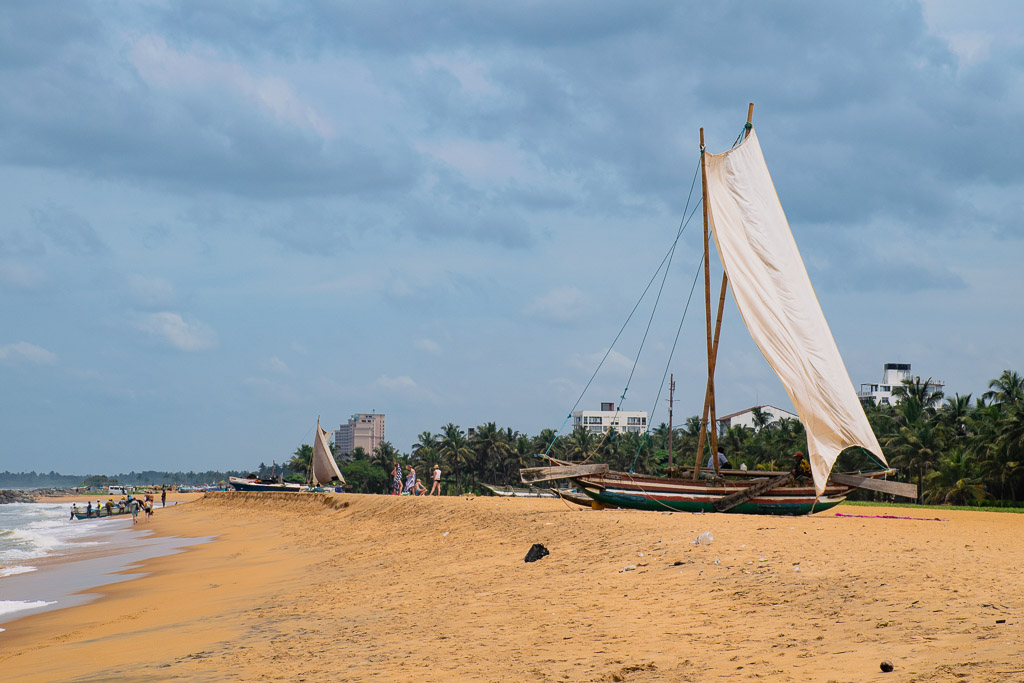
Instead, my favourite thing about visiting Negombo Beach was seeing the old fishing boats and catamarans parked on the sand.
Smaller boats were decked out in bright colours, while the larger sailing catamarans had a simple style. Walk along the beach, and you’re bound to be offered a sailing cruise, but I didn’t get a clear sense that it was affordable or worth doing.
Canals and Negombo Lagoon

The other feature shaping Negombo is the local waterways.
Just south of the city center is the vast Negombo Lagoon, where various species of birds live among its mangroves. Not only has the lagoon created channels and islands close to the city, but colonial figures also cut canals that lead inland.
Hamilton Canal is the easiest local canal to visit. You can see in the city center where it leads from the lagoon, but also in the backstreets of Negombo Beach. While it was the Dutch who built them, these canals reminded me more of Bangkok’s khlongs.

It’s easy enough to see the canals from land, but to appreciate Negombo Lagoon, you need to get out on the water. Taking a private boat tour is the most common approach, but it isn’t budget-friendly for solo travelers like me.
An alternative I only learned of later is a kayaking tour, something I’d be more inclined to try. Instead, I was stuck with views from bridges around its edges.
Downtown Negombo attractions

Attractions in Negombo that are much easier to experience are the cultural landmarks in the downtown area.
That’s partly because the city center is quite compact, but also because it only has a few main places to visit.
The most comprehensive way to explore this side of Negombo is on a sightseeing tour of the city, but you can try to do things independently on foot, like I did.
Most of the local cultural things to do in Negombo are old colonial landmarks. This includes the Negombo Dutch Fort, an old fort now used as a prison; you can visit the main gate and tower, that’s it.

Many of the other main landmarks are surprisingly Catholic churches.
While across Sri Lanka, you mostly find Buddhist temples, Hindu temples, and mosques, Negombo’s two main religious centers are churches.
St. Mary’s Church, seen above, is one of the most popular attractions in Negombo to visit. From the open-air feeling with all of its doors open, to the vivid colours used inside that you’d more likely expect at a Hindu temple, it’s an unexpectedly interesting landmark.
In contrast to its neoclassical look, another church north of the city, St. Sebastian’s Church, bears an equally unexpected neo-Gothic design.
Negombo Fish Market
Lastly, with no real museums in the city, one of the few attractions that highlight life in Negombo is the city’s massive fish market.
Sitting just north of the Negombo Dutch Fort, this indoor/outdoor market shows how fishing remains a primary industry for the city.
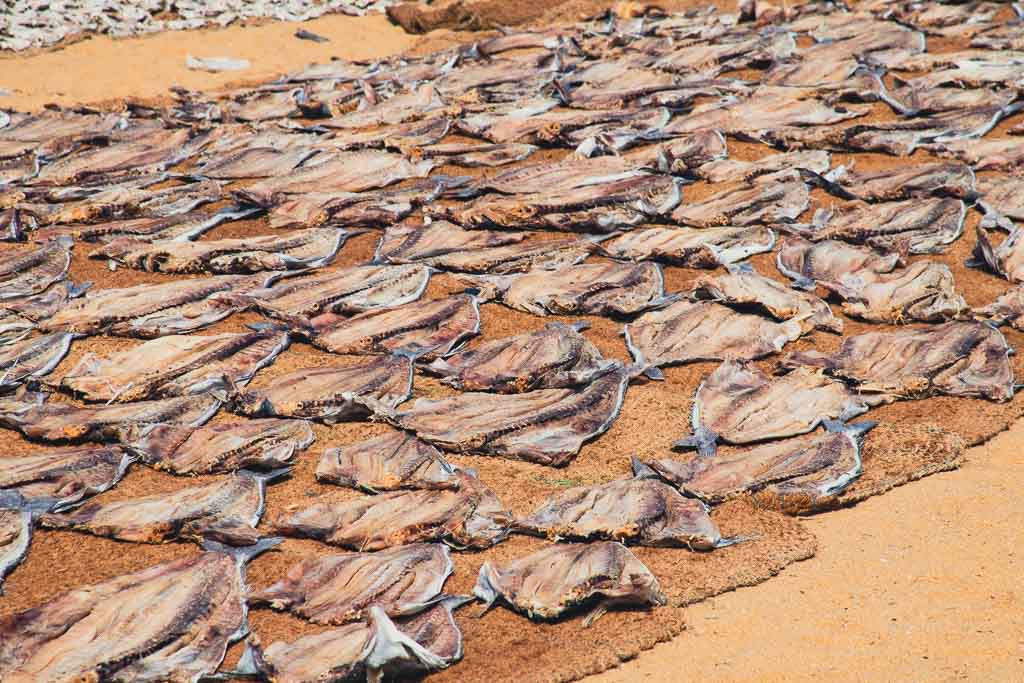
Stalls selling fish make up just a small part of the Negombo Fish Market. What’s much larger are the nearby mats on the beach with fish drying out in the sun.
See the fishing haul at this market, and the fleets of fishing boats and catamarans around Negombo all make a lot more sense. It’s one of the most pungent things to see when visiting Negombo, but still worth it, I think.
