Disclosure: This post (probably) contains affiliate links. If you click on one, I may make a small commission. Of course, this will come at no extra cost to you and helps keep this site running.
Like me, you may have never heard of Okuhida Onsengo before planning a trip to Japan. But if you want to experience a traditional ryokan stay and relax in an onsen, this hot spring region in Gifu could pop onto your radar. And based on my brief stay in Okuhida Onsengo, I feel like it’s an excellent place to do it when travelling in Chubu.
Staying in a ryokan and soaking in an onsen are two classic activities that many travellers to Japan want to try. For me, it was proving hard to find a way to fit these experiences into my packed itinerary. But then I came across the hot spring villages of Okuhida Onsengo, an ideal fit between visiting Takayama and travelling to Matsumoto. And so I added an overnight ryokan stay at Okuhida Onsengo to my travel plans.
Where is Okuhida Onsengo?

To know whether this particular onsen region is going to work for you, you need to know where it is. Okuhida Onsengo is a spa region made up of Hirayu, Fukuji, Shinhirayu, Tochio, and Shinhotaka, five villages located in the northern part of the Japanese Alps on the border between Gifu and Nagano prefectures.
The Okuhida Hot Spring Villages sit below the Yarihotaka Mountain Range, home to major mountains such as Mount Hotaka and Mount Yake. If you have the time while there, you can head up into the mountains on the Shinhotaka Ropeway.
On the far side of the mountains lies Kamikochi, one of Japan’s most famous scenic river valleys. But there is also a river valley running through Okuhida Onsengo and the views along the Gamada River are a nice alternative if you can’t make it to Kamikochi. I can only imagine what it’s like in autumn, when these areas are meant to be their most beautiful.
Getting to Okuhida Onsengo

Now, as it’s up in the mountains, Okuhida Onsengo is removed from Japan’s fantastic rail network. Instead, bus is your best option for getting to the Okuhida Hot Spring Villages without a car. Buses run from Takayama and Matsumoto to the Hirayu Onsen Bus Station, which serves as the main bus station for the area.
However, if you’re not staying in Hirayu, you’ll need the bus to the Shinhotaka Ropeway. This bus line runs from Takayama, through Hirayu Onsen and stops at each of the onsen villages before reaching the ropeway station. For Kazeya, where I stayed, I needed the Shinhotaka Onsen-guchi stop. When traveling between the other villages and Matsumoto, you’ll need to change buses at Hirayu Onsen.
Information onboard the bus makes it easy to tell when your stop is coming up. There’s also plenty of information available at the Hirayu Onsen Bus Station. The bus station has a restaurant, souvenir shop, snack food stand, luggage lockers, and vending machines.

Tickets can be bought at Takayama Bus Station and Hirayu Onsen Bus Station. For the local bus to the Hirayu Onsen Bus Station, you can get them from the driver. The bus from my ryokan to Hirayu Onsen cost 690yen (US$4.60), while the bus from Takayama cost 2050yen (US$13.70). You cannot use a JR Pass or Regional Pass for these trips.
Kazeya Ryokan

So, how was my ryokan stay at Okuhida Onsengo?
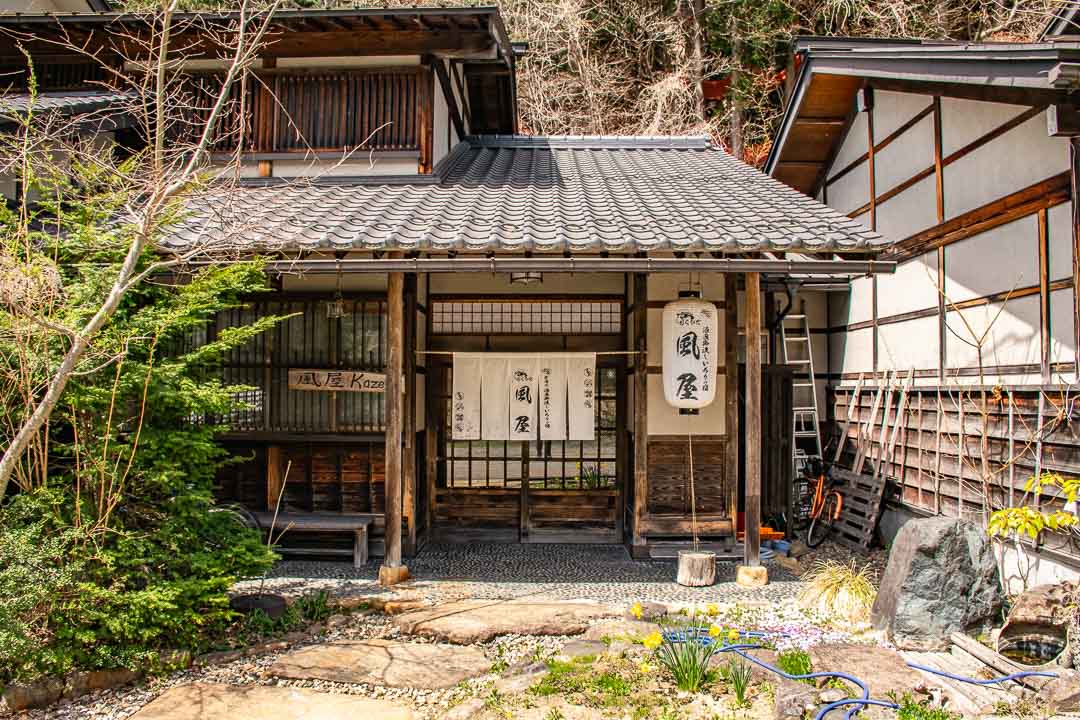
The Ryokan I spent the night at was Kazeya on the edge of the Shinhotaka village. I chose to stay at Kazeya as it was reasonably priced, well-reviewed, and most importantly, had availability. I left booking this part of my Japan trip a little late and options were quite limited at that stage.
Despite all that, I thoroughly enjoyed spending a night at this ryokan. It gave me exactly what I wanted – a night in a traditional ryokan with a chance to experience an onsen. I would later also stay at a more modern ryokan in the Kiso Valley, but this was my first experience of it.

Unlike the accommodation I normally stay at, a ryokan offers much more than just a room. But it’s worth starting with the room, as at Kazeya they are set up in a traditional style, with tatami mats. The rooms are also super spacious, which was a big change from Japan’s compact hotel rooms.
The room featured plenty of open space, as well as a refrigerator, tea equipment and a bathroom with shower. Included in the price of your booking is a large dinner and breakfast the next day in a semi-private dining space. You could upgrade the dinner set menu to include Hida Beef, but I didn’t feel the need after Takayama.
While Kazeya looks rather humble from outside at first glance, it’s because it’s not obvious just how large the ryokan is. Besides a large foyer, dining areas, and rooms, it also featured a nice garden and pond which I could see from my room window.

Public Onsen or Private Onsen?

As good as the food was and the general experience of a ryokan, the onsen is the big draw of this kind of experience. Kazeya offers guests both a public and private onsen to use for the duration of their stay. As is typical in Japan, the public onsen is divided by gender and had indoor and outdoor areas.
But I was also curious about the private onsen, which were available for use so long as it wasn’t occupied. What’s a little awkward about the private onsen is that you need to first wash your body in the public one and then walk the length of the building to the private one.
Once you’ve done that though, you’re free to relax in the soothing hot water of this outdoor pool. A fence to the street covers one side of this private space, but the rest looked out to local woods giving it quite a natural setting. The pool was ideally sized for two people, so having it to myself wasn’t a problem.
Things to Do in Okuhida Onsengo

With only one night in Okuhida Onsengo, I didn’t really have a chance to do much beyond the walls of my ryokan. But that’s not to say there aren’t things to do in the area.
With more time here, the first thing I would have done is go to the Shinhotaka Ropeway. Just a few stops by bus, the ropeway takes you way up into the Japanese Alps for some epic mountain scenery. There was clearly quite a lot of snow up there, so I can only imagine how impressive it must have been.
The other popular attractions near Okuhida Onsengo is Kamikochi. Buses do run from Hirayu Onsen to Kamikochi, but only from mid-April to mid-November. My visit was too early, so even had I had the time, I couldn’t have gone. But I really do want to see Kamikochi and its alpine scenery, so a return is always possible.
Advice for Staying in a Ryokan for the First Time

If you’ve never stayed at a ryokan, it can be a bit daunting and leave you uncertain of what to expect. I know I certainly felt that way before arriving. Some of my observations, based on my experience, are:
- Wear the yukata, the traditional clothes provided – you won’t be the only ones doing it.
- One night was nice, but a fair bit of effort for such a short experience. Stay longer and spend the days sightseeing in the area.
- Even though there’s a shower in the room’s bathroom, seems like the expectation is people will bathe at the onsen.
- Visiting a ryokan is generally a couple or group activity and it felt like I stood out as a solo traveller.
- Don’t expect there to be much in the village outside the ryokan in the way of cafes, convenience stores, etc.
- Bring any snacks you may want to eat, but you can get drinks at vending machines at the ryokan.
Have you ever wanted to stay in a ryokan and visit an onsen when travelling to Japan? Have you visited Okuhida Onsengo and stayed there? Please share your thoughts in the comments below.
