Disclosure: This post (probably) contains affiliate links. If you click on one, I may make a small commission. Of course, this will come at no extra cost to you and helps keep this site running.
Still not fully appreciated by international tourists, Romania is a far bigger country than people realise. Visitors tend to focus on the gothic mystique of Transylvania and the nation’s capital Bucharest, so some places like Timișoara slip through the cracks. This is such a shame as you can’t help but be impressed when visiting Timisoara thanks to its revolutionary history and vibrant architecture.
Timisoara is one of the largest cities in Romania and the de facto capital of the country’s west. But it’s not in Transylvania and is instead a long way from the popular tourist route there that connects Sibiu with Brasov. The city is much closer to major cities in neighbouring Hungary and Serbia, including Belgrade. And still, there’s no doubt in my mind that Timisoara is worth visiting, and you’ll be glad that you made the detour if you do.
Revolutionary Spirit

If Timisoara is famous for one thing, it’s the city’s revolutionary role in bringing about the fall of communism in Romania.
After decades under the socialist regime of Nicolae Ceausescu, citizens of Timișoara sparked the Romanian Revolution in December of 1989. What started as a local protest on December 16th quickly spiralled out of control and led to the overthrow of the government just 6 days later.
It must say something about the people of Timișoara that they were not only able to declare the city free from socialism in a matter of days, but also inspire the rest of the country so profoundly. That’s quite a feat! All of this history can be personally absorbed at the Revolution Memorial Museum, which is one of the most popular things to do in Timisoara. So if you’re curious about Romanian history, particularly 20th century history, Timisoara is not to be missed.
Timisoara’s Secessionist Architecture

It seems that being a leader is in Timișoara‘s DNA.
The city was not only revolutionary on the political front, but it was also at the forefront of the architectural front. So much of what there is to do in Timisoara involves its architecture, or at least that’s what kept me busy during my visit. I explored it on my own, but a walking tour is an even easier way to see the sights.
Throughout Timisoara, you’ll be treated to a particular style of art nouveau known as secessionist architecture, named after a Vienna art movement that spurned the established art world. Thanks to these many exquisite buildings in Timisoara, it’s fondly known as the “Little Vienna“. While I understand why, I will say that Timisoara takes things in a far more colourful direction than Vienna!
Spurning the conservative nature of the art and architecture establishment found in Vienna, artists and architects went rogue, incorporating new elements and variations into their work. The secessionist movement coincided with a building boom in Timisoara it seems, although it’s no wonder that this spirited city opted to go in such a bold direction.
Orthodox Cathedral

Timisoara’s most well-known attraction is no doubt the Orthodox Metropolitan Cathedral.
Standing proudly at the end of the boulevard-shaped plaza of Piata Victoriei, the cathedral’s vibrant design immediately draws your focus. While it may have only been finished in 1946, construction of the church had to be halted due to the outbreak of WWII.
Still, what it lacks in years it more than makes up for in its vivid appearance. Its design is what is known as neo-Moldavian, an inspired mix of features from Byzantine, Ottoman and Renaissance architectural styles. With its unusually vibrant colours and exaggerated dimensions, it feels like the kind of landmark that Disney would copy for inspiration.
Piaţa Victoriei

Even though the cathedral is Piata Victoriei’s most popular landmark, it’s certainly not the only one.
Looming high over the square’s lovely gardens and fountains, grand old buildings hint at the city’s architectural boom in the early 20th century. While buildings like the Dauerbach Palace may look a tad solemn with their dark colour palette, they contrast nicely with the bright and colourful gardens below in the square.
Interestingly, Dauerbach Palace was just a residence built for Georg Dauerbach and is only referred to as a palace due to the famous Palace Restaurant that for decades was situated on its ground floor.

At the far end of the square, you’ll find yet another style of design on display in the city’s National Theatre And Opera House.
Pre-dating many of Timisoara’s other grand buildings, the theatre was built in the 1870s, which could explain its different look. Originally given a Renaissance design, the old architecture was hidden behind a new neo-byzantine façade added after a fire in 1920. Yet another eclectic, rule-defying landmark of Timisoara.
Piata Unirii

After seeing Piata Victoriei, you’ll probably think you’ve seen the prettiest square in Timisoara.
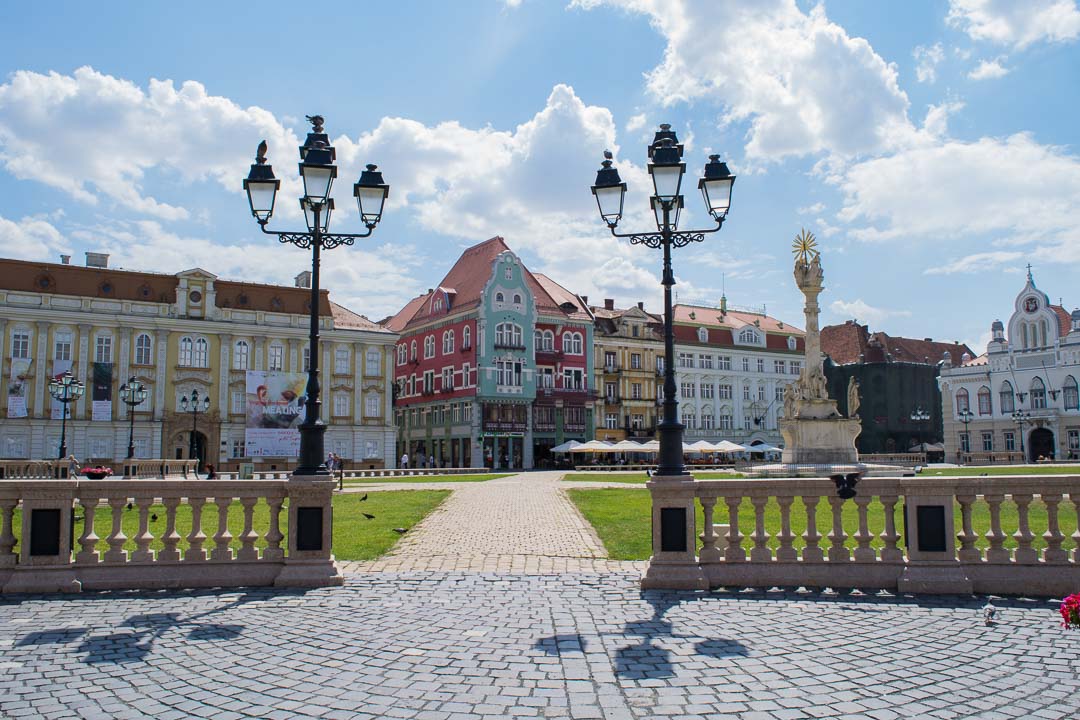
But no, that title belongs to the dazzling Piata Unirii. Right in the city centre, this large square is surrounded by the city’s most remarkable buildings, from palatial homes to churches. It appears that in recent years the square’s potential was recognised, ushering in a wave of restoration work that has transformed Piata Unirii into an unmissable pocket of Timisoara.

Of the city’s many, many art nouveau secessionist buildings, the colourful and most visually striking must be the palatial residence, Brück House. This 1910 building was only recently restored with its defined details, clearly giving the house a new lease on life. I’ve done my best to not add too many of my Timisoara photos of it, but I can’t deny I’m fascinated by it.
Also lighting up the square is the Serbian Orthodox Episcopal Palace with its pale colours and graceful architecture. The palace originally had a simple Byzantine style when first built in 1745. Later additions clearly elevated its design with laudable attention to detail. These are just two of the picturesque buildings found around Piata Unirii, but going from one to the next here would simply take too long.

Old Town Fortifications

Look at a Timisoara map and it’s hard to miss the rings of roads emanating from the circular old town.
You can plainly see where city walls once protected Timisoara, although sadly only fragments remain. On the eastern fringe of the city centre, you’ll find the Maria Theresia Bastion.
Open to the public, these immense walls give you some sense of how well Timisoara must have been defended during the Middle Ages. I guess it was quite necessary when the Ottomans kept trying to invade the city for centuries before finally seizing it.
Perhaps it was this legacy of being under siege that fuelled the city’s defiant, rebellious streak. Farther round the ring you’ll also find the city’s old castle, Castelul Huniade. Although a little worn around the edges, this 14th-century castle now hosts the Museum of Banat.
Nativity Church

Although there are other attractions throughout the city centre, an outer one worth seeing is the striking Nativity Church.
When the sunlight catches the gilded art on its facade, it’s hard not to believe in some divine inspiration for this beautiful building. Modelled on the style of a monastery, the Biserica Nașterea Maicii Domnului was built in the 1930s for the local parish. Walking past for the first time, I saw a wedding set up outside for bridal party photos.
No doubt as to why!
Travel Tips for Visiting Timisoara

Although Timisoara is located quite a distance from other popular Romanian destinations, it’s not that hard to visit the city.
Coming from other major cities in Romania such as Bucharest, it’s going to take either an all-day bus journey or overnight train trip to get there. Crossing in from neighbours Serbia and Hungary might be easier. The city’s saving grace though is that budget airlines offer domestic and international routes to Timisoara Airport.
Since Timisoara isn’t a good option for day trips, you’ll need somewhere to stay. I think two days in Timisoara works well, although you could add a day for day trips to Corvin Castle or Arad. For your stay, Timisoara has a huge range of hotels and apartments to choose from, and since my choice was frankly too far from the centre, I won’t bother sharing it.
The one thing I can recommend is the hotel/restaurant Casa del Sole, to the south of the city centre. It offered local cuisine, was reasonably priced and had a nice outdoor seating area in its internal courtyard.
To get around the city, there are trams and buses, but I didn’t manage to work the system out. I ended up walking everywhere, which would have been fine if I’d stayed more central.
if you’ve been, do you think Timisoara is worth visiting and if so, why? What other things to do in Timisoara do you think make it a good Romanian destination to visit? Please share your thoughts in the comments below.

This article is now available as a mobile app. Go to GPSmyCity to download the app for GPS-assisted travel directions to the attractions featured in this article.

16 comments
So glad you enjoyed Timisoara so much! I knew you’d like it! Wish we could have stayed longer there and explored more! Thanks David for linking up with #TheWeeklyPostcard!
Thank you for introducing me to the beautiful town of Timisoara. Despite being born and raised in Romania, I have never seen it. It’s a shame, isn’t it? I keep saying that “next time” we go back I’ll go visit Timisoara, but so far it didn’t happen. We’ll be in Romania again in September and this time I hope we’ll get there. Your post surely incited me to do it. #TheWeeklyPostcard
Well Romania is a fairly big country so I can’t blame you for not seeing it all Anda. I hope you have a great visit in September and look forward to seeing how it went.
I did look into Timisoara a little bit when I saw a cheap flight deal there from London. We ended up going to Colmar instead, but hopefully will make it there at some point. I love the architecture and the story about the revolution. I would really like to go to the museum. Thanks for sharing on #TheWeeklyPostcard
It does seem cheap flights to Timisoara pop up here and there, which can only be a good thing! I hope you make the trek over when you next get the chance Anisa.
This looks really nice! Romania sounds intriguing. #theweeklypostcard
It certainly is an intriguing country, I personally can’t wait to return. Thanks for commenting.
I must admit Romania is not on my list, but I think i have to make an exception for Timisoara. It looks lovely! Thanks for sharing #TheWeeklyPostcard
Timisoara looks far more beautiful than other cities I’ve seen in Romania. It looks like they have absolutely beautiful architecture and nice squares to enjoy it from. I think I would like to start here instead. That orthodox cathedral is really beautiful. I know that St. Basel’s is quite celebrated, but I’m starting to think these cathedrals are under appreciated for their beauty. #TheWeeklyPostcard
Probably what I love most about Timisoara is the Victoriei Square because of the beautiful flowers during summer and the colorful buildings that are very similar to some of the medieval houses still preserved in other cities. And of course, the Roses Park.
Timisoara looks like a really lovely city! Much more colorful and interesting than Vienna too. I haven’t seen such vibrant colors and interesting architecture in Vienna. The city also looks much less crowded. I hope I’ll get to see it some day!
THat looks amazing.
I love the pictures.
I had no idea Timisoara was that beautiful! That secessionist architecture is so impressive: I haven’t been to Romania yet.Would love to see Transylvania and Peles Castle: will need to add Timisoara to my route #TheWeeklyPostcard
I so love the architecture! Art Nouveau decor is so rare for these American eyes. Glad to see so much is preserved. Timisoara is on my list of places to visit when I get to Roumania.
Thank you very much for writing from the heart about Timișoara and for mentioning the Memorial of the Revolution! Wish you all the best!
Hi there,
we’ve recently returned from an 11 day road/rail trip through Transylvania from Bucharest to Brasov, then on to Sighisoara, Targu Mures, Cluj Napoca, Oradea, Timisoara, and then over the border to Belgrade before flying back to the UK via Munich. I absolutely loved Romania, the people were so welcoming and hospitable, the scenery and architecture were stunning. We were privileged enough to drop in on the Pheromonic Orchestra rehearsing for a concert in Targu Mures, and we saw a production of the ballet Giselle at the Royal Opera House in Timisoara.
At the age of 63 I still consider myself relatively young and healthy enough to enjoy travelling. Having been to Bucharest and Brasov 4 years ago, Romania holds a special place in my heart. From the majesty of the Carpathian Mountains, to Bran and Peles Castle, Rasnov Hill Fort, and the stunning Art Neuveau architecture of Oradea and Timisoara , Romania is a beautiful country to visit. Please, please, please, keep it authentic as your country open up to tourism.