
Disclosure: This post (probably) contains affiliate links. If you click on one, I may make a small commission. Of course, this will come at no extra cost to you and helps keep this site running.
For visitors, the gothic city of Brașov is a gateway into the surrounding towns of Transylvania. Brasov is a major regional hub and is quite centrally located within the Romanian region of Transylvania. It’s also close to Bucharest, the nation’s capital, making it an easy itinerary inclusion. All of this means that with day trips from Brasov, tourists have everything they could need to see this fascinating region of Romania.
Renowned for its enchanting history and wild beauty, the area around Brasov is particularly known for its magical castles. So while Brasov may hold your interest for a few days, make sure to allow time to explore its surroundings. To help, here are four such day trips from Brasov, that will allow tourists to explore Transylvania in a comfortable and easily manageable way.
Bran Castle
Let’s get this out of the way. The link between the Dracula story and Bran Castle is incredibly weak. While Stoker borrowed the castle’s name, the castle and setting in the story greatly differ from reality. The link with the real-life Vlad the Impaler is also tenuous.
At best, the ruler may have only rented the castle for a short time and there are many places in Romania that he had a closer relationship with. The castle itself does not play up its tie to the story of Dracula, surprising for a tourist attraction with a built-in hook. Within its exhibits, there is just one room related to Dracula, that aims to explain the local folklore from where Bram Stoker got some of his inspiration.
Now enough about what Bran Castle isn’t, and more about what it is!

Since the times of the Romans, the Bran Pass was a strategic point for securing this region near the Carpathian Mountains. As such, in the 14th-century Hungarian King Ludovic I de Angou decided that the locals needed to build a castle along the pass to help defend the kingdom from the Ottoman threat.
The castle passed hands frequently, between the Hungarians, Transylvanians and Wallachians, of which Vlad the Impaler was prince for a period. From the end of the 15th century onwards, the castle became the property of the city of Brașov.
As of the 18th century, it began to decline in importance and was not used to great effect until it became the summer residence of the Romanian royals, King Ferdinand and Queen Maria in 1920. When the castle was seized by the Communist regime in 1956, it was converted into a museum of medieval history and art, as it still is to this day.
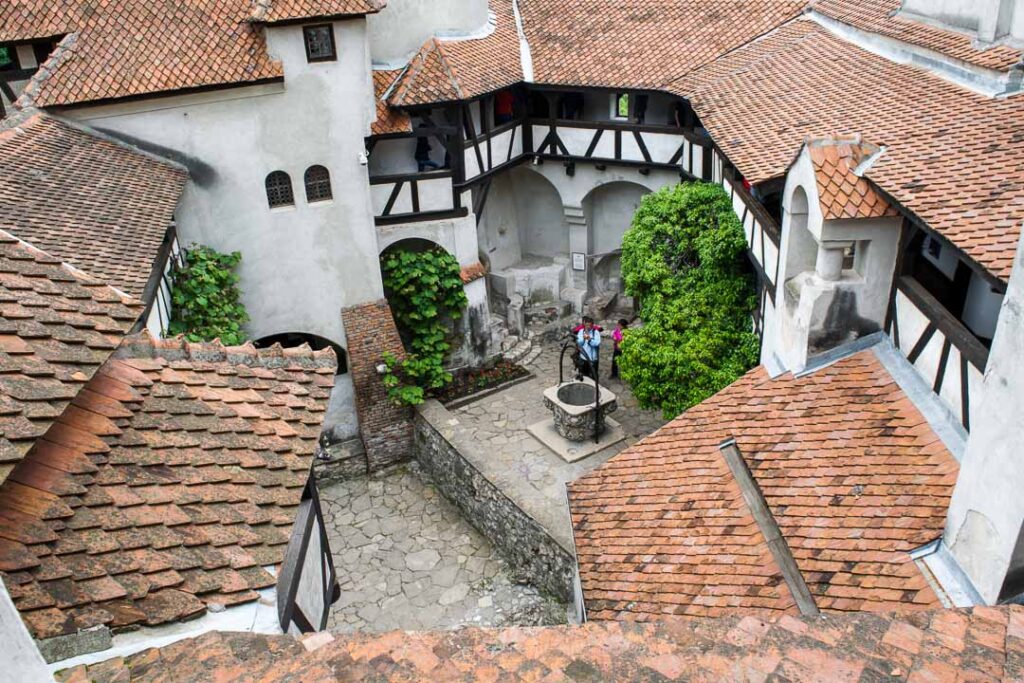
Much of the museum’s focus is on Ferdinand and Maria. Inside, displays in the rooms explore their family, their lives and how the residence looked in their day. Standout rooms include the library, with shelves of undoubtedly old books and the Music Hall with a bearskin rug and a charming German piano. Aside from seeing what the rooms and castle looked like, there is a wealth of information presented on panels in both Romanian and English.
Exploring the castle can be a disorienting experience, with many small rooms and staircases. The visit is not a linear one that’s for sure. In fact, at one point you can climb through an old secret staircase, somehow bypassing an entire floor of the castle. Still, who doesn’t think taking a secret medieval staircase is kinda cool?

Depending on your approach to museums, I can see the castle taking up roughly an hour of your time. Outside the castle, you can explore the grounds and there is also a small souvenir market directly in front of the entrance. Ultimately, the town of Bran won’t hold your interest much beyond the castle I don’t think. With an early start, you could combine this with another trip. Râșnov would make sense as it is on the way back to Brașov.
Day Trip to Bran
Entry: Tickets cost 35 RON for adults, including free photography (rare in Romania) or buy Fast Track Tickets
Getting there: Buses run hourly from Autogara 2 (not the one at the train station!) in the direction of Moeciu de Jos for 7 RON. More info here.
Tours: Given its popularity, its no surprise there are plenty of tours from Brasov that include Bran Castle.
Information: Romanian Tourism
Prejmer Fortified Church
The small town of Prejmer would not receive any visitors were it not for the town’s fortified church. As I’ve mentioned previously, this part of Transylvania hosts 7 fortified churches that together have made UNESCO’s World Heritage list due to their historical and cultural significance. Prejmer’s church is indeed one of these and the nearest to Brașov.
As with the other fortified churches and citadels in this part of Transylvania, Prejmer owes its history to the Germanic Saxon settlers of the 13th century. However, it was Teutonic Knights that began building the church in 1212 which the Cistercians later finished.
Prejmer became the largest fortified church in southeast Europe and although besieged over 50 times throughout history, was only ever taken once. The fortifications included walls 12 metres high and 5 metres thick, a 30-metre long entrance tunnel protected with an iron portcullis and a secret underground passage for supplies.
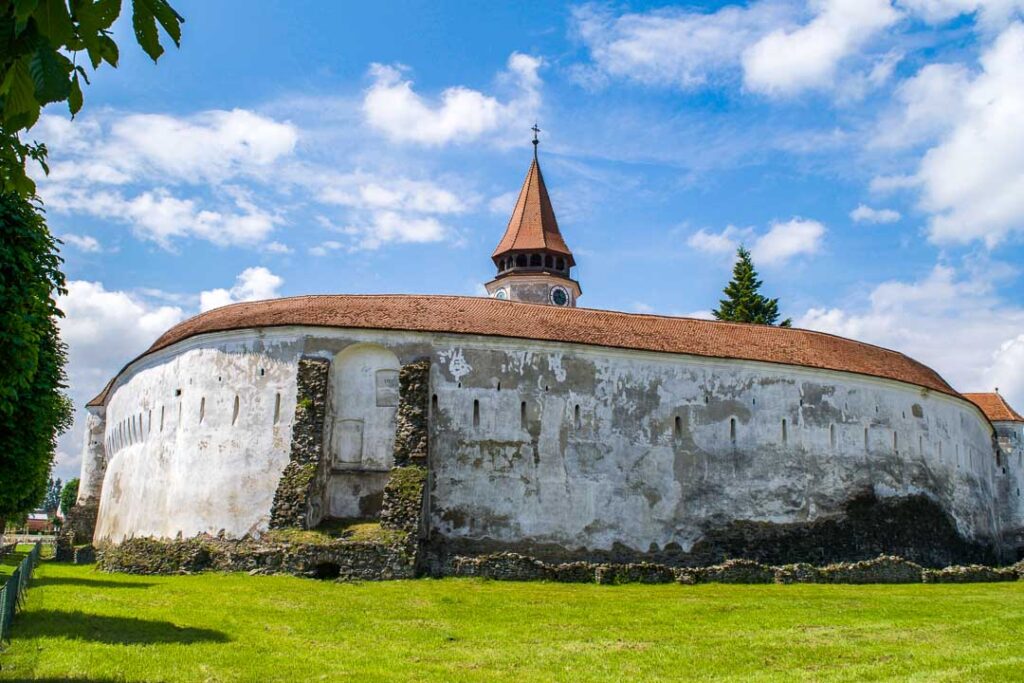
Despite its age, the fortified church has held up incredibly well against the ravages of time. One look at the big metal portcullis and you’d believe it could still hold off attackers. Then there are the rings of staircases and walkways inside the walls that still handle the foot traffic of tourists.
Around the inside of the fortified walls were four storeys full of rooms that could shelter over a thousand people during an attack. You can climb up into several of the rooms, most of which are bare. The several that are furnished give you an idea of what they would have felt like though.
Some staircases take you up into the rafters of the walls, where the defenders would have fought oncoming attacks. It’s quite dusty and claustrophobic, but it gives you a sense of the advantage the space provides. Other rooms include a small classroom with the old desks of students and fragments of paintings on the walls, and a room showing off locally painted woodwork and ceramics dating back to the 19th century.

Being a fortified “church”, I’d be remiss if I didn’t talk about the church part. The church is built in a Greek-cross plan, with the nave featuring Gothic vaulting. As it was later used by the Lutherans, it has a humble interior typical of protestant churches. The main feature of the church is its altarpiece, vividly depicting the Passion of Christ. It dates from the mid-15th century and is the oldest in the region. Make sure to also look up and admire the vaulted ceiling.
Prejmer is a very small town and one that can be quickly covered on foot. Once you have finished seeing the fortified church, you’re likely going to want to return to Brașov, but there are a couple of places to eat at if you want to break for lunch.
Day Trip to Prejmer
Entry: Tickets for adults are 10 RON
Getting there: While the train is quicker, it’s infrequent and the station is at the edge of the town. Minibuses run every half hour starting at Autogara Vest, but I was able to get onboard at Faget Bus Stop. Situated on Bulevardul Garii just east of the roundabout, it’s a more central spot. Ticket costs 5.5 RON with more info here.
Tours: A select few tours from Brasov are available that include Prejmer Church in their itinerary.
Information: Romanian Tourism
Peles Castle
When it comes to elegant, picturesque castles in Romania, Peleș Castle has to be near the top of the list. Although it doesn’t have the lengthy history of the other sights on this list, it more than makes up for it with its inspired architecture and regal extravagance.
More of a palace than a castle, Peleș was built for King Carol I and completed in 1914. Its design was inspired by a combination of influences, including hunting lodges and Germanic castles. This mix of styles meant it could meet Carol I’s desire for a unique summer retreat. Closed during the Ceauşescu regime, the Palace was reopened to the public in 1990 and is now a growing tourist attraction.
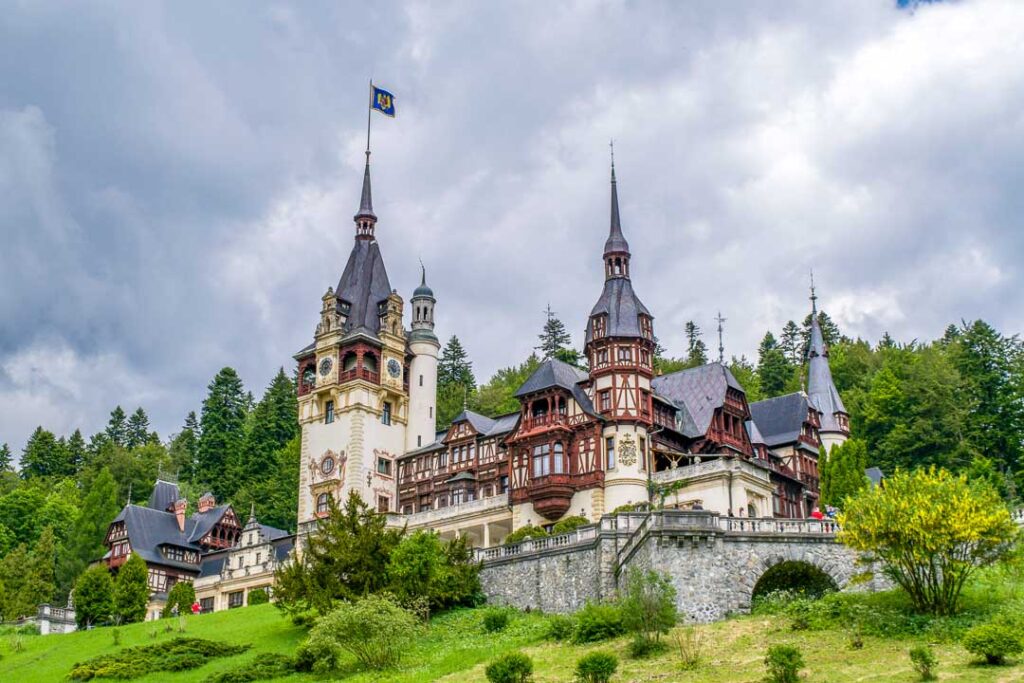
While the tours at Peleș focus on the palace’s interior, there is plenty to appreciate from the outside. For starters, the secluded palace is surrounded by forest and manicured gardens, that to this day look fit for royalty. The terrace gardens in front are very regal and a popular photo spot.
Aside from appreciating the beautiful architecture from the outside, there is also a courtyard where you buy tickets for the tours inside. This courtyard is sure to grab your attention from its classical stone busts to its gorgeous painted walls that should occupy your attention as you wait in the potentially long line to enter (I waited almost an hour to get in). Even just the windows and doors draw your attention, with intricate glasswork and ornate wrought iron protectors.
A well-known remark from Queen Elisabeth, wife to Carol I, was that they had craftsmen from all over Europe, each with a specific focus. This led to a cacophony of languages and a myriad of different attires that amused the queen, but evidently, it led to masterful results in each of the different trades.

While the outside of the castle is remarkably beautiful, the interior manages to be equally elegant. Again, they didn’t skimp on craftsmen. Room after room is adorned with gorgeous designs and lavish furnishings. Upon entering, you’ll be led upstairs to a foyer with some incredibly intricate woodwork in European walnut.
The glass roof is nothing to turn your nose up at either. Further rooms linked up by a rather regal red carpet include a well-stocked armoury, a Turkish salon and decadent residences. There are too many noteworthy details in the furnishing, windows, ceilings etc. to mention.
The basic tour of the castle includes the ground and first floor of the palace, while the complete tour includes the upper floor. Lines for the tours can be quite lengthy and unclear, while inside can be a little chaotic with multiple tours going in different languages. It feels like the castle hasn’t quite worked out the right system yet for the influx of interest it has seen.

The castle is situated above the town of Sinaia, itself known as a mountain resort. To reach Peleș from Sinaia, visitors must climb a little into the start of the Carpathian Mountains. There are two different approaches to the castle. One leads up a lovely pedestrian road through the forest to below the castle.
The other is a steep and windy road that the coaches take and brings you just above the castle. What’s interesting about that route is that you have to pass by a Bavarian-style inn/hotel which you otherwise miss. The former is certainly the more enjoyable path though.
The town of Sinaia is itself quite a nice place to explore, with plenty of beautiful green spaces and some elegant old houses. In the centre of town, you’ll find plenty of restaurants, cafes, bakeries, bars and a supermarket. If you intend to hike and explore more of the forests and mountains, Sinaia may be a useful place to stay. However, if the castle is all you’re after, then a day trip from Brasov is more than suitable.
Day Trip to Peles Castle
Entry: Starts from 20 RON for the basic tour (not including photography inside) or get a Fast Track Ticket
Getting there: Trains run roughly hourly from Brașov, in the direction of Bucharest with tickets at 13-17 RON; There are also a few buses that run in the morning from Autogara 1 to Sinaia. Tickets are 10 RON, with more info here.
Tours: Another popular sight, many tours from Brasov include Peles Castle as a stop.
Information: Romanian Tourism
Rasnov Fortress
The town of Râșnov is a bit of an outlier in this part of Transylvania. That’s because it isn’t known for a fortified church or castle, but rather its imposing hilltop fortress. This large citadel sits on the lower reaches of the Carpathian Mountains, high above Rasnov halfway between Brașov and Bran. Coupled with its extensive history and preserved buildings, visitors will find fantastic views out over the gorgeous landscape below.
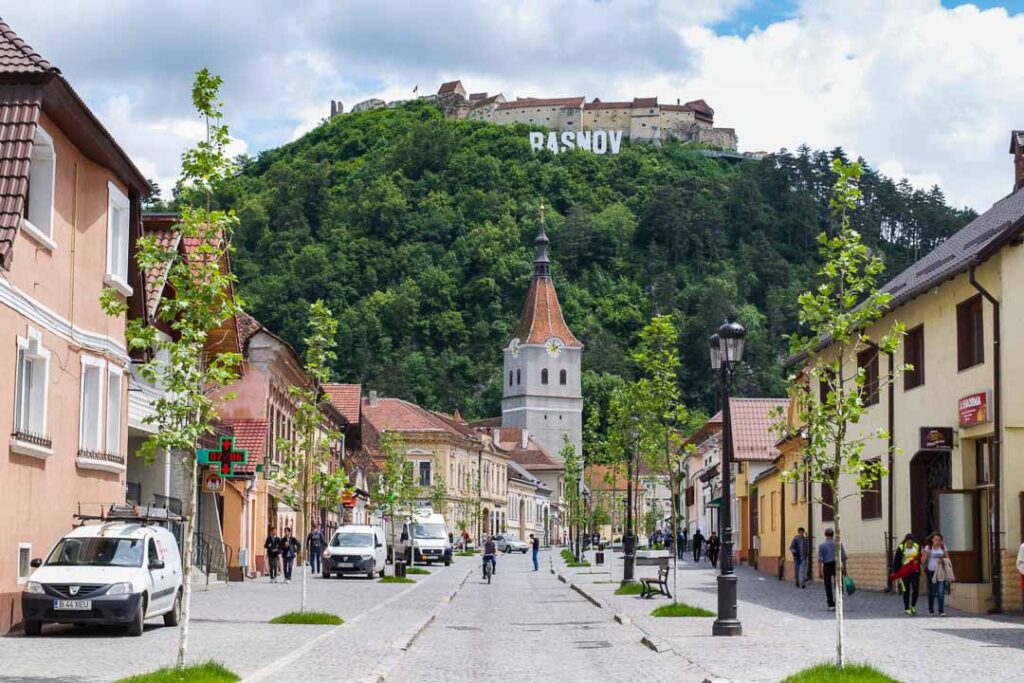
Although the strategic value of the hilltop has been known since ancient times, the current fortress dates back to the early 13th century. Built by the Teutonic Knights, it functioned primarily as a place of refuge during the repeated invasions of the Tartars and Ottomans.
These prolonged periods of invasion led people to build houses, a chapel and even a school inside the citadel. This way normal life could continue despite the situation beyond the walls. Throughout its history, the fortress was only seized once. The crucial problem then was that the secret route to its water supply was discovered, which forced the defenders’ surrender. Soon after a well was dug inside the citadel to prevent such events from reoccurring.
Surviving fires and earthquakes, the fortress was regularly used until 1850, when it provided refuge for the last time during the Hungarian struggle for independence in 1848-49. Despite neglect for 150 years, recent renovations have restored the imposing presence of this once vital stronghold. A brand new funicular has been built in the last few years to provide easier access to the growing numbers of tourists.

Arriving at the fortress gates, you’re met with the vast and mostly bare grounds within the walls. To the right of the path you’ll find rocks outlining where the citadel chapel once was, a simple and effective approach at showing you what was once there.
Climbing the gate tower, you get a sense of just how large the area is within those outer walls and understand how it could have once given refuge to multiple villages. Inside the tower, you’ll find information on various wars fought in the region and the various uniforms worn by soldiers from different periods. Further in you will reach the keep, with its narrow and maze-like streets. Here you will find some of the old houses that those seeking refuge once lived in and the ever-so-important well.
There are of course plenty of souvenir shops to browse and for the kids, a small archery range to keep them entertained. At the centre of the keep is a large rocky area by the flagpole with panoramic views of Râșnov, the mountains and plains below. It certainly makes the strategic value of the fortress crystal clear.

The town of Râșnov below, while quite large, is light on other activities. For tourists to Râșnov, the focus is very much of the fortress and a dinosaur park for children nearby. I chose to stay in Râșnov, rather than visit from Brașov, in the hopes of seeing a bit more of the region but I didn’t encounter much more.
In town, there are a decent number of options for dining and the main street has several boutique shops. There was a noticeable degree of construction going on in town which makes me believe they are hoping to cater more to tourists in the future, but for now, I’d still recommend it as just a day trip.
Day Trip to Rasnov
Entry: Tickets for adults are 10 RON
Getting there: Buses run every 15 minutes from Autogara 2 (not the one at the train station!) for 4 RON. More info here.
Tours: Rather than go it alone, you can find tours from Brasov that spend time at Rasnov Fortress among other spots.
Information: Romanian Tourism
If you were to visit Brașov Romania which of these do you think you would like to visit? Have you made any of these day trips from Brasov and are there other day trips you would recommend? Please share in the comments below.

21 comments
Lots of great options, but I’m a castle type girl, so I would choose Bran Castle and Peles Castle. All sound like interesting options. I appreciate you laying out all the details here, hope to be able to visit this area soon!
I’m a big fan of castles too Anisa, so I don’t blame you. Hope you find this helpful if you get a chance to visit one day
Peles Castle looks incredible. I’d love to visit Romania? A great post!
Thanks Laura, I’d recommend visiting both Romania and Peles.
I’m DYING to visit Peleș Castle!!! #TheWeeklyPostcard
The castles look amazing. Def some
For our list #theweeklypostcard
All four look interesting (Transylvania is such a beautiful region!) but if I could only pick one, I’d go for Peles Castle I think. I hate queuing up though (a one-hour queue like you did is just about at the limits of my patience), so I might go somewhere else haha. They all look good!
It’s a good pick Michelle. Not a fan of queueing either, but I believe I went at a really busy time. I had read that sometimes you need to knock on the front door because there isn’t anyone else about.
Oooo I love a good castle, even more so when there is a fascinating historical tale behind it! My favourites are Bran Castle and Peles Castle for sure but you’re right, the latter is more like a palace – splended architecture! Thanks for sharing! #TheWeeklyPostcard #FeetDoTravel 🙂
Well there’s always some good stories in this part of the world. Definitely more of a palace. Thanks for reading Angie.
These castles are just lovely! Romania has been on our list – I think Id rather venture around and see this type of stuff as I tend to be less of a city girl! #TheWeeklyPostcard
Thanks for reading Elizabeth. I can understand wanting to venture around, but you may find Brasov quite nice as it has parts that don’t feel like cities at all.
Great to see lovely posts about my country.
Well, there’s a lot of great things to see in your country Bican. Thanks for reading.
I’m happy to see such a detailed post about my country. 😀 Next time, you should check out the fortress of Fagaras or, if you have a car, the Bucura village, you won’t regret it 😉 Are you planning on coming back to Romania? #TheWeeklyPostcard
I’m glad you like the post Vlad. I really enjoyed my time and would love to return, just not sure when. Thanks for the suggestions, it’s good to know of some other places to visit.
Stunning photos David. Would love to visit this place – I’ve just pinned to my Pinterest Board for later
Love Reading this! I was in Romania this summer teaching English and on our last weekend we stayed in Brasov and visited Peles Castle, Bran Castle and the Roasnov Fortress! (Also Sighisoara was lovely!) Romania is definitely one of my favourite countries!
Thanks Chiera, glad to you visited the same places I did and enjoyed them too. Sighisoara is lovely I agree. I’m sure I will be returning to see more of Romania, there’s a lot to love.
Four great places to go, David – love your photos. Can I recommend Magura village and the Piatra Craiului national park for anyone who wants a little piece of natural paradise, and a day or two of perfect peace? Magura is one of the 9 villages of Bran, whose men built the castle in the 1370s: life here has been going on in much the same way for almost 1,000 years, but it is changing fast, so come and see it before the 21st century encroaches too far. Lots of photos here: https://maguratransylvania.com/photo-galleries/a-year-in-photos/
Hi David,
It’s always nice to read such kind words about my country.
There are a few things I’d add to the article. Regarding Bran Castle, I highly recommend visiting the nearby Bran National Museum. It’s just across the park, the entrance fee is very cheap and you have the chance to see fascinating exhibits that were once inside the castle: stunning furniture, weapons, clothing and several objects.
And finally, about Peles Castle, I am surprised to see that you mentioned the extended tour. This is often overlooked by guides or tour companies for an unknown reason… also, it’s totally worth paying the photo tax!
Here is a list of things to do in Brasov. If you want, you can add some to your post https://outdoorholidays.eu/blog/top-things-to-do-brasov-romania/