
Disclosure: This post (probably) contains affiliate links. If you click on one, I may make a small commission. Of course, this will come at no extra cost to you and helps keep this site running.
Repeatedly lauded as the world’s most liveable city, Vienna has a lot going for it. I’d say that one of the many factors that earn Vienna this title is the city’s exceptional public transport network. Among the many cities I’ve visited throughout the world, I rank the network as one of the best I’ve seen. It simply ticks all the boxes: reliable, safe, clean and easy to use. So for tourists visiting the Austrian capital, Vienna public transport is how you should get around.
Given Vienna’s size, it’s usually not convenient to simply walk everywhere and you’ll be exhausted if you try. With so much to see around the city of Vienna, it helps if you make the most of the city’s excellent public transport. Also, while it’s nice to stay right in the Inner Stadt, Vienna’s city centre, it’s not always possible because of availability or cost. But even if you stay in one of the districts further out, it’s easy to get back into the city centre using Vienna public transport.
After spending so much time in Vienna, I thought I’d put together a guide to the city’s public transport. Hopefully, with the information and tips inside, you’ll be able to make the most of it when sightseeing in Vienna.
Quick Vienna Public Transport Guide
| Location | Transit Line | Station/Platform |
| Vienna Hauptbahnhof | U1 Metro | Südtiroler Platz |
| Vienna Bus Station | U3 Metro | Erdberg |
| Schönbrunn Palace | U4 Metro | Schönbrunn |
| Old Town Centre | U1 or U3 Metro | Stephansplatz |
| Prater Ferris Wheel | U1 or U2 Metro | Praterstern |
Vienna Public Transportation App
Each form of transport has its maps and routes that you can find at stops or online. However, the easiest way to navigate all of Vienna’s public transport is to get the A Nach B app. Simply put in your location and destination and it shows you all the different ways to get there. In my experience, this is the ultimate planning tool for getting around Vienna. I have learned that there is another app also worth using called Qando.
Vienna Ticket Types

As with public transport networks the world over, you’ll find all sorts of different tickets available for purchase. Which ticket is right for you will depend on how frequently you plan on using the buses, metro and trams. I have to say, there is a level of freedom to having a longer ticket as you can just jump on public transport whenever you feel like it.
The most basic ticket type is a single-trip ticket for €2.4. As it is described, this ticket is for “one uninterrupted journey” in “one direction” with as many changes as needed. You can also get tickets that are valid for 24, 48 and 72 hours from the first time the ticket is validated. Even longer tickets include the 7-day and 31-day tickets, plus an annual ticket if say, you’re moving to the city.
Various Vienna city cards, like the “Vienna City Card“, “EASY CityPass Vienna” and “QUEER CityPass Vienna” include free use of Vienna’s public transport network. These cards include either discounts or entry to various places as well as use of the metro, trams and buses.
Also worth knowing is that Vienna’s public transport network is divided into zones. If you’re only travelling around the city centre and out to places like the Belvedere Palace, Prater and Donau Insel, then that is all part of the Core Vienna Zone.
You’ll need to pay more for tickets that head out to areas like the Vienna International Airport or into the outskirts like Baden bei Wien. Use the A Nach B app to calculate fares as I’ve yet to find any better information since the zones changed.
The U-Bahn / Underground

Both my favourite way to quickly get about Vienna and the most useful, the Vienna U-Bahn is the city’s underground metro network. It takes you right across the city limits of Vienna and is a reliable, easy-to-use system.
Made up of 5 different metro lines, the U-Bahn is great for sightseeing and getting from A to B. You won’t want to miss some of the older stations either as the open-air ones can be kind of pretty.
During peak hour, you’ll find that U-Bahn trains run with great frequency, roughly every two or three minutes. The thing is, even at their least frequent rates like on weekends and late at night, you shouldn’t be waiting more than seven minutes.
To get down to platforms, stations are generally equipped with escalators and lifts and are pretty good in terms of accessibility. However, because of how much the stations are used, always count on at least one escalator being closed for maintenance.
Within the heart of Vienna, 7 U-Bahn stations are very handy to know because they sit at the intersection of at least two different underground lines. That means that by connecting through two of them, you can practically reach any underground station in Vienna.
They are Stephansplatz, Volkstheater, Schottenring, Praterstern, Schwedenplatz, Landstraße and Karlsplatz, the only one where three lines meet. Each of them is very useful when sightseeing as they lie near so many of Vienna’s attractions.
As for U-Bahn etiquette, there are some things you should know:
- Always wait to the side of the doors as you let people disembark from the train before getting on yourself.
- When your stop is next, move to the doors before you arrive at the platform so as to not hold others up.
- Don’t be too loud, or noisy or take up more space than you need.
- Much like Vienna in general, people act conservatively and follow strict habits when travelling on the U-Bahn, so try to fit in.
Vienna Trams
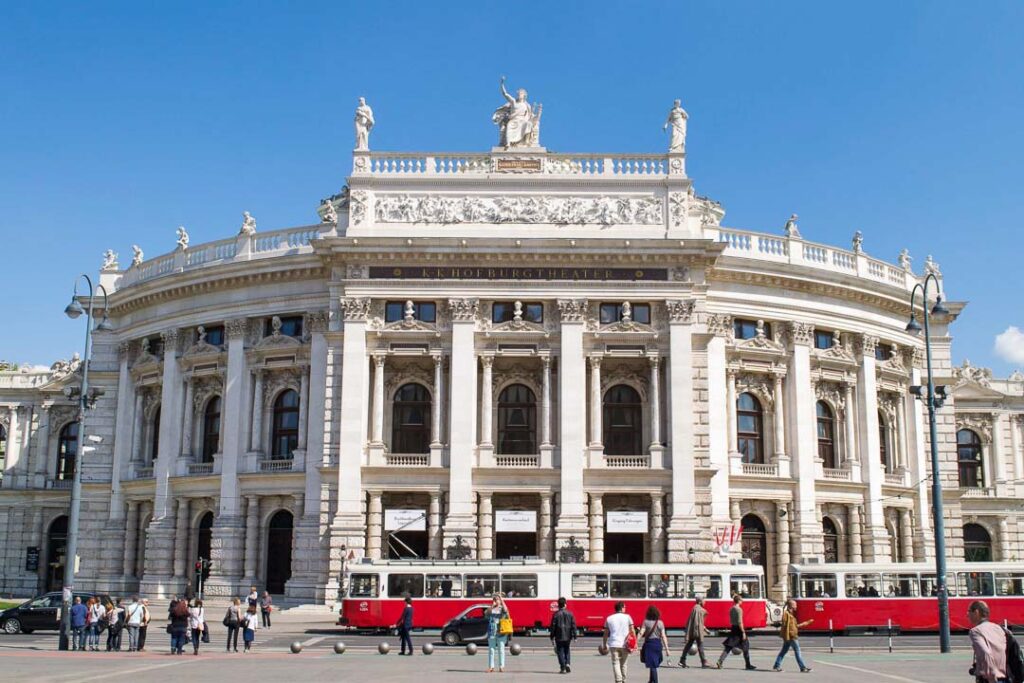
Depending on the route, there are times when the metro isn’t the best choice. That’s where the Vienna tram network comes into play. Working their way through much of the city centre, Vienna’s trams can be great for sightseeing in the city centre. They connect landmarks in a different way to the U-Bahn and can cut down on how much walking you do in that part of the city.
Three tram lines in Vienna are particularly useful for tourists to know, the 1, 2 and D trams. You see, the 1 and 2 together form a loop around Vienna’s Inner Stadt along the city’s ring road. The 1 takes you around the north-western side, while the 2 covers the south-eastern. There is a complete Vienna Ring Tram, although it is a special sightseeing tram that requires a special €9 ticket!
Finally, the D tram can take you from the Vienna Rathaus, past the Opera House up to the Belvedere Palace. It’s ideal for getting from one attraction to the next.
Lastly, unlike other forms of public transport, it is possible to buy a ticket from a machine on board the tram. Instead of the usual €2.4 single trip ticket, these tickets cost €2.6, last I checked.
Vienna Buses
Even with all the city’s public transport that I’ve used, I’ve barely taken any of the local Vienna buses. That’s because the U-Bahn and trams do such a great job at connecting the busiest parts of the city.
When I took the bus in Vienna, it was to reach places around the Vienna outskirts or in distinctly non-residential areas. For instance, if you want to head the vineyards around Grinzing or up into the hills of Kahlenberg, then you’ll want the bus. However, for the central districts of the city, taking the bus is rarely necessary.
Getting to Vienna Airport
Much like the city’s U-Bahn, Vienna is also home to a regional metro network, connecting the city with neighbouring towns and villages. There are only a handful of situations where you could find yourself needing the S-Bahn. Most of the time in Vienna, you should be able to make do with the U-Bahn and for day trips outside the city, you’ll be using the Intercity (IC) or Railjet (RJ) trains.
For the S-Bahn, the main scenario where you would use it is going to and from Vienna airport. The S7 train runs from Wien Mitte out to the airport every half hour. Very similarly, there is a Railjet train that connects Vienna Hauptbahnhof with the airport.
Other than the timing and where you take them from, these trains are the same in terms of journey and cost. Since the airport is beyond the city centre, you need to buy a €4.2 ticket. Generally, these trains are reliable and make the trip out to the airport quite a gentle one.
City Airport Train (CAT)

Besides taking the S-Bahn to Vienna International Airport, there is another train you can take, the Vienna CAT. Standing for City Airport Train, this is a special express train that connects the airport with the city centre. With the CAT, you can reach the Wien Mitte train station in 16 minutes and then use the U-Bahn to get around the city from there. But there’s a catch.
The CAT is not part of the regular public transport network and so requires its own ticket. A one-way ticket costs €14.90 in 2024, compared to the €4.2 S-Bahn ticket. What’s more, once you arrive at Wien Mitte, you may still need to buy a €2.4 ticket to use the U-Bahn, making it cost even more.
As for time saved taking the CAT, it’s only marginally faster than the RJ trains and even the S7 train only takes 23 minutes. In the end, the biggest selling points for the CAT are its simplicity and the time saved if you’re truly in a rush.
What’s most annoying to me about this service is how heavily it’s advertised within the arrivals terminal at Vienna Airport. It’s very easy to find kiosks inside the airport to buy CAT tickets and I’m sure many people get lured in by them.
Chances are people don’t realise it’s not the only train option and impulsively reach for the first option open to them. I’m not saying there isn’t a scenario to take the CAT, only that it isn’t the best option for most people.
Have you ever used Vienna public transportation before? Did you enjoy using it and what advice would you give to others visiting Vienna? Please share your thoughts and questions in the comments below.

This article is now available as a mobile app. Go to GPSmyCity to download the app for GPS-assisted travel directions to the attractions featured in this article.

1 comment
Honestly couldn’t agree more that they are reliable, clean and safe! I do quite enjoy them!