Disclosure: This post (probably) contains affiliate links. If you click on one, I may make a small commission. Of course, this will come at no extra cost to you and helps keep this site running.
The South of France is the region that keeps on giving, thanks to towns like Narbonne. Just back from France’s Mediterranean coast, the town is another gem in Occitanie that’s not yet overrun by tourists. And it’s not like there aren’t plenty of sights to see in Narbonne either. Much like the nearby town of Beziers, it has quite a few cultural and historical landmarks to its name.
Whether travelling through Occitanie or heading down to Spain, Narbonne is a natural stopping point for tourists. It lies at a crossroads between larger French cities and isn’t all that far from the Spanish border. This means you can easily add one day in Narbonne, or even two, to your France itinerary.
What’s great is that if you spend enough time in the town, you’ll find many more things to do in Narbonne than those below. This is a quick guide to what to see in Narbonne to help you see why I liked this town so much and why there’s no doubt that Narbonne is worth visiting.
Canal de la Robine

When visiting Narbonne, one sight you really can’t avoid is the Canal de la Robine. It carves through the heart of the town after all. Because of where my Airbnb was, I would follow the canal into the town. It made for a gentle place to walk, flanked by trees and full of boats.
But it’s definitely at its most pretty when you get to the eastern edge of the Old Town as you can see below. There you can walk down the Cours Mirabeau, the waterfront promenade that provides some of the best scenery in town. It’s the kind of scenery that instantly establishes Narbonne as one of the prettiest towns in France that I’ve been.

Place de l’Hôtel de Ville

Main squares are always a big deal in Europe and the Place de l’Hôtel de Ville in Narbonne is no exception. This square is the hub of life in the town in so many ways. On or near the square you’ll find many of the main sights of Narbonne. There are even the uncovered remains of the first Roman road through Gaul, the Via Domitia, submerged in the middle of the square.
You then have the Rue Jean Jaurès running through the square, which is one of the busier streets here. A block back from it you have the Canal de la Robine, to say nothing of all the cafes and restaurants on the square itself. Place de l’Hôtel de Ville was also where I saw a special procession taking place, with people draped in ceremonial robes.

Palais des Archevêques

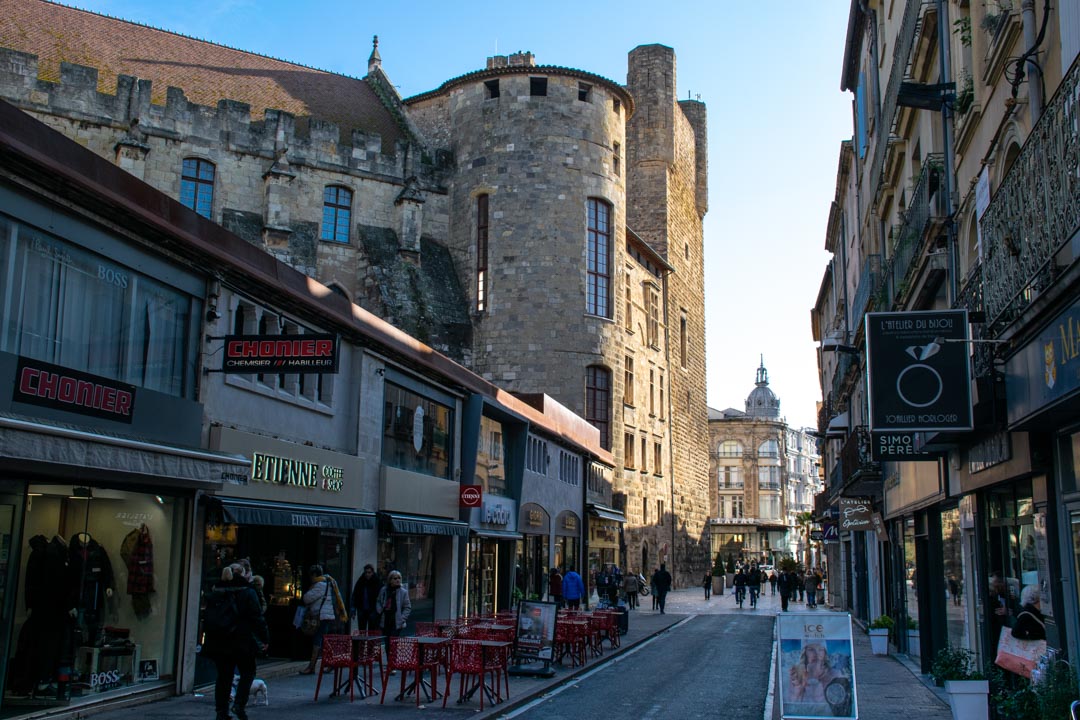
But for all the things on the main square of Narbonne, few compete with the Palais des Archevêques. Translated into English as the Palace of the Archbishops, it’s more of a motley, but impressive, cluster of buildings. Running from left to right you have the Gilles Aycelin Keep, the Hôtel de Ville or Town Hall and the Tour Saint-Martial. It’s remarkable that even with three buildings with different styles, Palais des Archevêques is quite a compelling sight.
And I don’t just mean starting at it from the main square. You can venture down the side alley into its inner courtyard or rear Archbishop’s Garden and it just keeps on impressing. There are also two internal parts of the palace, the Palais Neuf and Palais Vieux. Each has its own museum, the Museum of Art and History of Narbonne and the Museum of Archaeology respectively.
Unfortunately, the Museum of Archaeology was in the process of moving to a new building during my visit. Still, there’s quite a lot to see inside the Museum of Art and History of Narbonne, from the grand Archbishop’s Dining Room to its collections of art and ceramics.

But for me, the real highlight was the 14th century keep’s tower views. Up there you get a wonderful vantage point to admire Narbonne. Not only do you get to see the canals and Narbonne Cathedral much easier, but it makes clear how small the town is. In my mind, it was much larger before getting up there.
Narbonne Cathedral

Unfinished historic buildings often have a strange allure to them which is part of what makes the Narbonne Cathedral so memorable. Despite its massive size, only the apse of this 14th-century cathedral was completed. Head to where the nave should be and you’ll find gigantic columns and supports on the exterior of the building. It just looks like the skeleton of what the rest of the cathedral may have looked like.
To enter the cathedral, I recommend entering through the Saint Justus Cloister on its south side. It’s a classic medieval cloister, with pristine gardens and ornate arcades. Head through a door and you’re into the cathedral interior and its odd dimensions.

The floor plan feels quite small since the building is unfinished and yet the high ceiling still makes it feel cavernous. Finally, there’s the treasury, with all sorts of artefacts, including a complete ivory book panel. As with the Palais des Archevêques, this attraction is not to be missed when you visit Narbonne.
Old Town Streets

Of course, one of the best things to do in Narbonne is to simply walk around its historical centre. Meandering about you’ll spot cute little squares, plenty of old churches and some lovely street scenes. Make sure you explore both sides of the canal as well, as there is a subtle difference in character. This is also the best way to find places for dinner later, by seeing what takes your fancy.
Wonderful Street Art

Wandering around the Narbonne Old Town, I came across this awesome street art on Place de Verdun. It’s immediately intriguing thanks to its fractured style and muted colours, even if any context was lost on me. It wasn’t the only piece of street art I saw in the town either, but it was the most memorable.
Roman Granary Museum

Known as the Roman Horreum, this small museum offers up Narbonne’s only remaining structure from its Roman days. The museum is built over a series of underground tunnels that were used for storage, similar to a granary.
At street level, the museum has items and artefacts discovered from Narbonne’s past. But descend a staircase and you can wander these cold stone galleries and see how they were used. Measuring up to 50 metres in its west wing, it’s noteworthy that these tunnels from the 1st century BC have managed to survive this long.
Pont des Marchands

Finding our way back into the middle of Narbonne we have the Pont des Marchands over the town’s canal. This merchant’s bridge is lined with houses on its outside and a shopping street on its inside. The idea of people living on a bridge always fascinates me when I see these bridges, like the Ponte Vecchio of Florence or the Krämerbrücke of Erfurt. Honestly, walking down its street you don’t even realise it’s a bridge until you loop around.
Les Halles de Narbonne

Dating back a hundred years, Les Halles de Narbonne is where you’ll find the local Narbonne market. Inside this bustling area, all sorts of local and Mediterranean produce is for sale. If you’re after your French cheese, this is where to go. But you’ll also find spices, fruit, meat, olives and more in the many market stalls. The building itself is also quite nice, thanks to its windows covered in old photographs and highly ornate architecture.
Travel Tips for Visiting Narbonne

If you’re travelling in the South of France or heading to northern Spain, visiting Narbonne couldn’t be easier. The town is right near Beziers and Perpignan but also has great connections to bigger destinations like Toulouse and Montpellier. Getting to Narbonne by train is the easiest option, but you may find the occasional bus that also works.
When you visit Narbonne, you could either visit as a day trip from Perpignan and Beziers or spend a day or two there. I recommend staying overnight because it is a comfortable place to spend time in. As I keep saying, Airbnb is my first choice for affordable accommodation in France. However, there are plenty of proper places to stay in Narbonne if you need.
Would you ever like to visit Narbonne France? Is this the kind of scenery that you’d expect from a town in the South of France? Please share your thoughts in the comments below.

This article is now available as a mobile app. Go to GPSmyCity to download the app for GPS-assisted travel directions to the attractions featured in this article.
