Disclosure: This post (probably) contains affiliate links. If you click on one, I may make a small commission. Of course, this will come at no extra cost to you and helps keep this site running.
Germany may seem like the kind of country where you’ve already heard about all its most interesting destinations. But unless you’ve heard of Erfurt, you haven’t yet. Erfurt is the perfect example of a smaller German city loaded with character that doesn’t receive much notice. Despite being the state capital of Thuringia and conveniently located in central Germany, the idea of visiting Erfurt doesn’t seem to be a common one. Perhaps an Erfurt guide like this will help.
Coming from eastern Germany as I travelled across the country recently, Erfurt seemed like a natural fit. A little research later and I decided to give it a shot. I had no idea just how good of a choice I’d made at that point. Two days in Erfurt sightseeing and I didn’t come close to finishing the list of things to do there.
Even rather grey and gloomy weather didn’t dampen my enthusiasm for the city. So to help you find all the best places to visit in Erfurt, I’ve put together this Erfurt sightseeing guide. Looking through, you should be able to see just how much there is to do in this fantastic German city.
City of Erfurt

So, what do you need to know about Erfurt? Unlike places like Berlin and Munich, chances are you’re not all that familiar with it yet. Perhaps the greatest selling point of Erfurt is that it has one of the best preserved medieval old towns in all of Germany. If you like old-fashioned buildings, you’re in luck. Many of the historic houses in the city are named, with buildings like the “Haus zum Guldenen Stern” and “Haus zum Schwarzen Horn” both dating from the 15th century.
In fact, many of the best things to do in Erfurt relate to the city’s history and culture. As a state capital, it makes sense that the city would be a cultural hub, explaining why it’s home to many different museums and art galleries. Then there are the countless shopping areas, not to mention the weekend markets that fill different squares.
What’s nice is that most of the other tourists doing this will be Germans themselves. This means that Erfurt will feel genuine and untouched in a way that is often hard to find in parts of somewhere like Berlin.
Krämerbrücke Bridge

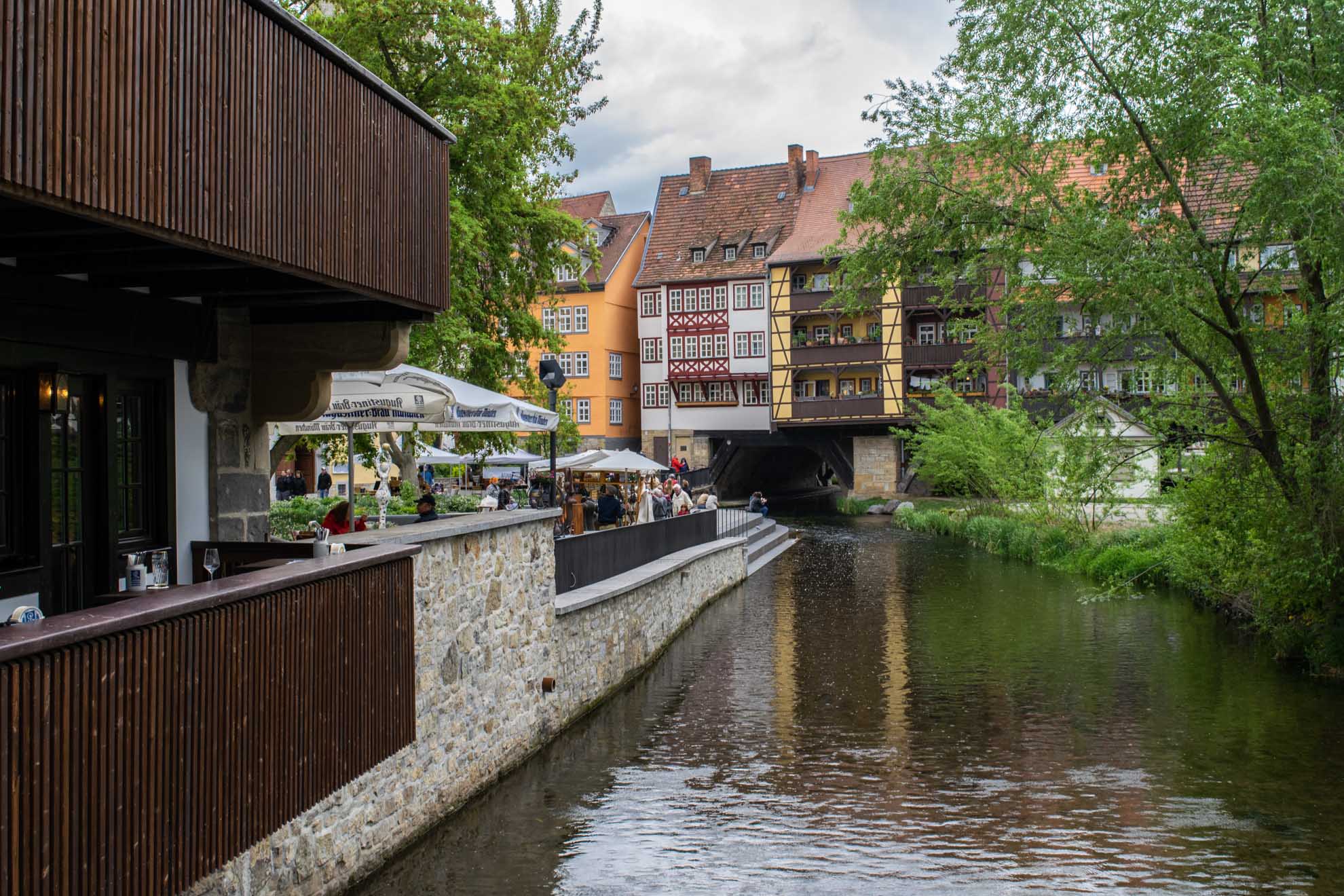
There’s no better place to start when visiting Erfurt than with the wonderful Krämerbrücke. An iconic sight of the city, this merchant bridge is reason to come all on its own. The Krämerbrücke is Europe’s longest bridge covered in houses, many of which people still live in to this day.
The current stone bridge was originally built in 1325 and expanded in 1472 after a fire. Originally there were 62 narrow merchant houses along the bridge, but over time houses were merged. Now some of the 32 remain houses actually have multiple entrances to them. Once you’ve walked along the cobblestone street that spans the bridge, you really need to come around to the small square north of it. It’s here that you’re treated to a full view of the bridge in all its glory.
At one end of the Krämerbrücke lies the Ägidienkirche church, who’s belltower you can climb for views of the old town. Nearby you’ll also find the remains of Erfurt’s medieval mikveh, a ritual bath used by the city’s Jewish community.
Gera Riverfront

One of Erfurt’s most defining features is the Gera river that flows through the city. Although not a major river, the Gera does grant the city a beautiful riverfront. The Krämerbrücke may be the most popular landmark along the river, but it’s worth taking a stroll along other parts as well.
The area by the river northwest of the iconic bridge is particularly beautiful. It’s here that you’ll see many restored traditional houses among lush trees overlooking the river. If you’re a fan of bridges, the Gera is also a good spot to visit with countless crossing its gentle stream.
Fischmarkt Square

For the heart of city life in Erfurt you need to head to the city’s main square, the Fischmarkt. Lined with traditional burghers’ houses, it really is one of the most splendid sights in Erfurt. It’s also one of the busiest places in the city, especially on market days. But even with crowds of people and trams rolling through, the Fischmarkt maintains its charm without issue.
What’s interesting about this main square is that the City Hall is greatly overshadowed by other buildings here. Among the beautiful buildings on Fischmarkt, “Zum Breiten Herd” and the Gildehaus next door are fascinating to look at thanks to the friezes on their facade. The “Zum roten Ochsen” house is no slouch, home to the Kunsthalle Erfurt art gallery that we’ll cover later.
Old Synagogue

Credit: Erfurt Tourismus und Marketing GmbH/ Photo: Vasiliy Dolzhansky
While it may have been lost to the world for a while, you need to find your way to the Old Synagogue of Erfurt. A visit here not only shows you this historic building but reveals the short-lived history of the Jewish community here. Records indicate that the Old Synagogue has been around since the 11th century. The current look of the building though comes work done in around 1270. Still, it remains one of the oldest synagogues in all of Europe.
With the Jewish Quarter squarely in the centre of the city, it was an integral part of city life in Erfurt. That coexistence between Christian and Jewish communities ended when the Black Plague hit Europe. Jewish communities across Europe were blamed and on 21 March 1349 the entire community was murdered. The Old Synagogue then passed through various owners and at one time was an inn with an upstairs ballroom.
As Erfurt developed, houses built up around the building and it was eventually just forgotten. Only in the 1980s was it rediscovered and restored and since 2009 has been a city museum recounting what Jewish life was like in Erfurt. The museum today takes you through this history and exhibits medieval Jewish manuscripts and treasures found in 1998 during excavations in the old Jewish Quarter.
Kirchgasse

Sometimes it’s nice to just walk along a pretty and quiet street and admire the houses. While you probably won’t find Krämerbrücke empty, Kirchgasse is another story. This small, yet atmospheric side-street runs along behind the Augustinian Monastery and is lined with beautiful half-timbered houses. With some covered in ivy and others recently repainted, it’s further proof that Erfurt has a fantastic old town that needs exploring.
Erfurt Cathedral

Of all the landmarks in Erfurt, I don’t think any quite have the gravitas of Erfurt Cathedal. This immense cathedral and the Church of St Severus next door form a figure that is hard to miss. Together they share the aptly named Cathedral Hill and overlook the wide-open Domplatz below. With their Gothic design and collection of spires, the pair create an iconic part of Erfurt’s skyline.
As nice as the Krämerbrücke is, it was the sight of Erfurt Cathedal that really dazzled me. I’m sure photographers spend countless hours capturing this attraction from every angle imaginable. My timing could have been better as there was a car show being held in Domplatz which obscured the view a bit. Not obscured though was the cathedral interior. It’s just as astonishing inside thanks to the elaborate altar and details on the wooden choir stalls.
Petersberg Citadel

Just as the spires of Cathedral Hill are hard to miss, so too is the imposing figure of the Petersberg Citadel. Sitting on another hilltop across from the Cathedral, the fortress has long protected to the city of Erfurt. Not only is it one of the largest fortress complexes in Europe, but also one of the best preserved Baroque city fortresses. That’s despite Napoleon capturing the citadel and the Prussians in-turn attacking it.
The main reason to the make the walk up to the citadel is for the city views there. As impressive as it is to walk through the outer walls and gates, that view of the city is where the magic is. The fortress’ panoramic terrace looks directly down on Domplatz and out over Erfurt’s sea of rooftops. While it is possible to roam the fortress grounds and follows its ramparts, this is definitely the first thing to do up here.

Andreasstraße Memorial and Educational Site

Just below the citadel you’ll find the Andreasstraße Memorial, one of Erfurt’s most detailed museums. Housed inside the city’s former Stasi headquarters, Andreasstraße both honours those who suffered under the secret police and shows visitors what life was like at the time. While I also visited a similar museum in Leipzig, I felt far more informed after my visit to Andreasstraße.
The museum is broken up into three themes with one per level: Imprisonment, Dictatorship and Revolution. Each theme takes you through a different stage of the communist era, with the tour culminating in the uprisings of 1989/90. For English speakers, it’s best to go with one of the audio guides there as they’re highly detailed.

The displays here are a great mix of audiovisual displays, rooms and items so that you get a very interactive and well-rounded experience. Being able to walk down between the untouched prison cells is certainly an unnerving feeling. Don’t miss the highly artistic “Cube of the peaceful revolution” installation in the courtyard either.
I probably would have spent more time here if I didn’t have other places to visit. For me, this may have been one of the best things to do in Erfurt while I was there.
Kunsthalle Erfurt

Modern art galleries aren’t always my thing. I often have a hard time working out what I’m meant to take away from the art they have on display. But when they’re as strange and quirky as some of the exhibits at the Kunsthalle Erfurt, it’s hard not to be drawn in.
As the art gallery focuses on temporary exhibits, there’s no telling what will be on when you visit but it’s worth a look nonetheless. For me, I experienced everything from short films to mammoth installations and plenty of surreal pieces in between.
Angermuseum

At the far more traditional end of the spectrum is Erfurt’s main art museum, the Angermuseum. Housed inside a palatial baroque building, if offers a variety of exhibits. It’s the kind of museum that seems to grow and grow in size the longer you’re there. The ground floor has quite a significant medieval collection, with plenty of historical artifacts and stunning cabinetry like seen above.
Upstairs, there is a picture gallery dedicated to landscapes and still life paintings. Tucked around a corner you’ll also find a densely filled exhibit of ceramics, metalwork and other finely crafted items. The temporary exhibit at the time focused on female artists of the Bauhaus era, something I was totally unfamiliar with. Still, another museum with considerable depth and few other tourists there.
The Anger

Despite being the first place I explored during my visit, I’ve left the Anger shopping street to last. Running 500 metres right up to the Angerbrunnen fountain, the Anger feels like the heart of Erfurt’s downtown. While there are plenty of shops that may interest some, it also boasts quite a few art nouveau facades. That combination of shopping and architecture mean the Anger is worth visiting regardless of which appeals to you.
Erfurt Travelcard

One of the best bits of advice I can give those visiting Erfurt is to get the Erfurt Travelcard. Erfurt has two options of a city card for tourists, the Erfurt Card and Erfurt Travelcard.
Both cards give you free access to the city’s museums and landmarks, including the Old Synagogue, Angermuseum and Andreasstraße. The big difference is that the Erfurt Travelcard includes free public transport for the 48 hours the cards are valid. Almost guaranteed to save you money if you do three or more of the main attractions.
Visiting Erfurt

Beyond sightseeing in Erfurt, there are a handful of other things worth knowing before you go. One that’s always useful regards making your way there. Your best options for reaching Erfurt by public transport are either by train or with Flixbus. Nearby cities that make sense to come from include Leipzig, Berlin, Dresden and Frankfurt. None are all that far, but Leipzig is so close you could possible visit Erfurt as a day trip.
The other accommodation thing to think about is where to stay in Erfurt during your trip. You don’t want to stay far from the historical centre if you can help it, although there are always local buses and trams. Erfurt has a nice selection of hotels and apartments which will give you options. From my experience there, the Radisson Blu Hotel Erfurt is a safe choice too.
For more advice on sightseeing around Erfurt, I really recommend visiting the Tourist Information Office. Not only can they help with seeing the city, but you can rent an audio guide there as well.
Were you surprised to learn about of these best places to visit in Erfurt? Where would you start when sightseeing in Erfurt? Please share your thoughts in the comments below.
*Disclosure: I received an Erfurt City Card and a night’s accommodation courtesy of Erfurt Tourism. As always, opinions are completely and genuinely my own.

This article is now available as a mobile app. Go to GPSmyCity to download the app for GPS-assisted travel directions to the attractions featured in this article.

1 comment
Germany has plenty of smaller towns with Mediaeval and Renaissance buildings still intact or lovingly reconstructed. In case you’re still in the area, try Goslar and Quedlinburg. Lübeck at the Baltic Sea is also charming, with a lot of northern German Mediaeval brick architecture. In case you have Hamburg on the initerary – and you should – it’s not far to Lübeck by train.
More to the south are Nuremberg and Bamberg. If you visit the latter, take a tour to the Veste Coburg to add to your castle collection. There are actually some castles near Erfurt as well, the ‘drei Gleichen’, castle Gleichen, the Mühlburg (both ruins) and the Wachsenburg (now a hotel).
In case you want some more suggestions for less well known places in Germany, feel free to ask.