Disclosure: This post (probably) contains affiliate links. If you click on one, I may make a small commission. Of course, this will come at no extra cost to you and helps keep this site running.
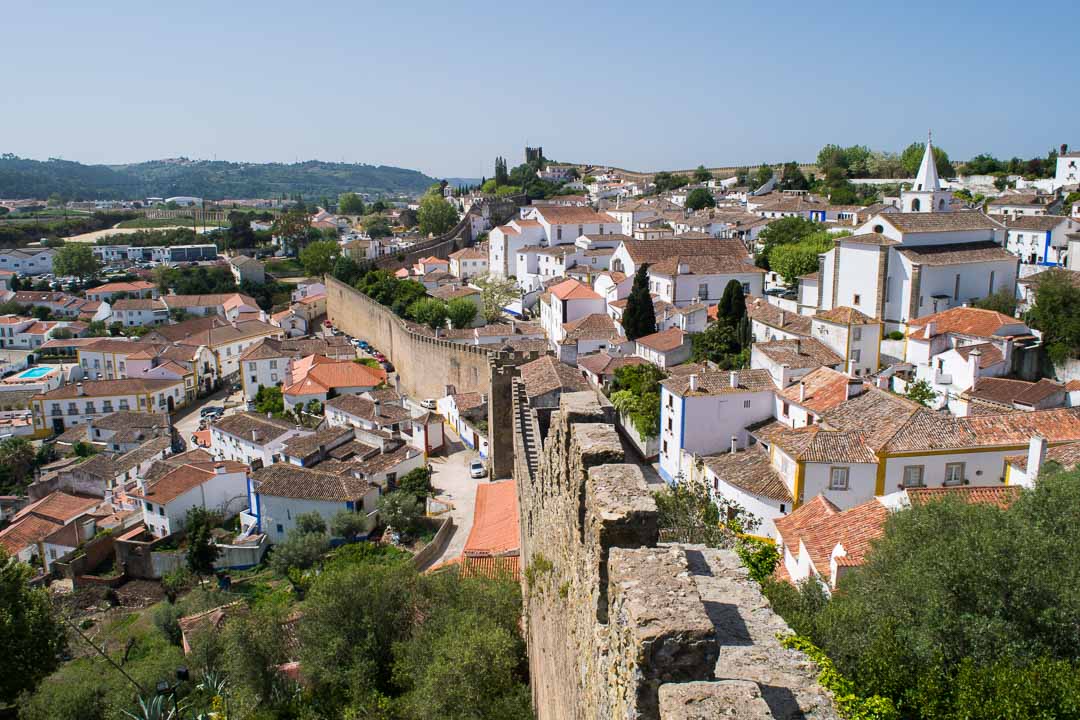
In all my travels through Portugal, few places compare with the visual splendour that you find when visiting Obidos. A small town in central Portugal, Óbidos is a delightfully scenic town on a hill wrapped up in ribbon-like walls, which forces the modern world to wait at its gates. Inside, you’re treated to some of the prettiest, quaint cobblestone streets and historic houses you could imagine.
The beauty of Obidos makes it one of the most popular day trips from Lisbon. And yet, wait until late afternoon or find a side alley, and it feels like you have the town to yourself. Visitors have many things to do in Obidos that showcase its history, culture, and scenery, so if you’re thinking of a day trip to Obidos from Lisbon, this is what you have to look forward to.
How to get to Obidos

Once you see what there is to do in Obidos, you’ll immediately want to know how easy it is to visit.
The good news is that visiting Obidos is easy to do, no matter how you go about it. Travellers looking for the easiest approach can just book a day tour from Lisbon, and it’s all handled.
If you want to visit independently, you have more options. Trains connect Obidos with Lisbon, but it’s not quick or especially convenient for a day trip, as you can only really take a 2-hour afternoon train there.
Instead, travel by bus to Obidos, with regular services taking an hour to reach Caldas Da Rainha, and from there it’s a 15-minute ride on the 788 bus. Buses also connect Obidos with Nazare through Caldas Da Rainha.
Another choice entirely is to drive yourself around this part of Portugal, giving you the freedom to go where you want and when. Lisbon is only 1 hour by car, and there are many places where public transport isn’t much help.
Where to stay in Obidos

Day trips can be a convenient way to visit, but staying in Obidos has its merits, too.
Before and after the day trippers, Obidos gets much quieter, which is perfect for peaceful sightseeing. But you can also use Obidos as a first stop while traveling north to Porto, if you have the luxury of time.
Stay in Obidos and you’ll find a nice range of reasonably priced hotels and guesthouses. The guesthouse I used no longer exists, but it was out by the station, letting me see the countryside as I walked into town.
Since I can’t recommend where I stayed, here are highly-rated options I’d start with:
Things to do in Obidos
Just as the logistics of planning a trip to Obidos are straightforward, so too is making a sightseeing itinerary.
Most Obidos attractions lie within its walled old town, except for the Óbidos Aqueduct and some landmarks I’ll highlight later. The main things to do in Obidos involve walking and admiring views, with only a few small museums sprinkled through the old town.
Find out below what’s in store for you when you visit Obidos.
Walk through the centre of the Obidos old town

Once you’ve arrived in Obidos and passed through one of its gates, it doesn’t take long to reach the town’s centre. With limited space, you’re unlikely to find too many squares, instead finding long cobblestone streets.
In these narrow streets, you find humble homes awash with white paint and bold stripes of yellow and blue. But it’s truly the plant life that brings Óbidos to life. From green creeping vines to gardens bursting with roses and calla lilies, Obidos can feel like one great big garden at times.
The look and shape of the town are certainly influenced by the landscape, but also by its past. Although its story stretches back to the Romans, it’s Obidos’ Moorish influences that have made it what it is today.

After all, it was the Moors who fortified the town, and the colour palette of Obidos mirrors that of Andalusia and its Moorish character. However, quite a few spots, like the Rua Direita and the main gate, date from later in the 14th century.
You can appreciate Obidos without knowing any of that context, that’s for sure. But if you do want that context, a walking tour is the way to go.
With a strong focus on tourism now and an ever-growing market, it’s no surprise that there are lots of souvenir shops here. Thankfully, they’re contained to the main pedestrian streets and honestly blend in with the town far better than most places. During your visit, you may notice that there are several bookshops here, which I’ll explain a little later.

See Obidos Castle

If there’s one great big landmark in Óbidos, it’s Obidos Castle. Sitting up one end of the old town, this medieval castle still bears its Moorish influences, and you may notice some similarities with Sintra’s Moorish Castle.
The most inviting fact about the castle is that you can stay there!
Hosting the Obidos Pousada, it was the first state-run inn to be housed in a historical building. Now, quite a high-end hotel, staying here is undeniably cool, but you do pay handsomely for the privilege.

Explore the outer alleys

Once you deviate from the busy central streets of Obidos, you start to find other sides of this historic town.
Home to a little over 3000 people, you start to come across the modest homes of locals when you walk the outer edges. While the central streets are dedicated to tourism, this is where local life resides. Here the paint is a little more faded on the homes and washing hangs on lines out windows.

Tucked into the various nooks and corners of the town walls, you find surprisingly dense gardens and greenery.
You’re definitely in for a surprise if you pop your head out of the western gate, assaulted by bright pink flowers of local Judas trees. Speaking of gates, while you’ll likely enter through the main town gate in the south, there are actually several gates, including one even big enough for cars.

Climbing up and down all the staircases that link up the different levels of Óbidos, you get to see plenty of the town’s backstreets.
One in particular worth finding above the central streets is an alley covered in blue graffiti. I never actually found any information on the how and why, but it’s a strong contrast to the rest of the town. I guess one quick coat of white paint and it’s all gone anyway.

Learn why it’s a UNESCO City of Literature

Now I mentioned earlier that there was a link between Obidos and books. This link takes its most extreme form when you visit St. James Church and find a bookshop inside.
Not just a cool idea, the church/library represents a commitment by Obidos to harness literature and creativity as useful cultural and social drivers. This dedication earned Óbidos recognition by UNESCO as a Creative City of Literature in 2015, in coordination with the town’s first International Literary Festival. It’s an admirable initiative and adds to the character of Obidos greatly.
Drink Ginja

If there’s one local custom worth trying on your Obidos day trip, then it’s a shot of the local ginja. A Portuguese cherry liquor, you also find ginja in Lisbon, but not like this. No, here in Obidos, they don’t use something as pedestrian as a shot glass.
Instead, the ginja comes in an edible chocolate cup and of course the two flavours go together perfectly. Obidos is actually surrounded by quite a lot of cherry trees I believe so the ginja is locally made.
So, if you like liquor, cherry, and chocolate, this is definitely one of the best things to do in Obidos.
Climb the town walls for their views

At some point, when visiting Obidos, it’s time to climb up onto the town walls.
By most gates, you’ll find stairs leading up onto the walls. Now, fair warning, there are no handrails and at points narrow walkways, that are often only a little more than one person wide. That being said, it’s the only way to fully appreciate Obidos as a whole. Walk to the very southern end and climb the tower, and you’ll see just how small Obidos really is.


The walls are actually further than they seem, so it can take a while to get around.
The drop from the walls varies as you go around, from a long fall to a little jump onto people’s rooftops. While there were kids up there with their parents, you definitely want to keep a close eye on them here. The walls are open well into the early evening so if you’re staying overnight in Obidos, you can watch both the city and surrounding landscape change colours.

Experience the countryside outside the town walls

Given the time, it pays to explore a little beyond Obidos’ walls as well.
Firstly there’s the section of the city that lies beyond the walls and it too has some charming streets. Still, there’s also a lot of hotels and restaurants out here and frankly, they’re easier to get to. One I just have to mention is the The Literary Man, a hotel with a library, bookshop and shelves of books in its restaurant.
Also just beyond the town walls you’ll find the local cemetery, a long aqueduct and abandoned remains of a wind mill. There are also walking trails leading through the nature that runs all along the western side of Obidos.

A decent ways away from the town centre past farmland you find the Santuario do Senhor Jesus da Pedra.
This church features an unusual shape, looking more like a castle keep than that of a typical place of worship. It doesn’t help that up close, the church looks as if it’s been abandoned.
And lastly, there’s the town’s tiny old train station down below its walls. A lone building surrounded by trees and farmland, standing at the station feels like you’re off in the countryside somewhere which I guess you are.

Have you had the chance to visit Obidos Portugal before? Would you like to include this scenic town on your next trip to Portugal? Please share your thoughts in the comments below.

This article is now available as a mobile app. Go to GPSmyCity to download the app for GPS-assisted travel directions to the attractions featured in this article.

5 comments
Love the post Dave, will be getting there sometime this year or next for sure!!
I thought you would mate. I had you guys in mind with the literary parts.
Looks idyllic! ?
Gosh. It was around 1981 I was there. Also Peniche, Nazare, Coimbra and down that coast and across the bottom into Spain. Doubt it’s changed much since then, though it is one of the few places I’d love to return to with my wiser world view. 🙂
It’s been seven years now since my time in Coimbra, and I wonder how much it may have changed in that short timeframe. I imagine it’s much busier now than when you went. Sounds like a nice Portugal trip you had. I’ve yet to visit Peniche myself.