Disclosure: This post (probably) contains affiliate links. If you click on one, I may make a small commission. Of course, this will come at no extra cost to you and helps keep this site running.
The Philippines is increasingly one of the most popular destinations in Southeast Asia.
Travellers looking to go island-hopping to visit beaches and jungles have a wealth of places like Bohol and Palawan to choose from. And then there’s Manila, the country’s capital. This huge city offers none of that and lacks the fun reputation that other capitals of the region have, like Bangkok.
Despite all that, I decided to visit Manila – and think you should too!
It’s fair to say that visiting Manila won’t be for everyone. If you prefer beaches and jungle over a sprawling metropolis, it could be a hard sell. But if you want to dip into the Philippines’ culture, history and cuisine, Manila is the perfect place to do so.
So, if you’re wondering “Is Manila worth visiting?”, here are my reasons why you should give it a try.
Starting Point for Exploring the Philippines
One of the benefits of beginning your Philippines travels with Manila is that it starts you on the path of getting to know the country.
With a Manila visit at the top of your trip, you can begin to acclimatise to life in the Philippines. Rather than going straight into “beach mode” or “resort mode”, you can learn a little about the people and the culture.
Doing this before any sightseeing or island-hopping means you’re going with your eyes open.
Seeing the history, the modernity and the poverty helps put everything you see afterwards into perspective. This could certainly include activities like visiting the National Museum and other major cultural institutions.
But it’s also the smaller details like hearing the fascinating mix of Filipino and English that’s spoken on the radio as you drive through the city.
Sights in Manila Old Town

When it comes to sightseeing in Manila, travellers need only look toward the historic district of Intramuros.
This historic area within dark stone walls is the Manila Old Town. It’s here that you’ll find most of the must-visit places in Manila, even though it’s a very small part of the modern city. This is where the Spanish colonialists first settled back in 1571 and where you should spend a day exploring.
You can do that on your own or with the help of a walking tour to make the most of your time.
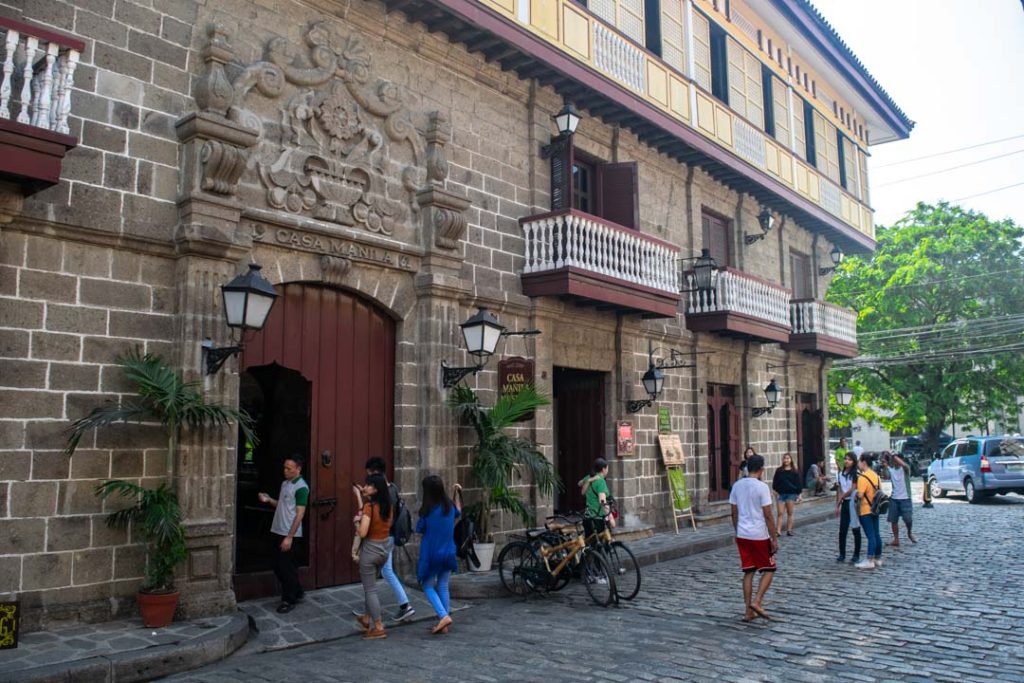
There’s no confusion about where the Old Town starts. The few entrances into Intramuros are through low-lying gates in the centuries-old city walls. And once you’re through the walls, the scenery around you couldn’t be more different. Suddenly you’re walking down narrow streets and surrounded by colonial buildings with balconies hanging overhead.
Intramuros really does feel like a whole new destination altogether.

There are even places like Casa Manila, that allow you to visit inside these grand old colonial buildings.
I’m a bit torn when it comes to colonial destinations like this or somewhere like Malacca in Malaysia. On the one hand, I find the look and atmosphere thoroughly captivating and feel like I’ve been sent back in time.
But the reality of colonialism and the exploitation it allowed can’t be ignored.
Learn its Revealing History

Since Manila has been the capital of the Philippines for centuries, its history and the history of the country have long been intertwined.
Many of the best places to visit in Manila, specifically those in Intramuros, relate to this history. It’s hard not to learn about the Philippines as you visit these attractions. The perfect example of this is Fort Santiago, a large citadel at the northern end of the old town. This defensive stronghold by the Pasig River has been around almost as long as the city itself.
Sure, Fort Santiago is worth visiting for its scenery of ancient walls and pretty gardens, but wait there’s more.

It’s here that you can visit the Jose Rival Museum and learn about this national hero of the Philippines.
Rival was a doctor who inspired the Philippine Independence Movement and was executed by the Spanish Colonialists as a result. It was amazing to me that I had never heard of Rival before, because by all accounts he was an impressive and tragic figure.
Visiting this one museum helped put so much more into context and drove me to learn more about the history of the Philippines during my trip.
Some Impressive Non-European Churches

Spend any time in the Philippines (or know any Filipinos) and you’ll learn it’s an overwhelmingly Christian country.
Over 80% of the country is Roman Catholic and that kind of dominance can only mean one thing – churches. While I’m used to churches in Europe, it’s interesting to see them in different parts of the world. Several churches inside Intramuros are major attractions, including the Minor Basilica and Metropolitan Cathedral of the Immaculate Conception.
The one not to miss though is the San Agustin Church.
Dating from 1607, it’s the oldest stone church in the Philippines and a UNESCO world heritage site. But it’s also part of a monastery that now houses a museum relating to the history of Christianity in the Philippines. There are some interesting exhibits here, from historic artifacts to revealing tidbits.
For instance, did you know it was Spanish preachers from Mexico who brought Catholicism to the country?

But even if none of that interests you, visiting the San Agustin Church gives you the chance to see the charming monastery corridors and the gorgeous church hall seen above.
Get to Know the Filipino Food Scene

While I really enjoy eating many East Asian cuisines, I have to admit I knew very little about Filipino food.
To be honest, I still don’t. But my time in Manila was a great introduction and left me keen to explore it more. Around the Makati area, I found several places that did Filipino food. It was here that I got to try dishes like chicken inasal, a marinated grilled chicken and pork sisig, a fried pork dish. Both were great thanks to hints of sourness and spiciness, leaving me eager to continue exploring.
I also learned about the national obsession with calamansi, a local citrus fruit, that is everywhere. In hindsight, doing a Manila food tour would have probably been easier. But it’s not just Filipino food that you’ll find around Manila. The overwhelming number of Japanese and Korean places made it clear that they were the common favourite of foreign cuisines here.
Unsurprisingly, there were also loads of American chains around, in case you need something familiar.
Modern City and its Malls

Exploring a modern urban business district probably sounds pretty boring, right?
And yet, I thoroughly enjoyed my time walking about the business district of Makati. More than just high-rises, it’s a surprisingly green pocket of Manila.
That’s thanks to the park through the Ayala Triangle Gardens and nearby Greenbelt Park. Both are verdant and inviting, but what makes the Greenbelt Park incredible is that it’s found wholly within the Greenbelt Mall. Yes, that scenery above is from the centre of a mall!
Now, if you’ve travelled in Southeast Asia a bit, you should know the value of malls in this region. More than just somewhere to go shopping and hang out, they show you a slice of local life. You see people’s interests, how they socialise and how they unwind.
Add to that all the mall’s excellent and varied restaurants that reflect local tastes and you have a fascinating, unfiltered slice of local life waiting for you.
Advice for Travel to Manila Airport
Ok, so this is where I go on a mini-rant.
Travelling through Manila Airport was not a fun experience, two of the three times I was there. Flying in the first time was no problem as it was relatively late at night and my taxi worked out fine.
The troubles occurred when I left Manila for Bohol and when I had to transfer there to leave the country. Trust me, it’s essential you aim to arrive at least three hours before your flight!
The first problem was the crawling, yet hectic traffic getting to the airport. But the biggest hurdle is the simple act of entering the terminal. For both domestic and international, there is a security checkpoint right at the entrance, with a line of people out the door.
Despite the volume of passengers, they never seemed to have more than a couple of metal detectors working, creating a huge bottleneck. The check-in desk to check your bags was no better and both times I found myself being skipped to the front of the line as they accepted the final bags before closing check-in. That was after waiting an hour in the line already!
But the final straw came when transiting back through Manila to Thailand. Passengers transiting from domestic to international were told that the next shuttle wouldn’t be for 45 minutes. There was also no guarantee we’d even get on it.
This resulted in everyone taking a Grab or taxi between the domestic and international terminals just to make their connecting flight. In this scenario, definitely take a Grab as it will surely be cheaper.
With a 3-hour connection, I only just made that connecting flight.
TLDR / Long story short: Allow more than three hours to make your departing or connecting flight. Book a taxi, Grab, or use a shuttle bus service.
Travel Tips to Help Visit Manila

Unless you plan on exploring more of the island of Luzon that Manila is on, I don’t think you need more than a couple of days there.
I suggest splitting your time between Intramuros and the modern business district of Makati just as this guided tour does. That way, you get to see several sides of Manila and modern life there.
To get between the two parts of the city, it’s easiest to use the ride-sharing app Grab or take a taxi. While I prefer the convenience of Grab, the taxi I hailed turned out to be considerably cheaper. And as for getting to Manila, you can find flights on Kayak and ferries on 12Go.
For accommodation in Manila, I took the advice from The Broke Backpacker and stayed in Makati. It’s a gentle option for those new to the country and there are lots of food options nearby. I opted for the Mini Suites Eton Tower, which while compact, proved to be comfortable and well-located.
But there are plenty of choices of hotels and apartments in Makati to choose from.
Have you had the chance to visit Manila before? Why do you think travellers should include the capital when travelling to the Philippines? Please share your thoughts in the comments below.

This article is now available as a mobile app. Go to GPSmyCity to download the app for GPS-assisted travel directions to the attractions featured in this article.

4 comments
A very informative post. Thanks.
Glad you thought so Coral, thanks for reading as always!
Nice blog on Manila David. I would agree on your recommendations of Intramuros and Makati. I lived there many years, and also agree about the traffic and issues with the airport. A couple of things to correct though, it’s Jose Rizal, not Rival, he’s a national hero, and last time I checked, Quezon City is the capital.
Hi Kim, thanks for leaving a comment. Appreciate the catch on Jose Rizal, I’m not sure how I got that wrong repeatedly. About the capital of the Philippines, Quezon City was the capital until 1976 when it was moved to Manila. https://en.wikipedia.org/wiki/Capital_of_the_Philippines#:~:text=During%20President%20Ferdinand%20Marcos'%20period,940.