Disclosure: This post (probably) contains affiliate links. If you click on one, I may make a small commission. Of course, this will come at no extra cost to you and helps keep this site running.
Vientiane is described as the sleepy capital of Southeast Asia and travelers to Laos often don’t make much time for it. But many things to do in Vientiane can help you learn about Laos’ culture and history and make a visit worthwhile.
I will agree that Vientiane isn’t as pretty as Luang Prabang or as action-packed as Vang Vieng. But my time in the city before starting my G Adventures tour of Laos showed me that Vientiane is worth visiting. Learn more about visiting the Laos capital with this Vientiane travel guide.
How to get to Vientiane

Working out the best way to get to Vientiane will depend on where you’re coming from and how you’re travelling through Laos.
- If you’re starting your Laos trip in Vientiane, you may be flying in or crossing over the Thai border.
- If you’re ending your Laos trip in Vientiane, you’ll want to know how to get there by bus, train, or transfer.
Starting in Vientiane
Wattay International Airport is Vientiane’s airport, with flights coming in from other Asian cities. Land at Vientiane Airport and you can get a cheap transfer to your hotel.
Coming across the border from Thailand is more complicated, but still manageable to do on your own:
- First, you need to reach Nong Khai, often by train or bus from Bangkok.
- Then it’s often a tuk-tuk to the Nong Khai Border Checkpoint from either station.
- Pass through immigration and board a bus to cross the First Thai–Lao Friendship Bridge (the bus costs 30 baht).
- Go through immigration to enter Laos at the Thanaleng Border Crossing.
- Then a local bus or taxi into Vientiane (the local bus to the city costs 18k LAK)
Ending in Vientiane
When Vientiane is your last stop in Laos, you’ll likely be coming from either Luang Prabang or Vang Vieng.
To make the journey to Vientiane, you have the choice of minivan transfers or taking the train.
The new high-speed train in Laos cuts down travel time around the country considerably. However, the stations are often quite removed from the cities.
It’s a matter of time or money:
- if you’re on a budget, book a minivan transfer;
- if you want to save time, pay more for a train ticket.
Where to Stay in Vientiane
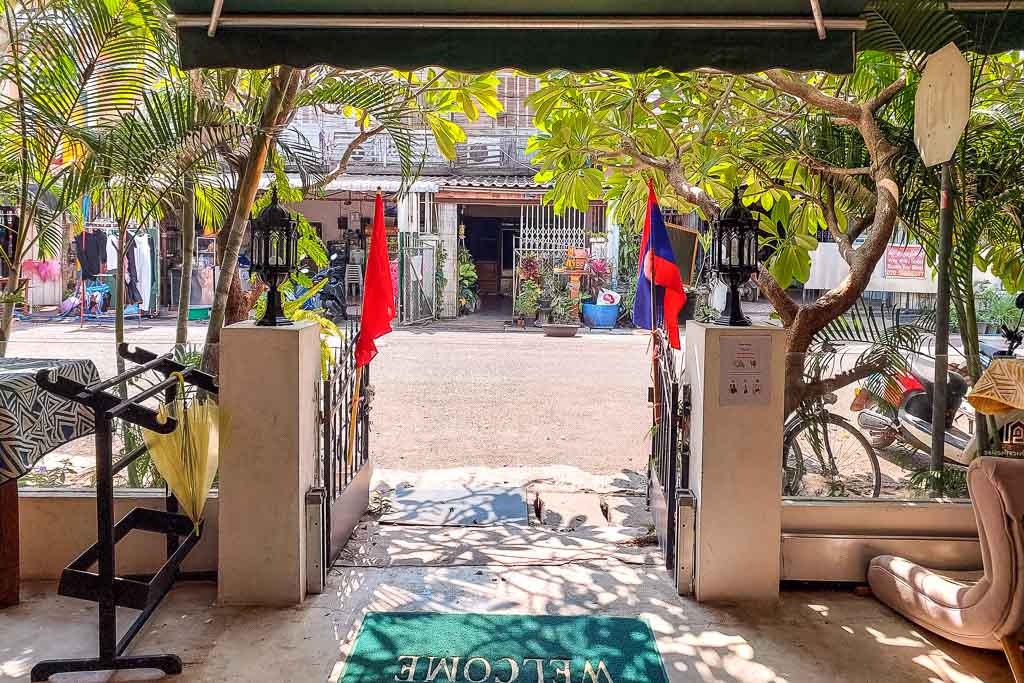
Accommodation in Vientiane is clustered around the city’s historical centre, although some stray options lie in other areas.
With most attractions, restaurants and cafes being situated in the historical centre, it’s just easier to stay somewhere central. Vientiane is larger than it looks, so getting around takes longer than you might think and anything you can do to make visiting more convenient is worth it.
During my visit, I stayed at both the SYRI Guesthouse and City Inn Vientiane. SYRI Guesthouse is a laid-back hostel-style place in a quiet street; City Inn Vientiane is a standard mid-budget hotel that’s fine but unremarkable.
For some alternatives, these are highly-rated options in Vientiane:
Tours in Vientiane
While I mostly explored Vientiane independently, I can see situations where taking a local tour would make things easier.
Oddly enough there aren’t that many tours of the city offered online. An alternative is to just arrange for a tuk-tuk driver for a few hours to take you to popular attractions. But these are some tours you can book if you want:
- That Luang, Vientiane Museum of Contemporary Arts, and Patuxai Day Tour in Vientiane
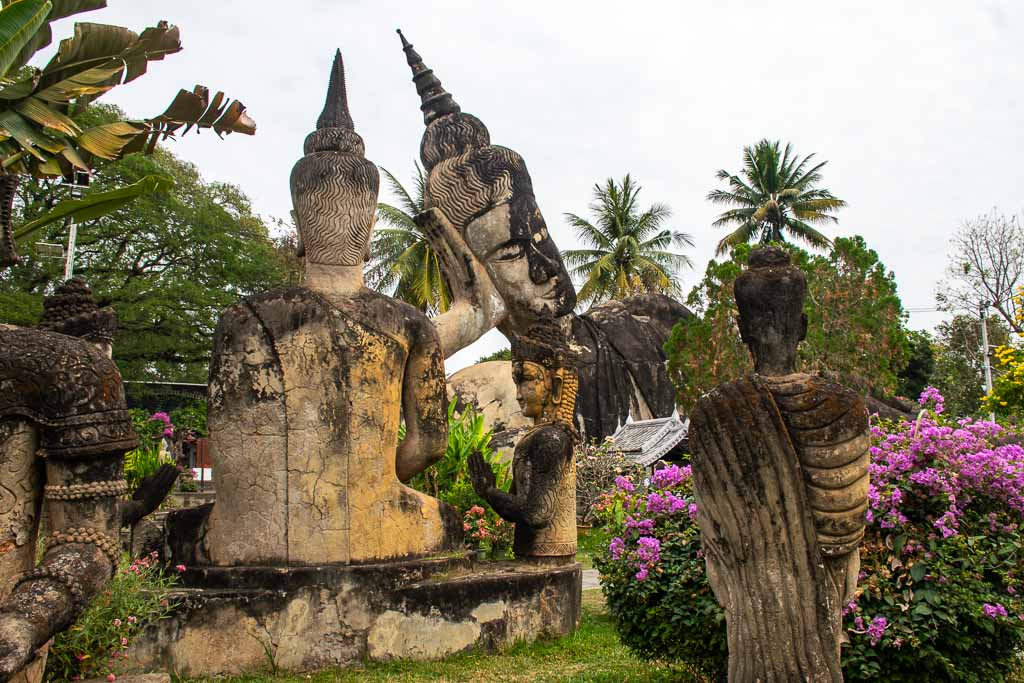
- Private Vientiane Tour with the Buddha Park Included
Of course, to see more of Laos, I recommend the G Adventures tour I took of the country.
Things to do in Vientiane
Travellers may be surprised to learn that there are more than enough things to do in Vientiane to fill one day there. I actually recommend allowing at least two days in Vientiane if you want to see all of its attractions. Sightseeing in Vientiane will take you from the old part of the city to places around the city, which is hard to do in just one day.
Patuxay – Victory Monument
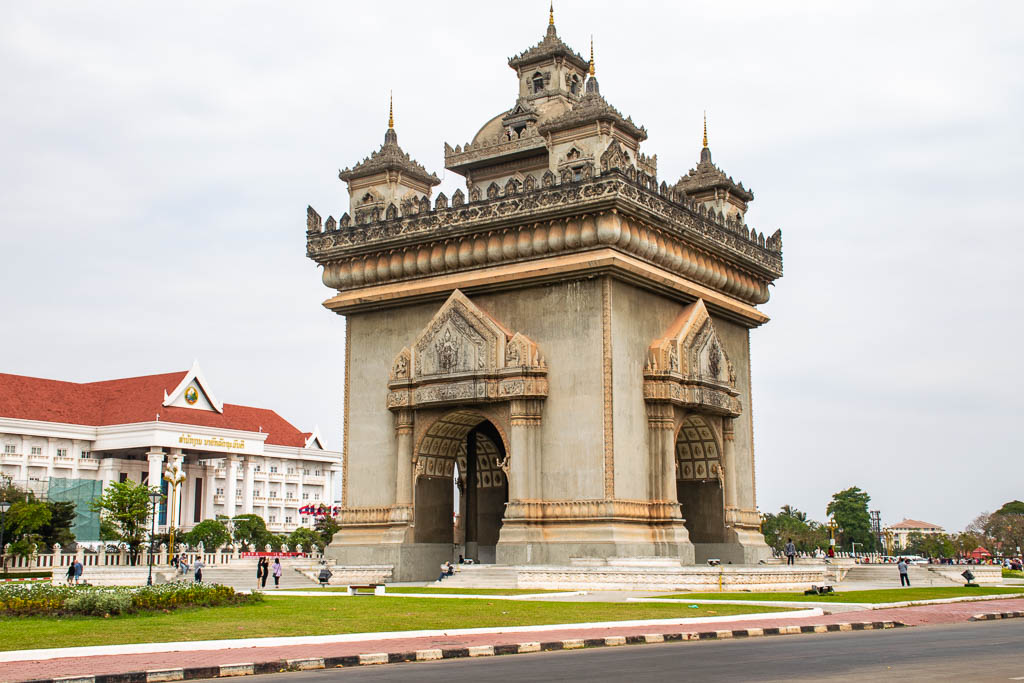
Vientiane’s signature landmark is the Patuxay – Victory Monument.
This gate is a monument to Lao’s independence from the French and was built in the 50s-60s. That the monument took inspiration from France’s Arc de Triomphe but with broad Asian influences, is a clever way of thumbing their nose at their colonial past.
Visiting the Victory Monument, it’s worth walking underneath to see the ceiling patterns within the gate.
You can then pay (30k LAK) to climb the stairs leading to the gate’s terrace for city views. Along the way, you pass an exhibition level, with information on the monument’s history and the devastation caused by the 1966 floods. Exhibits also explain how Buddhism and the Taj Mahal inspired its design.
Pha That Luang
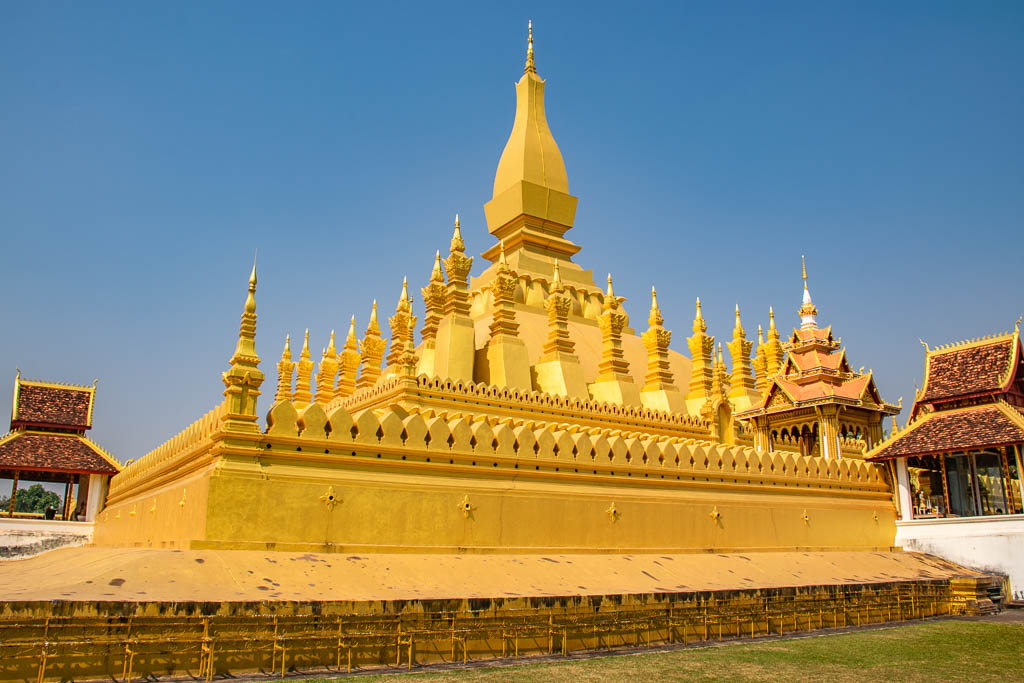
Temples are everywhere in Laos and Vientiane, but few stand out quite like Pha That Luang.
A temple literally covered in gold will do that. Ok, to be fair, most of the temple is covered in gold paint, but the effect is no less impressive and you can see why the temple is a national monument.
Pha That Luang is located in the northeast of the city, so taking a tuk-tuk, bike, or bus is recommended. But don’t let the distance to this temple stop you.
The trip out is worth it.
The first Buddhist stupa at the temple site is said to have been built in the 3rd century. But the current stupa dates from 1566 and was restored in the 20th century following centuries of damage from wars.
To visitors, seeing the golden exterior of the temple and the surrounding Buddhas is the main appeal of visiting (entry is 30k LAK).
However, what makes Pha That Luang such an important place of worship is that it’s said to have a relic of the Buddha enshrined inside. You can’t see it, but it adds to the ambience knowing that I think.
Wat Sisaket
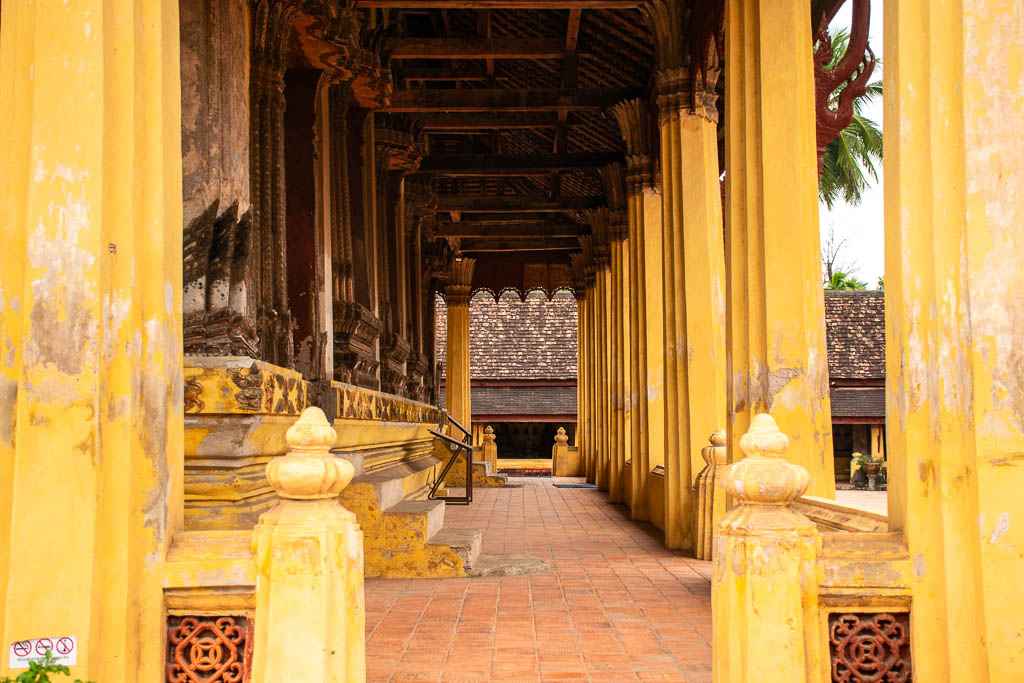
Back in the historical centre of Vientiane, the temple of Wat Sisaket has seen better days.
The worn yellow walls of this temple immediately reminded me of places in Vietnam like Hoi An.
But, what’s special about Wat Sisaket is that it’s the only temple in Vientiane that survived the 19th century intact. Not that it’s incredibly old – it was only built in 1818 – but that doesn’t diminish it.
The surrounding gardens of the temple are nice, as is its courtyard awash in yellow. To many, the main attraction at Wat Sisaket is the 6,840 figures of Buddha tucked under the arcade around the courtyard. Entry is 30k LAK.
But inside there are also fragile murals painted on the temple’s interior (photos are not allowed), so I encourage you to definitely see inside for yourself.
Ho Phrakeo Museum
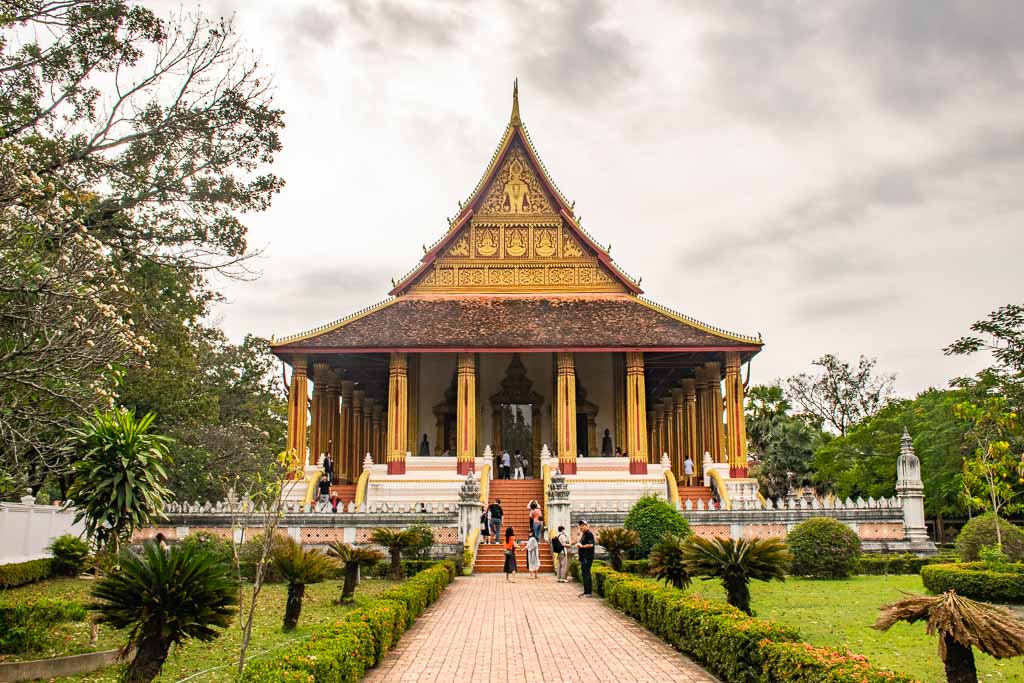
Just across the road from Wat Sisaket stands the Ho Phrakeo Museum.
If you ask me, calling this a museum and not a temple is misleading. While it’s true that since 1987 it no longer functions as a temple, many visitors wouldn’t know otherwise.
For travellers who have been to Bangkok, the Ho Phrakeo Museum offers an interesting connection to one of the city’s most famous landmarks.
The Emerald Buddha at the Grand Palace is an iconic sight in Bangkok, but for over 200 years, that icon was actually housed inside this purpose-built Vientiane temple after some moving about.
Visiting the museum (30k LAK) allows you to see the reconstructed 16th-century temple, plus the collection of artefacts and sculptures inside.
COPE Visitor Centre 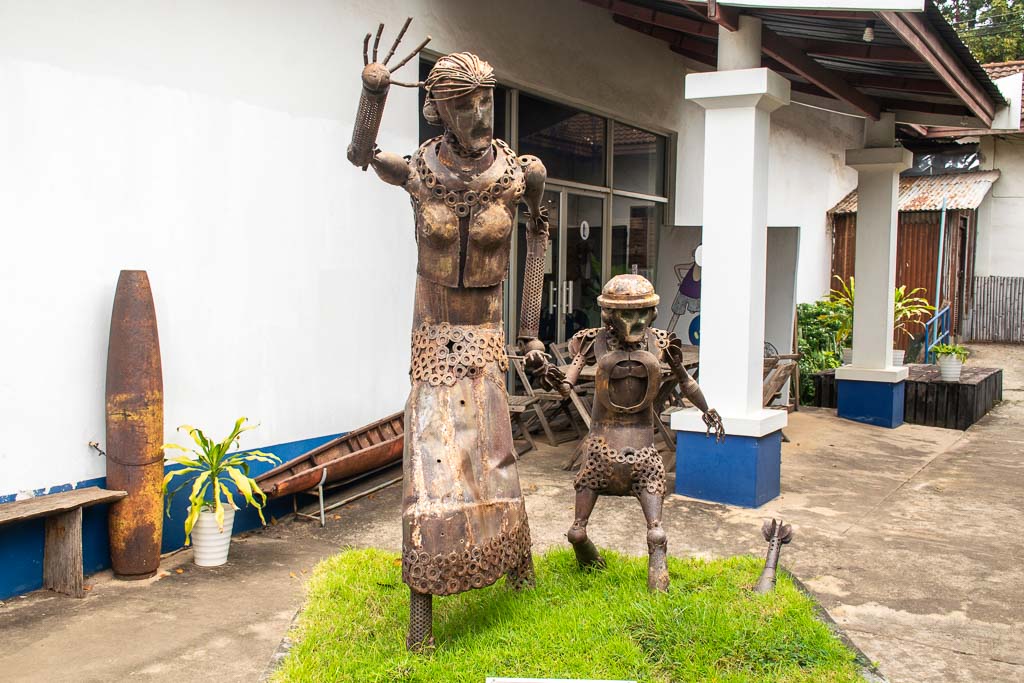
Laos has the awful title of the most heavily bombed country in the world per capita in history.
That history, the harm it has caused the population, and the work done to rehabilitate people is the focus of the COPE Visitor Centre.
Inside, you can learn how unexploded ordnance has been a blight on the people of Laos since 2 million tons of ordnance were dropped in Laos during the Vietnam War. A problem that lingers to this day.
This ordnance continues to contaminate land in Laos (roughly 25% of villages), causing casualties and leading to amputations, especially among children. A small consolation is the work being done to provide prostheses for victims of these incidents.
Visiting the COPE Visitor Centre is eye-opening and speaks to the reality of life for many in Laos.
Wat Si Muang
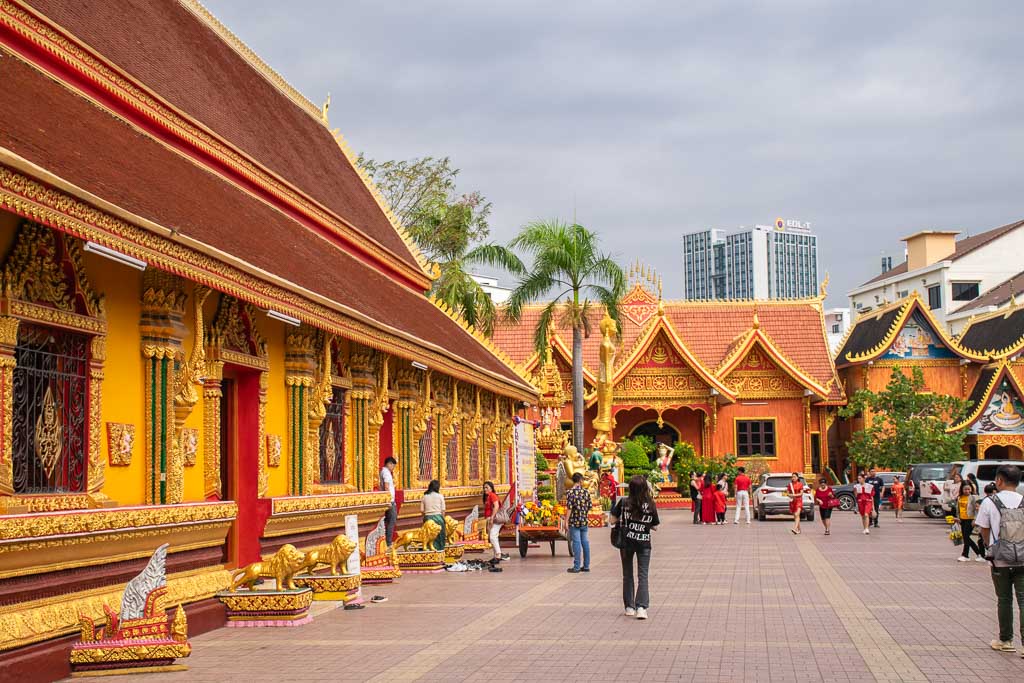
You may quickly get tired of visiting temples in Vientiane, but Wat Si Muang is a little different so I’ll mention it.
Rather than being decorated in muted colours, Wat Si Muang is lavishly decorated in bold and vibrant colours. What also stood out to me about this temple was how many people were there, as it seems to be a temple actively used by the local community.
This makes it stand out from the mostly historical temples I’ve shared so far.
I suggest going to Wat Si Muang just as much to see how the temple is actively used as for its vivid design.
The Buddha Park
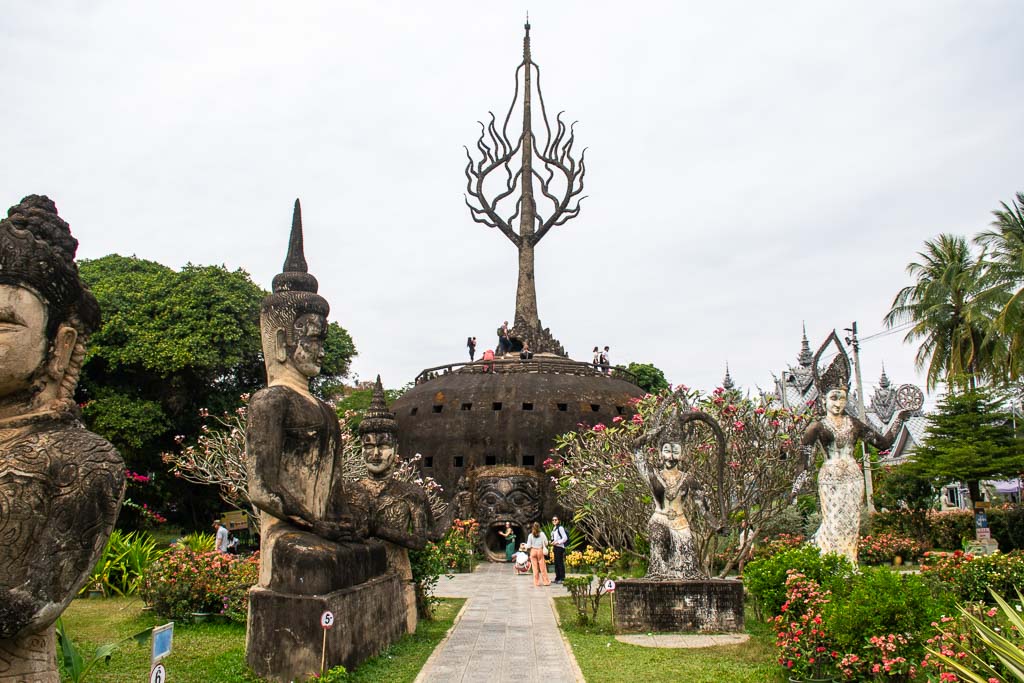
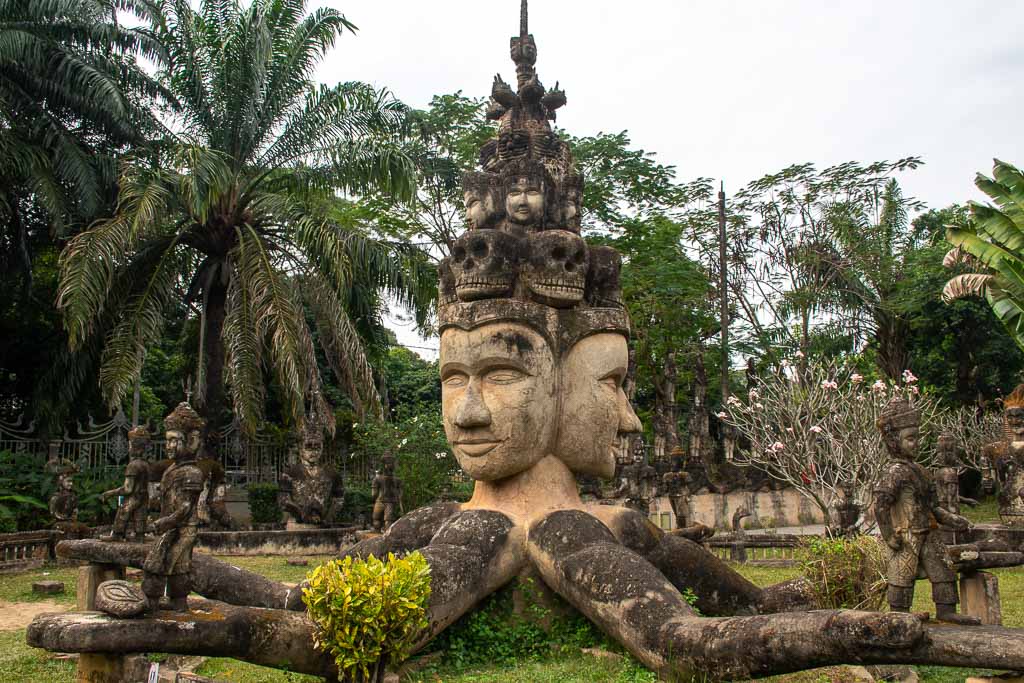
It may be the most outer Vientiane attraction, but you certainly haven’t seen anything like the Buddha Park before.
And yet it’s exactly what the name suggests – a park with Buddha statues.
There’s just a lot of them. In every form conceivable.
It’s an incredibly creative place and well worth the cost of entry (40k LAK). There’s not much depth, history, or cultural significance to the park. It’s just a park with an overwhelming number of Buddha statues. And some nice gardens, blooming with frangipani and bougainvillea.
The main drawback to visiting the Buddha Park is that it’s well outside Vientiane. People either organize private transport like a tuk-tuk/Grab or you can take the bus (18k LAK one-way). At the main station in Vientiane, ask for the #14 bus to the Buddha Park. To get there, you actually stop at the border crossing to Thailand and then continue along the river.
But I think the park’s surreal nature is worth the trip.