
Disclosure: This post (probably) contains affiliate links. If you click on one, I may make a small commission. Of course, this will come at no extra cost to you and helps keep this site running.
Most people see the seaside city of Alicante on Spain’s Costa Blanca as a beach destination. Like other places on the coast, such as Altea and Benidorm, it’s mostly popular among British tourists seeking sea and sun. But Alicante is worth visiting even if you don’t want to spend all your time at the beach.
As winter crept closer in December, I had no interest in visiting the beach during my Alicante holiday. While I enjoyed the seaside views, I wasn’t there for the beaches. Instead, I had a great time making the most of the various scenic and cultural things to do in Alicante. If you’re in the same boat, these are the Alicante attractions you can visit.
How to get to Alicante
Before we get to what to do in Alicante, let’s look at some Alicante tips on how to get there.
Alicante is an extremely useful entry point to this part of Spain and works well as a base from which to explore the Costa Blanca. You can fly into Alicante, get a bus into the city, and then continue through Benidorm, Murcia, Cartagena, etc., without much hassle.
If you’re traveling from closer places in Spain, train and bus options are easy to come by.
For instance, it’s less than two hours by train from Valencia to Alicante. There’s even a special tram/light rail hybrid that connects Alicante with Benidorm, Altea, and Denia. Day trips to Alicante are even easier thanks to luggage storage options in Alicante, as well as Benidorm and Valencia.
Where to stay in Alicante

Then there’s where to stay in Alicante.
I stayed in a private room of an Airbnb host just north of the train station in a fairly unremarkable residential area. That’s often my go-to when trying to save money in Western Europe, but it doesn’t add much to the experience.
But you won’t have any problem finding hotels, guesthouses, and apartments in Alicante; just be prepared to pay a little more to stay in the city center. Perhaps try the Mercado area if you’re after somewhere more affordable.
Some highly-rated hotels in Alicante include:
Things to do in Alicante
To see why Alicante works for more than just beach holidays, let’s get to some of the city’s best attractions.
Some of the Alicante attractions offer views of the city’s fantastic scenery, while others dig into its past and present. There’s more to see and do, but these landmarks are a great place to start.
Barrio Santa Cruz
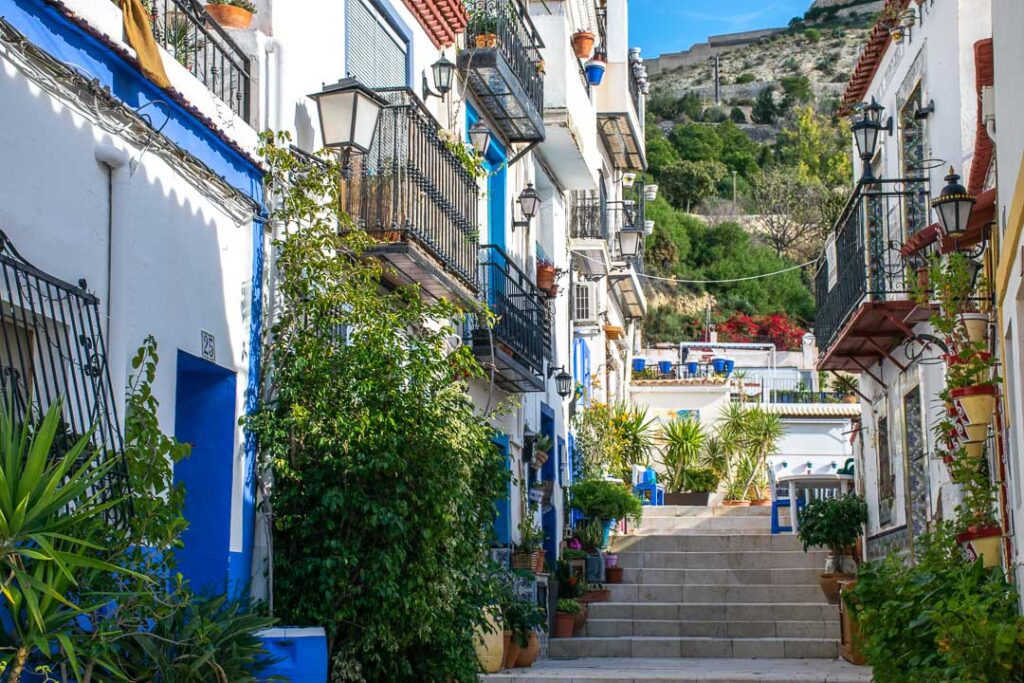
With its colours and charm, the historical neighbourhood of Barrio Santa Cruz is a must-see in Alicante. It’s basically the Old Town of Alicante, sitting to the east of the city centre against the steep hillside slopes of the Parc de l’Ereta.
However, only a very small part of Barrio Santa Cruz looks like these photos. That’s not to say the rest of the neighbourhood lacks appeal, but these picture postcard lanes aren’t everywhere. Find these particular streets and staircases in the northern part of the Old Quarter up from Plaza del Carmen.
The area also features several nice viewing terraces if you want some city views without climbing up to the next Alicante highlight. One downside to exploring the area solo is that I never learned much about Barrio Santa Cruz’s history, which seems a pity. That problem is easily fixed by taking a walking tour through the area.

Santa Bárbara Castle

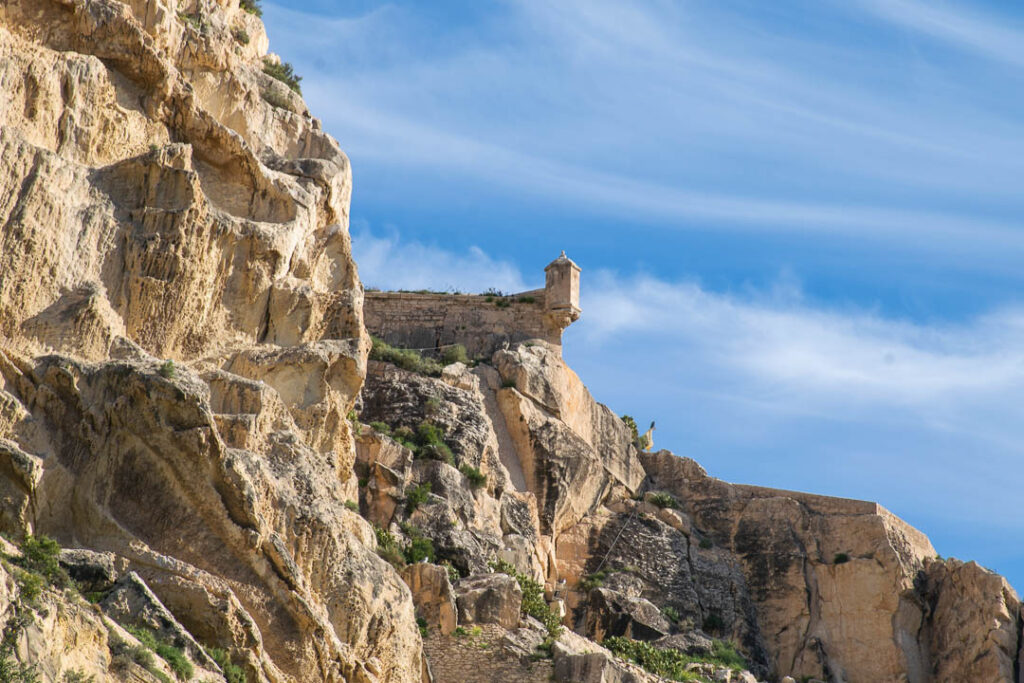
If you’ve been wondering what to do in Alicante before arriving, it won’t take long to see one answer once you’re there. Towering over much of the city is Santa Bárbara Castle, a monumental fortress atop Mount Benacantil just outside the city centre.
Visiting this castle built by the Moors in the 9th century is obviously one of the most popular things to do in Alicante among holidaymakers. Within the fortress walls, you can see the remains of buildings and churches, as well as exhibits from a small museum. Each of the various levels of its fortifications has a different view over Alicante and the surrounding coast.
Seeing the castle way up the top of a mountain begs the question; how do you get up there? I opted for the hardest choice, walking up, but I recommend doing it if possible as there’s plenty to see along the way. Otherwise, you can always take the special lift or board a bus to save yourself the energy.

Esplanada d’Espanya

Unlike Valencia, where the beach is miles from the city centre, Alicante’s waterfront sits right off the city centre. Following the waterfront along the city’s marina is the palm-lined Esplanada d’Espanya. It’s a nice little promenade decked out with mosaic tiles, bordered by outdoor seating for cafes and gelaterias.
Further up from the Esplanada d’Espanya lies Alicante’s beach, the Playa del Postiguet.
It sits directly beneath Santa Bárbara Castle, and while it isn’t huge, it’s definitely big enough for visitors on holiday in Alicante seeking sand beneath their feet. The Playa del Postiguet is the first of many beaches you’ll find if you continue north along the coast to Cap de l’Horta and beyond.
Wander the city centre

It may seem like a broad suggestion for sightseeing in Alicante, but I really liked just wandering around the city centre of Alicante. The modern parts of some European cities can be quite unremarkable, but I liked Alicante for some reason.
Spots like the Plaza de los Luceros with its fountain and palm trees seen above help with that I think. Parque Portal de Elche is another green space that catches your eye, looking like it belongs more in Australia than in Spain. Then there’s the city’s Mercat Central, which lives up to the high standard of Spanish markets.
The other benefit of visiting the city centre is the overwhelming range of places to eat and drink. For an easy route past many options, I suggest starting by walking down the pedestrian street Calle Periodista Pirula Arderius. Of course, a tour is another great way to explore the city’s food scene.
Mushroom Street

One final quirky place that tourists might want to see is El Carrer dels Bolets or “Mushroom Street.”
With a name like that, you might think this is where all of Alicante’s mushroom vendors are based. But no, it’s weirder than that. This inner city street received a fantastical facelift with a series of cartoonish mushroom statues planted along it.
I like that it’s a good example of street art drawing tourism to a neglected part of the city. After all, who doesn’t want to walk through here to check it out themselves?
Travel tips for your Alicante holiday

Obviously, the above isn’t an exhaustive list of everything Alicante offers. But it’ll get you started and you can easily fill a day or more just visiting these places.
Other Alicante attractions to look at include Castell de Sant Ferran, MACA Contemporary Art Museum of Alicante, and the Basilica of St Mary of Alicante. Plus, you always have the beaches in Alicante when you want a break.
If you’ve had the chance to travel to Alicante on holiday before, what would you recommend other visitors do? What did you like or not like about the city? Please share your thoughts in the comments below.

1 comment
Great article on your trip to Alicante. Loved reading about Barrio Santa Cruz and Santa Bárbara Castle. Recommend taking a walking tour next time to learn more about the places you visit. Keep on traveling and writing!